

The best API search company’s homepage is the main entry point for developers, businesses, and product teams who need to find, evaluate, and integrate APIs (Application Programming Interfaces) quickly.
A strong homepage communicates what the platform does, who it serves, and how to get started, all within seconds of landing on the page.
The main benefits of a well-designed API search company homepage in 2026 include faster API discovery, reduced integration time, and greater confidence in the services developers choose.
Developers spend less time searching and more time building. Product teams can evaluate APIs based on pricing, performance, and documentation without leaving the homepage.
API search company homepages serve 3 primary use cases: discovering APIs across many categories, testing and evaluating APIs before committing to integration, and accessing SDKs (Software Development Kits), code samples, and documentation to begin building immediately.
A typical API search company homepage includes 6 main components: a clear value proposition, a powerful search bar with filters, live API testing tools, developer-friendly documentation, transparent pricing, and trust signals such as client logos and security information.
This guide covers what these homepages really mean, how to identify the best ones, which platforms lead the field, and how to choose the right platform based on your specific project needs.
What “Best API Search Company’s Homepage” Really Means

The phrase “best API search company’s homepage” refers to 2 related concepts.
First, it describes a platform homepage where developers search and compare APIs across categories like finance, weather, and e-commerce.
Second, it refers to a service homepage that allows users to query company websites directly through APIs to extract structured data.
Both meanings are relevant in modern API-driven development. Today, APIs power SaaS tools, AI applications, SEO platforms, data analytics systems, and sales intelligence tools.
Because APIs are deeply embedded in how software systems communicate, developers rely on API search platforms to discover reliable services quickly and with minimal friction.
Types of API Search Company Homepages
There are 3 main types of API search company homepages. Understanding each category helps developers identify the right platform for their project.
1. API Discovery Platforms
API discovery platforms help developers search and compare APIs across many industries.
These platforms act as search engines for APIs, allowing developers to browse thousands of services in one place without visiting individual company websites.
Typical features include API categories, ratings and reviews, documentation previews, live testing consoles, and pricing comparisons.
These platforms work well for beginner developers and startup teams that need to build products quickly. Well-known examples include RapidAPI and Postman API Network.
2. Search Engine APIs
Some API search companies specialize in search engine data APIs. These services return structured search results from major search engines including Google and Bing, and are widely used in SEO tools, market research platforms, and automation systems.
SerpApi
SerpApi provides structured search engine results from multiple global search engines. Key strengths include reliable structured data, simple integration, and global search coverage.
Developers use SerpApi to build SEO platforms, analytics tools, and automation systems.
Brave Search API
Brave Search API provides results from an independent search index, not relying on the major search engine data providers.
Its benefits include independent search data, clean responses, and AI-friendly results. This API works well for AI systems and research tools that need unbiased search data.
ScrapingBee
ScrapingBee combines web scraping technology with search data APIs. Its core strengths include proxy rotation, browser rendering, and clean JSON (JavaScript Object Notation) responses.
Developers use ScrapingBee to collect search results and structured website content at scale.
3. Company Homepage Data APIs
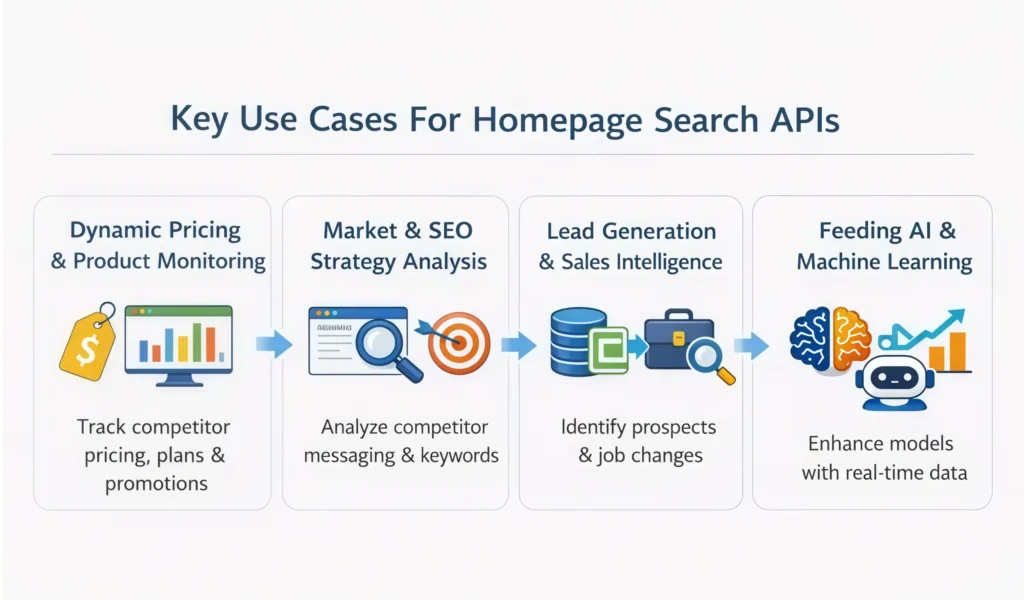
Some platforms focus on extracting information directly from company homepages. These APIs convert live web pages into structured data, making them useful for competitive intelligence, pricing monitoring, product tracking, and market research.
Homepage extraction APIs provide real-time insights such as product information, pricing changes, marketing messages, blog updates, and job postings.
Because this data comes directly from live websites, it tends to be fresher than data stored in traditional company databases.
Traditional Company Data APIs vs Homepage APIs
There are 2 main approaches to company data search. Each has distinct strengths and limitations.
Traditional Company Data APIs
Traditional company data APIs provide structured company information including company size, funding history, leadership teams, and industry classification. Examples include Crunchbase, Clearbit, and Coresignal.
Strengths include structured data and simple integration. The limitation is that this data may update slowly and may not reflect recent changes on company websites.
Homepage Search APIs
Homepage APIs extract data directly from company websites. Their strengths include real-time updates, fresh marketing information, product announcements, and pricing changes. These APIs deliver deeper insight for competitive intelligence and market monitoring.
The tradeoff is that homepage APIs require more complex technology. Websites use anti-bot protections, dynamic rendering, and rate limiting, all of which add technical complexity to homepage data extraction.
What Makes the Best API Search Company’s Homepage
A strong homepage reflects the overall quality of the API service behind it. The best platforms share 7 key homepage elements.
Clear Value Proposition
Visitors should understand within seconds what the API does, who it helps, and how it works.
Clear messaging reduces confusion, improves user trust, and increases the likelihood that a developer stays on the platform to explore further.
Powerful Search Tools
The homepage should make API discovery fast and easy. Important tools include search bars, filters, categories, and example queries.
These tools help developers find the right API without browsing through irrelevant results.
Live API Testing
The best API platforms allow users to test endpoints directly on the homepage. Developers should be able to send API requests, test parameters, and view real responses before signing up or integrating anything.
Live testing reduces uncertainty and builds confidence in the product.
Developer Friendly Documentation
Good documentation includes clear setup instructions and practical examples. Essential elements include authentication steps, request examples, error handling guidance, and code samples. Strong documentation reduces integration time and lowers the barrier to adoption.
Performance Transparency
High-quality API companies share performance metrics directly on their homepage. These metrics typically include response times, uptime statistics, and infrastructure information.
Showing these numbers signals technical maturity and gives developers a realistic picture of what to expect.
Transparent Pricing
Reliable API providers clearly display pricing details on the homepage. Typical information includes free plan availability, usage limits, and pricing tiers.
Transparent pricing builds trust and allows developers to evaluate cost before investing time in integration.
Security Information
Security features should be clearly explained on the homepage. Common security features include API key authentication, HTTPS (Hypertext Transfer Protocol Secure) encryption, and access control systems. Visible security practices help developers and businesses trust the platform with their applications and data.
Developer Experience Signals on the Homepage
The best API search company homepages focus heavily on developer experience. There are 4 key signals to look for.
One Click API Keys
Developers should be able to generate API keys quickly, with minimal steps. Fast onboarding encourages experimentation and lowers the friction of getting started.
Platforms that require lengthy verification processes before issuing a key lose developers early in the evaluation process.
Code Examples
Good documentation includes examples in multiple programming languages. Common languages covered include Python, JavaScript, Java, and Curl.
Code examples reduce setup errors and help developers understand request structure before writing a single line of their own code.
SDK Libraries
Software Development Kits (SDKs) simplify integration by providing pre-built functions and wrappers for the API.
Many platforms provide official SDK libraries alongside community-supported tools. SDKs reduce the amount of custom code developers need to write and maintain.
Interactive Demos
Live demonstrations allow developers to see real results before integration. Interactive demos that return actual API data increase confidence in the product and give developers a clear picture of what they will be working with.
This is one of the most effective ways a homepage can communicate the value of an API.
Examples of Top API Search Company Homepages
Several platforms consistently deliver strong homepage experiences. These 4 examples represent different approaches to API search and discovery.
Algolia
Algolia provides powerful search APIs used by websites and applications across e-commerce and SaaS. The Algolia homepage focuses on real-time search demos, fast onboarding, clear documentation, and performance metrics.
Algolia’s homepage is especially effective because it lets visitors experience the speed of its search functionality before signing up. The platform targets developers building search into their own products.
RapidAPI
RapidAPI operates one of the largest API marketplaces available. The homepage includes a massive API catalog, live testing tools, unified API keys that work across multiple services, and simple API discovery features.
RapidAPI works well for projects that require access to multiple APIs from a single account. Its homepage serves both beginners and experienced developers.
Elastic
Elastic offers powerful search infrastructure based on Elasticsearch. The Elastic homepage emphasizes technical depth, enterprise scalability, and advanced search architecture.
It targets large organizations that need full-text search, log analytics, and observability at scale. Elastic’s homepage signals credibility through detailed technical content and enterprise case studies.
AddSearch
AddSearch offers site search APIs for websites, helping developers implement search bars, autocomplete, and analytics. The AddSearch homepage emphasizes simplicity and ease of integration.
This makes it especially useful for small and medium businesses that need a working site search solution without complex infrastructure setup.
Related: Top 10 Best API Search Companies in 2026
Key Features of the Best API Search Company’s Homepage
There are 6 key features that distinguish the best API search company homepages from average ones.
1. Clear Navigation and Search Functionality
The most effective API search homepages feature a prominent search bar that allows users to filter APIs by category such as finance, weather, and e-commerce, by protocol such as REST (Representational State Transfer), GraphQL, and SOAP (Simple Object Access Protocol), and by popularity or ratings.
Clear navigation ensures users can access trending APIs, new releases, and specialized categories without wasting time.
2. Better Decision-Making
With clear pricing, usage limits, and technical details displayed on the homepage, developers can evaluate APIs effectively and choose the ones that align with their project requirements.
A homepage that surfaces this information upfront removes the need to dig through documentation just to understand basic constraints.
3. Developer-Centric Design
The homepage should cater directly to developers by providing quick access to technical documentation, SDKs, and testing tools.
This includes instant API testing features in the browser, code snippets for popular languages like Python, JavaScript, and Java, and real-world API use case examples.
A developer-centric design reduces the learning curve and encourages faster adoption.
4. Highlights of Key APIs
The homepage often highlights featured APIs including the most popular APIs on the platform, APIs with the highest ratings or reviews, and new and trending APIs.
Highlighting featured APIs improves discoverability, helps users find useful tools faster, and shows which services have already been validated by other developers.
5. Integration and SDK Access
A strong API search homepage makes it easy for developers to start integrating immediately.
Features include SDK downloads for multiple programming languages, pre-built templates and sample projects, and one-click API key generation or sandbox environments for testing.
Providing these resources on the homepage increases productivity and reduces time to first integration.
6. Trust Signals and Testimonials
High-quality API search company homepages include trust signals such as client logos, success stories or case studies, and security and compliance badges.
These elements help new users feel confident in the platform’s reliability and credibility, which is especially important when developers are evaluating a service for the first time.
Challenges in Homepage API Search
Extracting data from live websites is technically complex. There are 3 main challenges that affect homepage API search systems.
Anti Bot Systems
Many websites protect themselves with systems such as rate limits, IP blocking, and captcha challenges.
These systems are designed to prevent automated scraping and make it harder for homepage extraction APIs to retrieve data reliably at scale.
Large Scale Monitoring
Monitoring thousands of websites requires advanced infrastructure including proxy networks and browser automation tools.
This infrastructure increases operational complexity and cost, which affects pricing and reliability for end users of homepage extraction APIs.
JavaScript Rendering
Modern websites load content dynamically using JavaScript. API systems must fully render pages before capturing data, which requires headless browsers and adds latency to the extraction process.
Platforms that handle JavaScript rendering well have a significant advantage in delivering accurate and complete homepage data.
How to Select the Best API Search Company’s Homepage
The right platform depends on specific project goals. There are 3 main scenarios.
Choose API Marketplaces If You Need
Choose an API marketplace if the project requires many APIs in one place, quick testing environments, and simple onboarding. Best options include RapidAPI and Postman API Network.
Choose Homepage APIs If You Need
Choose homepage extraction APIs if the project requires competitive intelligence, real-time company data, or website monitoring.
Homepage extraction APIs are the best fit for these use cases because they pull live data directly from company websites.
Choose Search APIs If You Need
Choose a search API if the project requires search engine data, SEO automation, or market research. Best options include SerpApi, Brave Search API, and ScrapingBee.
Read more: How to Choose the Best API Search Provider for Your Business
Future of API Search Platforms
API search platforms continue to evolve as software ecosystems grow. There are 3 major trends shaping the future of API search and discovery.
AI Powered API Discovery
Modern platforms increasingly use artificial intelligence (AI) to recommend APIs, improve search results, and suggest integrations based on what a developer is building.
This reduces research time and helps developers discover services they might not have found through manual browsing.
Unified API Platforms
Some platforms now combine API discovery, testing, monitoring, and analytics into a single environment.
This simplifies the development workflow by giving developers everything they need in one place, from finding an API to monitoring its performance in production.
AI Friendly APIs
Many APIs now provide structured data specifically designed to support AI systems and large language models.
This allows developers to build intelligent applications that use real-time structured data as input, opening new use cases in automation, research, and decision support systems.
Frequently Asked Questions
What is a homepage data API?
A homepage data API extracts structured information directly from company websites in real time. These APIs convert web pages into clean, structured data that developers can use for competitive intelligence, pricing monitoring, and market research.
What is an API search platform?
An API search platform helps developers find, evaluate, and integrate APIs quickly using searchable catalogs, documentation previews, and live testing consoles. These platforms reduce the time developers spend researching services.
Why are API discovery platforms useful?
API discovery platforms allow developers to compare APIs, test endpoints, and review documentation before integrating services. They reduce the need to visit multiple individual company websites during the evaluation process.
Do API platforms support AI applications?
Yes. Many modern APIs provide structured data that AI systems and language models can use directly. Several API search platforms now highlight AI-compatible APIs and filter results specifically for AI-related use cases.
Which industries use API search platforms?
Developers in SaaS (Software as a Service), AI, SEO (Search Engine Optimization), e-commerce, and data analytics commonly use API search platforms. These industries depend on reliable API data to power products, automate workflows, and analyze markets.
Conclusion
The best API search company’s homepage helps developers discover, evaluate, and integrate APIs with greater speed and confidence. Strong platforms combine powerful search tools, clear documentation, interactive testing environments, and transparent pricing into a single cohesive experience.
API marketplaces such as RapidAPI simplify discovery across thousands of services. Search APIs like SerpApi and Brave Search API provide structured web data for SEO tools and research platforms. Homepage extraction APIs deliver real-time competitive intelligence by converting company websites into structured data sources.
Platforms like Algolia, Elastic, and AddSearch demonstrate that a well-designed API search homepage can serve very different audiences, from e-commerce developers who need fast autocomplete and analytics, to enterprise engineers who need scalable search infrastructure.
As API-driven development continues to grow, the quality of an API search company’s homepage becomes a direct signal of the platform’s reliability, developer focus, and long-term viability. Developers who choose the right API search homepage gain faster development cycles, better access to data, and stronger digital products.

What Makes The Best API Search Company's Homepage Stand Out?
February 28, 2026 3:18 pm[…] into a dynamic playground. You can visualize HTTP status codes directly within the browser. The best API search company’s homepage builds trust through interactive […]
What Is A DDoS Attack? Definition, Symptoms & Removal Guide
March 24, 2026 12:19 am[…] a DDoS attack, people may not be able to log in, open important pages, complete payments, or use APIs. DDoS is a type of denial of service (DoS) attack. A DoS attack usually comes from a single […]
API Search Integration: Step-by-Step Guide For Developers
March 24, 2026 12:19 am[…] pages or user profiles. You can often mirror the same content types you highlight on your API search company homepage, for example key products or important docs. For each type, define one stable identifier (for […]