
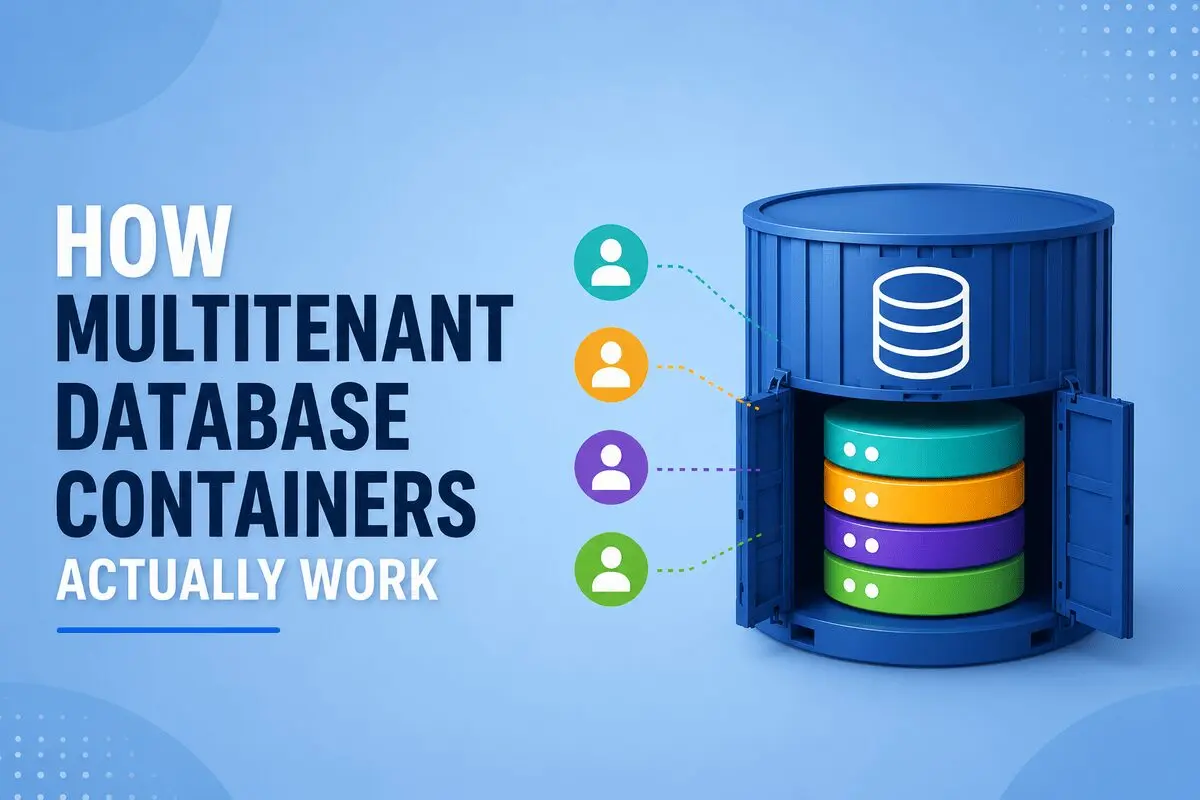
Management of data is not an easy task anymore. As businesses use different applications, client databases, and even cloud services. These continue to evolve, making their management very complex and expensive.
In a typical architecture, individual databases are dedicated to each particular application or client. Although this approach is effective when a company is new, the management process becomes complex as the business expands and requires additional resources.
A better approach here would be that of multitenant database containers. With their help, you can run several individual tenant databases at once on a shared database infrastructure. Despite the similar name, this is different from an application client container in Java EE, which manages client-side connections.
Why Traditional Databases Start Becoming a Problem
In older setups, companies used a single database per application or customer. At first, this worked fine. But as the system grows, problems start showing up. You end up managing:
- Multiple servers
- Separate patches and upgrades
- High infrastructure cost
- Complex monitoring systems
Even simple tasks like backups become slow and risky. Over time, this approach becomes less reliable, less affordable, and harder to scale. That’s exactly why organizations moved toward multi-tenant database design patterns.
Multitenant vs Traditional Databases
The table below shows the main differences between traditional databases and multitenant databases.
| Feature | Traditional Database | Multitenant Database |
| Setup | One database for each customer or application | Many customers share one database system |
| Cost | Higher cost | Lower cost |
| Scaling | Takes more time to add new databases | New tenants can be added quickly |
| Resource Usage | Some resources may be wasted | Resources are used more efficiently |
| Maintenance | More databases to manage | Easier to manage from one place |
| Updates | Updates must be applied to many databases | Updates can be done centrally |
| Growth | Harder to scale | Easier to scale |
Multitenant databases help businesses save money, use resources better, and grow faster. This is why many modern cloud platforms use this approach.
What Are Multitenant Database Containers?
The multitenant database architecture involves storing multiple databases in a single shared database rather than creating a new database per tenant.
Even then, the tenants appear to operate independently. They have their own data and user sets, as well as unique security protocols. However, all these operations take place on shared resources.
Consider the analogy of an office complex. The building is the database container, while the organizations within are the individual tenants. The individual firms work independently while sharing resources such as elevators and electricity.
It enables businesses to eliminate inefficiency while maintaining their necessary independence.
What are the Core Components of a Multitenant Database Architecture?
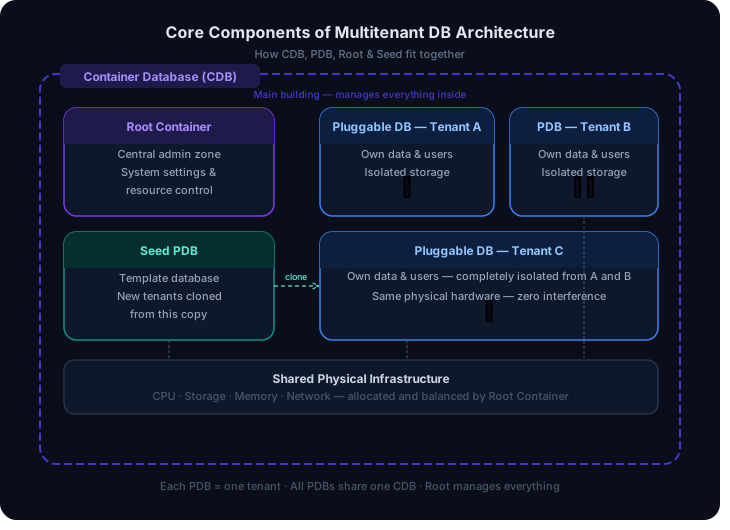
Before learning how multitenant database containers work, it helps to understand the architecture of the multitenant database.
Container Database (CDB)
The Container Database (CDB) is the main database that manages the entire environment. It stores shared system resources and controls all tenant databases.
You can think of it as the main building that contains several separate offices.
Pluggable Database (PDB)
A Pluggable Database (PDB) is a separate database inside the CDB. Each tenant gets its own PDB to store data, users, and applications.
Even though multiple PDBs share the same infrastructure, their data stays separate.
Root Container
The Root Container is the central management area of the CDB. It stores system settings and controls resources across all tenant databases.
Database administrators use it to manage the entire environment.
Seed PDB
The Seed PDB is a template database. When a new tenant is added, the system creates a new PDB by copying the Seed PDB. It makes the setup process much faster and easier.
How Multitenant Database Containers Actually Work?
The working model of multitenant database containers is based on a layered structure. At the top level, you have a central system that controls everything. This system manages resources, security rules, and global configuration. Below it, you have individual tenant databases that operate independently.
Creating a tenant means a new database environment for that tenant. It includes allocating storage space, setting up access privileges, and defining resource limitations. This process normally happens quickly and effortlessly.
Although all tenants operate on the same physical hardware, there will be no interference between them because each tenant exists in a separate, isolated environment. These layered multi-tenant database design patterns make systems both powerful and practical for real business use.
Why Do Companies Use Multitenant Database Containers?
Companies don’t adopt multitenant systems just because they are modern. They adopt them because they solve real business problems.
Cost-effectiveness is one of its greatest benefits. Because, instead of maintaining separate infrastructure for each client or application, everything can be managed in one place. It greatly reduces the hardware required and associated costs.
The process of adding new tenants is completed in minutes rather than days. It becomes easier for software companies to scale and accommodate their customers.
Secondly, there is the advantage of improved resource utilization. Rather than underutilizing servers, multitenancy ensures optimal workload distribution across shared database infrastructure.
How Different Industries Use Multitenant Databases?
Many industries use multitenant databases to achieve cost savings from database consolidation and manage data more efficiently.
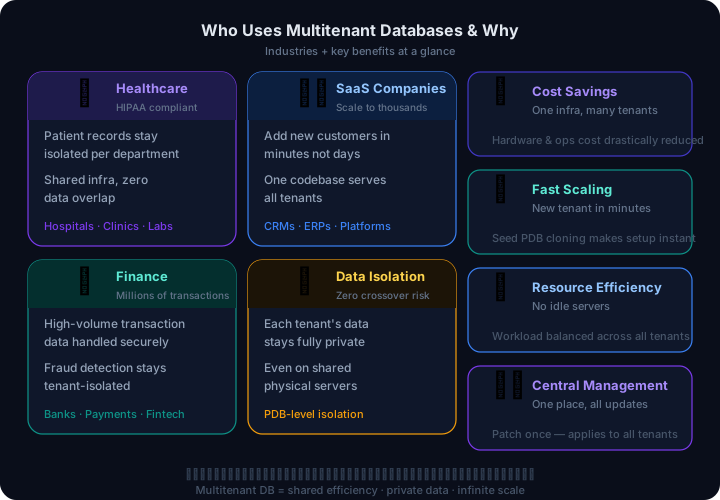
Healthcare
A multitenant database is used in healthcare institutions, such as hospitals and clinics, to manage large volumes of patient information daily. It also enables various departments within an organization to use the database while ensuring that their patient files do not overlap.
In addition, healthcare institutions must comply with regulations such as HIPAA.
Finance
Banks, payment processors, and other financial institutions handle millions of transactions daily. These multitenant databases help in managing customer account information.
Financial institutions need to adhere to security standards such as PCI DSS.
SaaS Companies
The SaaS model serves many users through a single platform. There is no need to create separate databases for each user. Instead, a multitenant database serves multiple customers concurrently.
Each client uses their own dataset, while the provider performs the remaining operations using a single system.
How Major Platforms Use Multitenant Database Containers?
Multitenant database containers are not just a theory. Big tech companies already use them in real systems. However, each of these companies has a slight difference in its multitenant approach.
Oracle uses a container database, which means a single database contains multiple other databases known as Pluggable Databases. Each of them functions as a separate database, but all of them work within one big container.
SAP HANA employs MDC technology for its multitenancy. A single SAP HANA multitenant database container can host many tenant databases. Each of these tenants is separate and contains its own information. They all belong to the same database management system, where the system database rules everything.
Microsoft Azure also employs a multitenancy model in some of its services, such as Azure SQL Database. But each database still stays separate and secure. It helps apps scale easily without needing separate servers.
Even though Oracle, SAP, and Azure use different multi-tenant database design patterns, the idea is the same. They all allow multiple databases to run together in a single system while keeping data separate. It helps companies save money, use resources better, and manage systems more easily.
Noisy neighbor problem in shared databases
Another problem encountered in multitenant database systems is noisy neighbors. The reason for this problem is that the system’s resources, such as CPU cycles, memory, and storage capacity, are shared by all tenants. Most often, everything goes along fine until one of the tenants suddenly starts using too many of these resources.
To address such an issue, multitenant databases rely on controls that limit tenants’ resource consumption. Once the control measures are in place, no tenant can use more resources than the others, thereby avoiding adverse effects. Under normal circumstances, users face no difficulties with adequate control measures in place.
How Multitenant Architecture Scales in Modern Systems?
Modern cloud systems depend on the ability to scale up or down. Multitenant architecture is built to support this. Instead of managing many separate databases, you scale a single system that handles all tenants. This makes it simpler to manage performance. You can also allocate resources as needed.
Many organizations are scaling multitenant databases in Kubernetes and cloud-native tools. They do this to automate scaling, deployment, and recovery processes. It helps them manage their cloud systems efficiently.
Database container security best practices
Security in multitenant systems is not optional. It is built into the architecture. Database container security best practices include:
- Strong access control rules
- Encryption at rest and in transit
- Tenant-level isolation
- Continuous monitoring
- Regular backup strategies
When done properly, multitenant systems are just as secure as single-tenant setups.
Conclusion
Multitenant database containers are a change in how we manage modern systems. We used to give each application or customer its own system, but now we use a single shared environment.
It makes things easier to manage. It costs less to operate. We can also scale the system up if needed, which is really helpful. Businesses do not have to choose between being efficient and keeping things separate. Now they can have both database containers and the benefits that come with them.
As more people adopt the cloud, architecture will become even more important. If you are developing SaaS solutions or working with business systems, knowledge of multitenant database containers is essential to developing a better database strategy.
Frequently Asked Questions (FAQs)
What are multitenant database containers in simple terms?
A multitenant database container is one database system that serves many users or applications. Each one has its own separate and secure data.
How do multitenant database containers improve performance?
They use shared resources to run more efficiently. It reduces waste and helps the system work faster.
Is data safe in multitenant database systems?
Yes. Each user’s data stays separate from others. Security controls help protect data from unauthorized access.
What is the biggest advantage of multitenancy?
The biggest advantage is the cost savings from database consolidation, combined with scalability. Businesses can grow faster with shared database infrastructure.
How do multitenant systems handle heavy traffic?
They share system resources fairly among users. It helps the system run smoothly even during busy times.
When should a company avoid multitenant databases?
A company should avoid them if it needs complete physical separation of data and systems. It is common in some government and highly regulated industries.

Comments are closed