
Traditional Wi-Fi was designed for a world with fewer devices and simpler layouts. Today, smart homes, remote work, video calls and dense IoT deployments strain a single router very quickly. One box in a hallway or corner room often cannot cover every floor, room, or outdoor area.
A Wireless Mesh Network (WMN) solves this problem with many cooperating nodes instead of one central access point. Each node can forward traffic for its neighbours, so the network spreads like a web across the building or site. This approach improves coverage, resilience and scalability for homes, offices, campuses and smart city projects.
In this blog, you’ll learn what is WMN?, how wireless mesh networks operate, and where they deliver the most value.
What Is a Wireless Mesh Network (WMN)?
A Wireless Mesh Network (WMN) is a communications network built from many radio nodes arranged in a mesh topology. Each node can send and receive data and can also relay packets for other nodes. The result looks like a web of links, not a simple star around one Wi-Fi router.
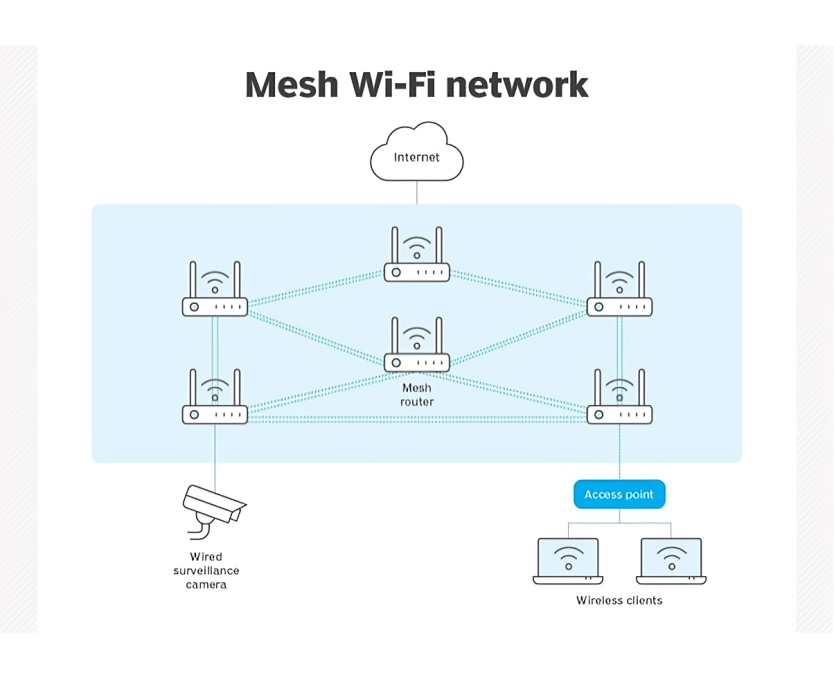
Typical WMN designs include three main roles:
- Mesh routers act as intelligent access points and forward traffic through the mesh cloud.
- Mesh clients are end devices such as laptops, smartphones, cameras or IoT sensors.
- Gateways connect the WMN to the internet or another backbone.
A WMN is often described as a form of wireless ad hoc network, but with mostly static or slowly moving nodes and planned placement. It sits between fixed infrastructure Wi-Fi and highly mobile MANET systems used in tactical and emergency operations.
So the WMN meaning in simple terms is this: It is a multi hop, decentralized system where many nodes share routing work. In homes and small businesses, this appears as a Wi-Fi mesh network or mesh wireless system sold as a single kit.
If you ask “what is mesh Wi-Fi?” or “what is a Wi-Fi mesh network?” you usually mean a consumer Wi-Fi mesh system. These products bundle several mesh routers, an app and cloud based management into one package. Popular systems such as Google Nest Wi-Fi, Amazon Eero and other mesh technology Wi-Fi solutions hide most routing details behind a simple interface.
How a Wireless Mesh Network Works

Mesh Nodes, Clients And Gateways
In a typical wireless mesh network, each mesh router contains at least one mesh radio. Many professional and high end consumer systems use two or three radios. One radio often handles backhaul between mesh routers. Other radios serve local Wi-Fi clients on different channels.
Mesh clients are normal devices. They might be:
- Smartphones and tablets
- Laptops or rugged field computers
- Smart TVs, printers and security systems
- IoT devices such as thermostats, locks and sensors
A gateway node connects the wireless mesh to a modem, fiber termination or cellular link. Not every node needs that connection. Many designs use one or two uplink nodes and many relay nodes. This keeps deployments flexible in venues such as warehouses, tunnels and large campuses.
Multi Hop Routing And Self Healing
In wireless mesh networking, packets rarely travel in a single hop. Data usually crosses several intermediate nodes before it reaches the gateway or final destination. This multi hop pattern extends coverage with moderate transmit power at each hop.
Routing inside wireless mesh networks uses specialized algorithms. Many implementations rely on link state or hybrid approaches, similar in spirit to IEEE 802.11s mesh routing and earlier ad hoc protocols. Nodes discover neighbors, measure link quality and compute preferred next hops based on loss, congestion and delay.
Key behaviors include:
- Nodes monitor which neighbors offer the best path toward each destination.
- Routes adapt when nodes join, move or fail.
- The mesh chooses alternate paths when one link degrades.
This dynamic behavior produces the familiar self healing property. If one mesh router loses power, traffic shifts through another path where possible. Users may notice lower throughput, yet service usually continues.
Radios, Bands And Backhaul
Most WMNs that carry regular IP traffic use 802.11 Wi-Fi radios in the 2.4 GHz, 5 GHz and, increasingly, 6 GHz bands. Many newer Wi-Fi 6 and Wi-Fi 6E mesh systems use 5 GHz and 6 GHz bands for dedicated backhaul and keep 2.4 GHz for legacy devices.
Some deployments combine wireless and wired backhaul. For example, you might use Ethernet between floors and mesh links within each floor. This mixed design reduces the collision domain, improves throughput, and simplifies channel assignment.
For low power IoT, mesh can also run over IEEE 802.15.4–based technologies such as Zigbee and Thread, which focus on small payloads and long battery life. In long range outdoor networks, 802.16 or cellular technologies can link remote mesh clusters back to the core.
Key Benefits Of WMN
Scalability And Coverage
A WMN extends coverage by adding nodes rather than replacing a central router. New mesh routers usually self configure, join the mesh cloud and discover paths to gateways. This makes WMNs suitable for growing offices, multi building campuses and outdoor venues such as stadiums and parks.
Compared with basic repeaters, a Wi-Fi mesh network usually offers more consistent signal strength and smoother roaming. Devices can move between nodes with less disruption, which improves video calls and streaming sessions.
Resilience And Self Healing
Since packets can travel across many spatial paths, WMNs tolerate node and link failures better than single router setups. If one access point fails, routing protocols pick alternate paths where possible.
This self healing behavior is important for:
- Emergency deployments and temporary command posts
- Industrial sites with moving metal obstacles
- Public Wi-Fi where interference changes during the day
Community meshes and amateur radio networks rely on this resilience during power cuts and natural disasters.
Flexibility, Cost And IoT Friendliness
WMNs reduce dependence on Ethernet cabling. Only a few nodes need physical links to a modem or fiber demarcation. Other nodes can run on mains power or even solar power and batteries when cabling is difficult.
This flexibility helps in:
- Construction sites and temporary venues
- Historic buildings where new cable runs are restricted
- Remote or rural locations with limited infrastructure
A wireless mesh also fits well with Internet of Things (IoT) projects. Many low bandwidth flows from smart meters, cameras, traffic lights and soil sensors can share the mesh backhaul. Low power protocols such as Zigbee, Thread and other LPWAN technologies complement Wi-Fi based WMNs in larger architectures.
Challenges And Limitations of Wireless Mesh Networks
Interference And Bandwidth Sharing
All wireless nodes share spectrum. Every extra hop consumes airtime on at least one radio channel. In dense deployments, overlapping cells can interfere if channels are not planned carefully.
Tri band and multi radio systems help by dedicating one band for backhaul. Many high end mesh Wi-Fi systems reserve a separate 5 GHz or 6 GHz band for node to node traffic, which keeps user traffic on other bands.
Latency on Multi Hop Paths
Each hop adds processing, queuing and propagation delay. For very latency sensitive flows, such as some trading systems or tightly controlled industrial loops, long multi hop paths may be unsuitable.
However, for typical VoIP, gaming and video meetings, well designed WMNs with limited hop counts and strong backhaul can perform acceptably.
Power And Hardware Constraints
Battery powered mesh routers must balance coverage, modulation rate and power draw. Low power designs use duty cycles and sleep modes, which limit throughput and sometimes increase latency.
High performance WMNs with MIMO and multiple radios require more capable hardware and stable power. That raises capital cost compared with a single basic router.
Management And Security Complexity
A basic consumer mesh Wi-Fi system is easy to install through a mobile app. Large WMNs across campuses, factories or city districts are harder to manage.
Network administrators must design:
- Node placement and wireless mesh topology
- Channel plans and power levels
- Monitoring, alerting and change procedures
Security adds another layer of complexity, as described next.
Real World Applications of Wireless Mesh Networks
Smart Homes And Whole Home Mesh Wi-Fi
Consumer mesh Wi-Fi systems address common problems in multi story homes and larger apartments. One mesh router connects to the modem. Satellite nodes extend signal into attics, basements, garages and yards.
A typical mesh Wi-Fi network supports:
- Streaming on smart TVs and consoles
- Security cameras and smart locks
- Thermostats, lighting and household appliances
- Smart speakers like Alexa and Google Home
Users often switch from extenders to a mesh Wi-Fi system because it offers a single SSID, smoother roaming, and centralized control through an app.
Smart Cities And Public Wi-Fi
Cities and municipalities use WMNs to support public Wi-Fi, traffic management and environmental monitoring. Mesh routers on light poles, rooftops and vehicles form a flexible urban backhaul.
Smart city projects use WMNs to connect:
- Traffic lights and parking meters
- Cameras and public safety sensors
- Information screens and kiosks
Community meshes such as Guifi.net show that shared, neutral infrastructure can scale to tens of thousands of nodes when supported by local stakeholders.
Industrial IoT, Warehouses And Factories
In industrial plants, pulling Ethernet to every asset is not always practical. A WMN can supply resilient backhaul inside:
- Warehouses with tall racks and moving forklifts
- Factories with rotating machinery and heavy metal structures
- Open pit mines and oil fields with harsh conditions
Here, mesh routers in wireless mesh networks link sensors, controllers, autonomous vehicles and inspection drones. Telemetry feeds into analytics platforms for remote monitoring, predictive maintenance and safety applications.
Healthcare, Utilities And Smart Grid
Hospitals and clinics use WMNs to connect mobile workstations, infusion pumps, monitoring devices and temporary treatment zones. Utility companies deploy wireless mesh networks to read smart electricity and gas meters and manage distribution assets.
Smart grid projects often combine WMNs with power line communications, fiber and cellular links. The goal is near real time visibility into energy consumption and grid conditions across large territories.
Rural, Remote And Emergency Deployments
WMNs are appealing in rural and underdeveloped regions where fiber or cable is expensive. Community projects and ISPs use wireless mesh as a last mile solution to extend broadband into villages and farms.
During disasters, portable WMN kits with solar powered nodes can restore basic communication for responders and affected communities. Amateur radio groups deploy mesh firmware on standard Wi-Fi hardware to create emergency ad hoc networks.
At a different scale, the Iridium satellite constellation forms a space based mesh with cross linked satellites. This design provides near global coverage for voice and data services, even at the poles and over oceans.
Security In Wireless Mesh Networks
Security in a WMN must cover both the radio link and the higher protocol stack.
At the Wi-Fi layer, modern systems use WPA2 or WPA3 with strong AES encryption to protect traffic. Enterprise deployments often add 802.1X authentication with a RADIUS server so only approved devices join the mesh.
Sensitive applications should also protect data at higher layers using TLS 1.3, QUIC or IPsec. This matters for healthcare records, industrial control commands and financial data.
Good practice in wireless mesh networks includes:
- Strong admin passwords for controllers and gateways
- Segregated guest networks with strict isolation
- Timely firmware updates to remove known vulnerabilities
- Monitoring tools that detect anomalies and suspected intrusions
Larger organizations increasingly adopt zero trust principles. Devices receive least privilege access, and identity checks continue throughout each session, not only at login.
Because WMNs often front public hotspots and IoT deployments, defenses against DoS, DDoS and credential attacks are important. Many operators combine rate limits, WAFs, behavior analytics and external threat intelligence feeds to detect and block malicious activity.
Setting Up a Wi Fi Mesh System
When To Choose Mesh Instead Of A Single Router
A Wi-Fi mesh network makes sense when:
- The site has several floors or thick internal walls
- One router cannot cover the required area
- Many devices spread across rooms, conference spaces or outbuildings
- Running Ethernet to each access point is difficult or costly
A single high quality router can still work in a small apartment or one room office. In that case, a full wireless mesh topology may be unnecessary.
Planning Your Wireless Mesh Network
Before purchasing a Wi-Fi mesh system, check:
- Internet speed from your service provider
- Floor area, wall materials and outdoor zones
- Number and type of devices that will connect
- Locations for power outlets and possible Ethernet runs
Vendor specifications for coverage per node assume open spaces with limited interference. Real buildings often require more nodes for stable wireless mesh coverage.
Basic Deployment Steps
- Connect the primary mesh router to the modem using Ethernet.
- Use the mobile app to create the SSID, Wi-Fi password and admin account.
- Place additional nodes halfway between the main router and dead zones.
- Wait while nodes join the WMN and perform self optimization.
- Walk through the site with a phone or laptop and test coverage and speed.
Modern Wi-Fi mesh systems often provide tips for node placement, automatic channel selection, device prioritization, guest network isolation and basic threat detection. Some business oriented systems add VLANs, Ethernet backhaul options and integration with identity providers.
Future Of Wireless Mesh Networking
WMNs continue to evolve alongside Wi-Fi 6E, Wi-Fi 7, 5G and large scale IoT growth.
Emerging trends include:
- Higher throughput radios using advanced OFDM and wide channels in the 6 GHz band.
- AI based optimization that predicts congestion and reshapes routes proactively.
- Integration with edge computing, so some processing stays close to users and sensors.
Research explores software defined wireless networking and SDN style control over mesh routing. Controllers can program paths, allocate spectrum and set QoS policies while still using distributed forwarding at each node.
In IoT focused networks, low power mesh nodes use energy harvesting and advanced sleep strategies to extend battery life. Protocols like 6LoWPAN, MQTT and CoAP help constrained devices communicate over IPv6 with minimal overhead.
Security research looks at post quantum safe cryptography and scalable key management for large distributed WMNs. These improvements will matter for smart grids, healthcare and critical infrastructure deployments that require long lifetimes.
As remote work, streaming, gaming and billions of smart devices continue to expand, robust mesh wireless designs will remain a core part of modern network infrastructure.
Final Thoughts
A wireless mesh network replaces a single weak point with many cooperating nodes. It delivers broader coverage, higher resilience and easier expansion for homes, campuses and industrial sites.
For home users asking what is WMN?, the answer often appears as a Wi-Fi mesh network kit. It solves dead zones, supports many devices and keeps management simple through one app.
For businesses, utilities and smart city projects, WMNs provide flexible, infrastructure light backhaul for dense IoT deployments. Careful design, solid security and proper node placement remain essential for reliable results.
As device counts grow and layouts stay complex, mesh wireless will continue to complement wired links and traditional Wi-Fi. Understanding WMN fundamentals now makes future upgrades and planning more straightforward.
FAQs About What Is WMN?
Is WMN The Same As Mesh Wi-Fi?
Not exactly. WMN (Wireless Mesh Network) is the general mesh networking architecture. Mesh Wi-Fi is a consumer WMN product designed mainly for whole-home wireless coverage.
Does A Mesh Wi-Fi Network Increase My Internet Speed?
Mesh Wi-Fi does not raise the speed from your internet provider. It helps you use that speed more consistently in every room by reducing dead zones and weak signal areas.
How Many Mesh Nodes Do I Need At Home?
Most small apartments work with one main node and one satellite. Larger houses with multiple floors often need three or more nodes, depending on wall materials and layout.
Can I Mix Different Mesh Systems Or Use A Mesh Router With A Regular Router?
Different mesh brands usually do not interoperate in one wireless mesh network. You can often keep a regular router as a modem or gateway, but mesh nodes should come from the same family.
Is A Wireless Mesh Network Safe For Sensitive Work Or Smart Devices?
A WMN can be safe if you enable WPA2 or WPA3, use strong passwords and keep firmware updated. For extra protection, separate guest traffic, restrict admin access and encrypt important applications end to end.
