
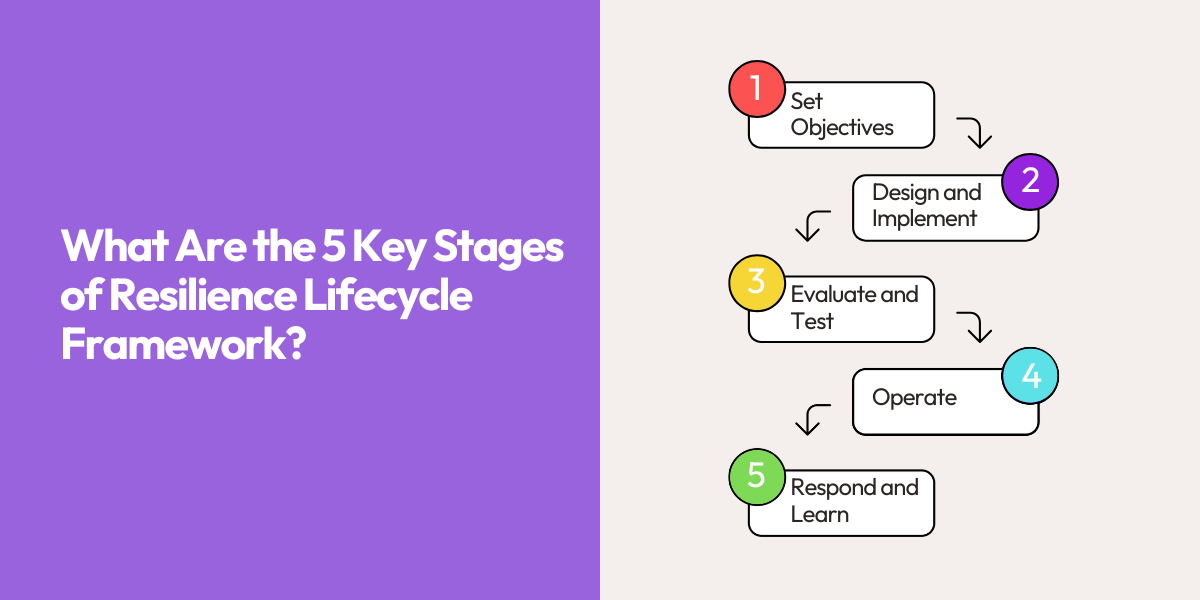
In today’s digital world, resilience is key to keeping systems running smoothly. When systems fail, it costs businesses a lot. For example, a single hour of downtime can cost over $300,000 for many companies. Some incidents cost millions. A data breach can cost companies an average of $4.88 million.
This is why teams need to know how to build resilient systems. One good way to do that is using the resilience framework specifically the resilience lifecycle framework that breaks the process into five clear, actionable stages. In this article, we explain this framework and break it down into 5 key stages. These stages help you design, run, and improve resilient systems.
What Is The Resilience Lifecycle Framework?
Resilience means that systems continue to work or can quickly recover when issues arise. In modern IT, this includes managing disruptions like server crashes, network failures, or third-party service outages.
The resilience lifecycle framework is a structured approach for building, maintaining, and improving resilience in systems over time. It was developed from real-world experience and practical use cases.
Rather than being a one-time task, resilience should be an ongoing effort. The framework helps teams integrate resilience into their daily operations, ensuring systems are better prepared to handle disruptions and recover quickly when needed.
By continuously revisiting and improving resilience practices, organizations can stay ahead of potential issues and maintain system uptime without significant setbacks.
Why An IT Resilience Framework Matters For Modern Organizations
Today’s systems are complex. They rely on many components like cloud services, remote teams, and third-party APIs. An IT resilience framework gives teams a structured way to manage this complexity — identifying which components are critical, defining how much failure is acceptable, and ensuring recovery processes are tested before they are needed. This complexity increases the chance of failure. Small issues in one part can spread to others. In fact, over 90% of companies report significant losses from downtime, some as high as $1 million per hour.
A clear framework helps you manage these risks. It helps you make decisions about how much to invest in building resilient systems. For AI-focused companies resilience also includes ensuring that data pipelines, machine learning models, and storage systems work without interruption.
5 Key Stages Of The Resilience Lifecycle Framework
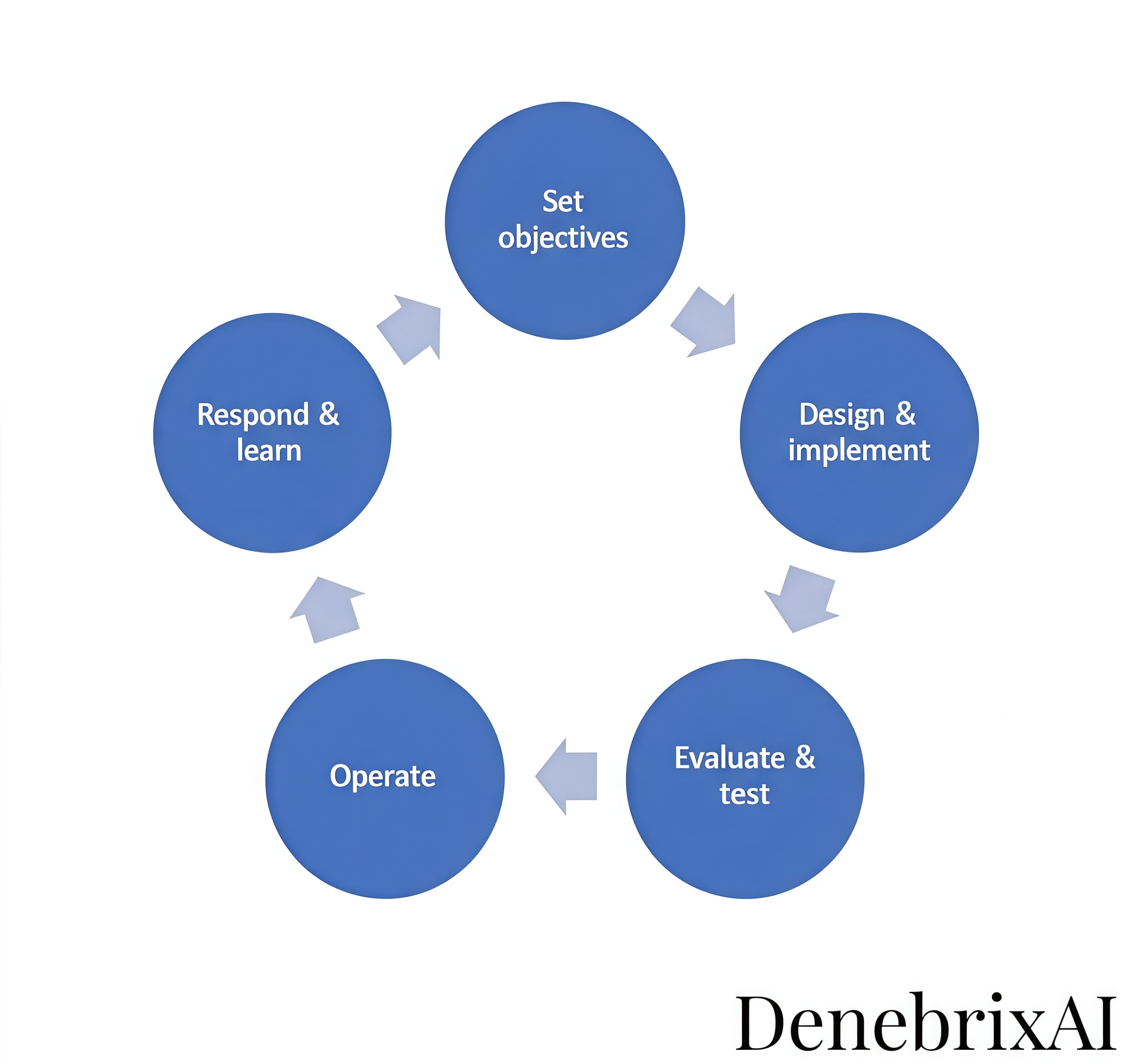
Let’s look at the five stages of the resilience lifecycle framework in more detail. These stages build on each other, guiding you from planning to improving resilience over time.
The stages are:
- Set Objectives
- Design and Implement
- Evaluate and Test
- Operate
- Respond and Learn
These stages aren’t separate projects. Instead, they work together as a continuous process that helps you get better over time.
Let’s break down each stage in more detail.
Stage 1: Set Objectives
The first stage is about clarity. Before building anything, you need to decide what “resilience” means for your system.
Start by identifying the business functions that are most critical. These could be things like user login, payment processing, or accessing customer data.
Next, map these functions to the IT components that support them; like web servers, databases, or APIs.
Now, think about how much downtime is acceptable. For example, how long can your system afford to be down before it hurts the business?
- This is your Recovery Time Objective (RTO): How long can the system be down?
- This is your Recovery Point Objective (RPO): How much data can your system afford to lose?
Setting these targets helps everyone understand what you are trying to protect. It also shows where you should focus your resilience efforts.
Stage 2: Design and Implement
Stage two is all about building. Here, you start designing and building systems that can meet your resilience goals.
At the infrastructure level, you might choose to run critical services across multiple Availability Zones (AZs) or even across multiple regions or clouds. This helps reduce the risk of failure.
For your applications, use patterns that allow the system to degrade gracefully when something fails. For example, use retries, timeouts, circuit breakers, and rate limiting.
You also need to set up good security controls, like using multi-factor authentication (MFA) for critical systems.
And don’t forget change management. Using CI/CD pipelines and automated testing helps ensure that changes to your system are safe and can be rolled back if needed.
Stage 3: Evaluate and Test
Stage three is all about testing. Designing a resilient system isn’t enough; you need to prove it works.
Here’s where you run drills to test your system’s recovery capabilities.
- Disaster recovery (DR) drills simulate a disaster and test whether your backups can restore your system within your RTO and RPO targets.
- Load tests simulate high traffic to see how your system handles peak demand.
- Chaos engineering breaks parts of your system to test its response to failure.
You should also integrate resilience tests into your CI/CD pipelines. This means checking resilience as part of the daily development process, not just during special tests.
Stage 4: Operate
Stage four is about running your systems. After all the design and testing, it’s time to operate your system in real environments.
Here, observability becomes crucial. You need to track how your system behaves in real time. This includes tracking metrics, logs, and traces of your services and their dependencies.
Alerting is key as well. Set up alerts that tell your team when the system is at risk of missing its SLOs. This allows the team to react quickly.
Use runbooks (documents with clear steps) to handle incidents and respond to problems quickly.
Finally, managing changes safely is important. Always make small, incremental changes. This limits the risk of breaking something important.
Stage 5: Respond and Learn
Even with the best planning, incidents will happen. Stage five is about responding to those incidents and learning from them.
During an incident, your team follows predefined roles, clear communication channels, and established procedures. The focus is on fixing the issue safely and quickly.
After the incident, conduct a post-mortem. Review what happened, what worked well, and what went wrong. The findings from these reviews should be added to your backlog as items to improve. Some teams may introduce new tools, adjust alert thresholds, or tweak CI/CD pipelines based on post-mortem findings.
Update your system design, test cases, and runbooks based on what you’ve learned. This continuous feedback loop helps build stronger systems over time.
How The Resilience Lifecycle Connects To SDLC And DevOps
The resilience lifecycle doesn’t replace your SDLC or DevOps practices; it supports them.
- Set objectives lines up with your planning phase in SDLC.
- Design and implement maps to your design and development phase.
- Evaluate and test fits with QA, testing, and continuous integration.
- Operate ties into daily operations, monitoring, and on-call duties.
- Respond and learn connects with retrospectives and continuous improvement in DevOps.
By integrating resilience into each part of the process, you make sure it stays top of mind throughout your work.
Practical Ways To Apply This Resilience Framework
You don’t need a huge program to apply this resilience framework. Pick one critical system to begin with and run it through all five stages before scaling to others.
For example, let’s say you pick your checkout system. Run it through the 5 stages:
- Set objectives: Define the RTO, RPO, and SLOs for the checkout system.
- Design and implement: Ensure it’s built for resilience, using patterns like retries, circuit breakers, and redundancy.
- Evaluate and test: Run DR drills, load tests, and a chaos engineering experiment.
- Operate: Use dashboards and alerting to monitor performance.
- Respond and learn: After an incident, run a post-mortem, capture lessons learned, and update processes.
Once you’ve done this for one system, you can start applying it to other critical systems.
Final Thoughts
Building resilience into IT systems is more important than ever. In today’s fast-paced digital world, systems need to be ready for any disruption, big or small. The resilience framework structured around five lifecycle stages helps ensure systems can handle issues and recover quickly without major setbacks. By integrating resilience into daily operations, organizations can stay ahead of challenges and maintain uptime.
FAQs – What Are the 5 Key Stages of Resilience Lifecycle Framework
How can a resilience framework help save money in IT?
An IT resilience framework helps you focus resources on the most critical systems making sure you protect what matters most while avoiding unnecessary costs on lower priority areas. It makes sure you protect the most critical parts of your system while avoiding unnecessary costs on less important areas.
Can resilience strategies be used for cloud-based systems?
Yes, resilience strategies are key for cloud systems. Cloud providers, such as AWS, offer tools to create systems that remain operational, even when something goes wrong.
How is resilience related to IT security?
Resilience is closely connected to security. A resilient system not only recovers from problems but also prevents or quickly handles security threats, reducing their impact.
How does the resilience framework help with digital transformation?
The resilience framework helps businesses move to new technologies safely. It makes sure that systems are strong enough to handle changes, recover quickly from issues, and keep running smoothly.
How can teams make remote work more resilient?
Teams can make remote work more resilient by utilizing reliable systems, establishing backups, and closely monitoring their systems. This makes sure that work continues smoothly even when issues happen.
Why is data backup important in a resilience framework?
Data backups are a key part of resilience. They allow you to quickly restore important information in the event of an issue, helping your systems recover more efficiently and minimizing data loss.

Comments are closed