
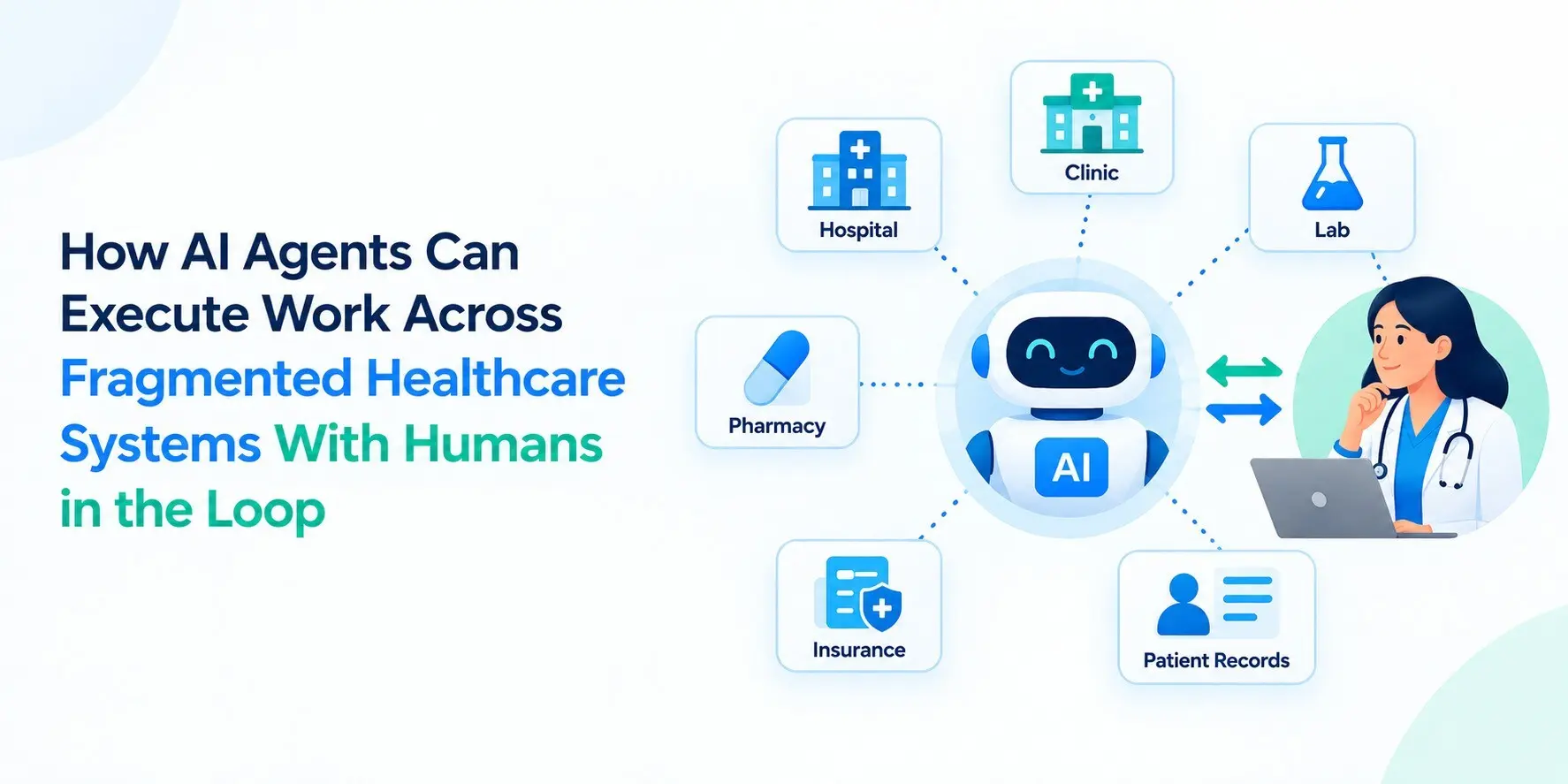
The difficult part of deploying AI agents in healthcare is not getting a model to understand a task.
It is getting an agent to execute reliably when the work spans systems the organization does not control, remains open for days or weeks, depends on external responses, and occasionally reaches a point where a person has to make a decision.
A single healthcare workflow can touch an internal database, payer portal, government system, licensing board, document repository, email inbox, PDF, and spreadsheet before it is complete.
Some of those systems expose APIs. Many do not. Authentication can expire. MFA can interrupt a workflow. External systems may return inconsistent statuses. A successful submission may not appear downstream for several days.
That makes healthcare agents fundamentally different from a chatbot that receives a prompt, generates an answer, and stops.
As DenebrixAI explains in its work on AI agent development, the meaningful shift is from systems that simply return information to systems that can use tools, take actions, and carry multi-step work forward.
In healthcare, that distinction matters because completing one action rarely means the underlying workflow is finished.
Healthcare workflows rarely end when an action is taken
Consider payer enrollment.
Preparing and submitting an application is only one part of the process.
After submission, the payer might:
- acknowledge receipt
- request another document
- identify inconsistent provider information
- require a signature
- return the application for correction
- leave it pending for several weeks
- approve the provider with a future effective date
- approve one product while another remains pending
- reject the application because the network is closed
If automation stops when the application reaches SUBMITTED, much of the operational work still belongs to the team.
The same pattern appears elsewhere in healthcare.
A roster is not complete because a file was uploaded. The payer still has to process it, and individual provider records can fail.
A license application is not complete because it was filed. A licensing board still has to review it and issue the license.
Primary source verification is not necessarily complete because information was retrieved. A discrepancy can require additional review.
The distinction is simple but important:
Action taken does not always mean business outcome reached.
Agents designed for healthcare need to account for everything that happens between those two points.
Long-running workflows need continuity
Many healthcare workflows remain open much longer than the individual actions inside them.
A payer enrollment may remain unresolved for 30, 60, or 90 days. During that time, there may be a few minutes of activity followed by days of waiting, another interaction, another external dependency, and then another round of work.
When that workflow becomes actionable again, the system needs enough context to understand:
- which provider is involved
- which organization, TIN, and location are relevant
- which payer and product the enrollment applies to
- what information has already been submitted
- when it was submitted
- what confirmation was received
- what happened during the last interaction
- what information is still missing
- what needs to happen next
That is different from simply keeping conversational history inside a model.
The operational context needs to survive over time.
When a payer responds three weeks later, the workflow should continue from its current state rather than forcing someone to reconstruct the case from portal notes, email, spreadsheets, and memory.
Waiting is part of the workflow
Traditional automation is usually easiest to imagine as:
Trigger → Action → Complete
Healthcare operations often look more like:
Action → Wait → External response → Evaluate → Act again → Wait
Waiting is not the absence of a workflow. It is one of its states.
A long-running process might move between conditions such as:
| State | What it means |
| Ready to act | Everything required for the next step is available |
| Waiting externally | A payer, board, provider, or other system needs to respond |
| Follow-up required | Enough time has passed that another action should occur |
| Additional information required | Something needs to be supplied or corrected |
| Human input required | The workflow needs judgment, authorization, or a signature |
| Complete | The intended business outcome has actually been reached |
This distinction matters because an agent should not behave the same way in every state.
Sometimes it should act.
Sometimes it should wait.
Sometimes it should retry.
Sometimes it should stop and bring in a person.
External systems make execution unpredictable
A major challenge for healthcare agents is that the systems on the other side of the workflow are inconsistent.
One payer might expose a portal. Another might require a PDF. Another might expect a roster file. Another might route certain transactions through a third-party system.
Requirements can vary by state, provider type, product, line of business, or organization.
The agent therefore has to operate in an environment where the interface, authentication method, required fields, and response format can differ from one workflow to the next.
This is why tool use and integration are such an important part of agent design. DenebrixAI describes agents as systems that combine models with external tools and an execution loop, rather than stopping at a single prompt-response. Their guide on building AI agents goes deeper into that distinction.
In healthcare, that creates several practical problems.
Authentication can interrupt a workflow
A session can expire.
MFA may be required.
Credentials may change.
The external system may request an additional verification step.
The system needs to distinguish between:
the workflow failed
and
the workflow is temporarily blocked by authentication
Those should not be treated as the same problem.
A successful action still needs evidence
Pressing a Submit button does not prove that a transaction completed correctly.
For consequential actions, the system should be able to capture evidence such as:
- confirmation number
- timestamp
- receipt
- reference ID
- generated document
- portal status
- confirmation email
Without that evidence, it becomes difficult to know whether the action should be retried or whether the external system simply has not updated yet.
Retries are not always safe
If a connection drops immediately after a submission, automatically repeating the same action can create duplicate applications, duplicate updates, or conflicting records.
A reliable execution system must ask whether the action is safe to repeat before retrying.
Sometimes the correct response to failure is another attempt.
Sometimes the correct response is checking the external system first.
Submission and completion should be separate concepts
This is particularly important in healthcare because many processes are asynchronous.
| Workflow | Initial action | Actual outcome |
| Payer enrollment | Application submitted | Provider approved and effective |
| Licensing | Application filed | License issued |
| Roster management | Roster submitted | Changes processed and reconciled |
| Credentialing | Verification completed | Credentialing decision completed |
A workflow can successfully reach the middle column and still be far from the outcome in the final column.
That has an important implication for AI agents:
The agent should be designed around the operational outcome, not merely the easiest step to automate.
Otherwise, organizations can end up with workflows that look automated on a dashboard but still require people to perform most of the coordination needed to get them across the finish line.
Humans should enter at decision points
Human-in-the-loop does not have to mean placing a person between every pair of agent actions.
That defeats much of the value of automation.
A better model is to define explicit boundaries around the actions that require judgment.
For example:
| Situation | Appropriate response |
| Standard information is available | Continue |
| Waiting for an external party | Pause |
| Portal temporarily fails | Retry when safe |
| Required data is missing | Request or surface it |
| Unexpected external response | Evaluate or escalate |
| Signature required | Human action |
| Credentialing decision required | Human decision |
| Ambiguous compliance issue | Human review |
This is a more useful definition of human oversight.
The agent executes the repeatable work.
People enter where the workflow genuinely requires judgment, authorization, interpretation, or accountability.
This also aligns with how DenebrixAI approaches production agent systems: agents can operate across existing enterprise systems, but the scope of autonomy and workflow design still need to be deliberately defined.
A useful escalation includes the context needed to resolve it
Poor automation often replaces manual work with another queue.
Something goes wrong, and the system creates a task:
Needs review.
The employee then has to work backward through the entire process to understand what happened.
A useful escalation should make the decision clear.
The person should be able to see:
- what the system was trying to accomplish
- what already happened
- what external system is involved
- what response came back
- why execution stopped
- what input or decision is required
- what will happen after that input is provided
This becomes especially important for workflows that have been open for weeks.
The purpose of maintaining context is not simply to make the agent smarter. It is also to reduce the amount of work required when a person does need to step in.
Auditability has to cover actions
With generative AI, attention often focuses on the answer a model produced.
Agents create a different requirement because they take actions.
For healthcare workflows, organizations may need to know:
- what action occurred
- when it happened
- who or what initiated it
- which provider or record it affected
- what source information was used
- which external system was accessed
- what response came back
- whether human approval was required
- what changed afterward
This history matters for compliance, troubleshooting, and everyday operations.
It is also what allows a team to answer questions like:
Why is this enrollment still pending?
or:
Did the payer actually process this roster change?
If the answer still requires manually searching across several systems, the automation has not addressed enough of the workflow.
Healthcare systems are often eventually consistent
Another complication is that success in one system does not always appear immediately in another.
A roster can be accepted for processing but not yet loaded.
A payer enrollment can be approved but not yet effective.
A demographic update can be submitted but not yet reflected in a payer directory.
So the workflow may need to distinguish between:
submitted
acknowledged
processing
approved
effective
verified
These are not interchangeable states.
A healthcare agent that treats the first successful transaction as completion can create false confidence.
In many workflows, the system needs to check again later and compare the expected state with the actual external state before considering the work finished.
Building all of this internally becomes a substantial project
At this point, an organization building healthcare agents internally is no longer building a simple LLM integration.
It is building an execution layer around the model.
That layer needs to account for:
- APIs and browser-based systems
- authentication and MFA
- long-running workflows
- external dependencies
- delayed responses
- safe retries
- duplicate-action prevention
- evidence capture
- exception handling
- human approval boundaries
- audit history
- changing external requirements
- asynchronous downstream processing
Then the organization still has to encode the healthcare workflow itself.
For provider operations, that means accounting for providers, organizations, TINs, locations, payers, products, documents, licenses, credentialing requirements, enrollment relationships, roster changes, and external verification sources.
For some teams, building and maintaining that infrastructure may make sense.
For others, it means owning a large technical and operational problem that sits outside their core product.
For provider workflows, Assured can take on much of that complexity
Provider workflows are a good example because they span external systems, payer-specific requirements, provider data, documents, and processes that can remain open for weeks.
Instead of building every workflow internally, healthcare organizations can use Assured across credentialing, licensing, payer enrollment, roster management, and ongoing monitoring.
Assured uses agents to execute provider workflows such as primary source verification, application preparation, payer submissions, and other repetitive operational work. The platform keeps provider, location, organization, and payer information connected across those workflows, while the team steps in where a decision, signature, exception, or manual intervention is required.
For credentialing, Assured can run primary source verification across 2,000+ sources and produce committee-ready files, while credentialing decisions remain with the appropriate human reviewers. More detail is available on Assured’s credentialing platform.
For payer enrollment, Assured supports application preparation, submission, tracking, and follow-up operations across the provider, payer, entity, and location relationships involved in the enrollment.
That means healthcare organizations do not have to build separate automation for every provider record, verification source, application, payer requirement, and workflow handoff simply to reduce the manual work required to get providers live.
The important distinction is execution.
The system is not limited to telling an operations team that something needs to be done. Agents can perform the parts of the workflow that can be automated while keeping people in control of decisions that require their input.
For an enrollment team, for example, that can mean less time spent transferring provider information into applications, repeating verification work, tracking submissions in spreadsheets, or reconstructing enrollment status across disconnected systems.
The objective is not to remove the team from the process.
It is to reduce how much of the process requires manual intervention to move the work forward.
The real test of a healthcare agent starts after the first action
It is relatively easy to demonstrate an agent filling out a form, navigating a website, or producing an answer.
That does not prove it can run a real healthcare workflow.
The more useful questions are:
What happens if the workflow remains open for 45 days?
What happens when authentication expires?
What happens when an external system returns something unexpected?
What happens if an action may have succeeded but confirmation is unclear?
What happens when required information changes?
What happens when a person needs to intervene?
What happens when the external system still has not reflected the change two weeks later?
And most importantly:
Does the system still know what needs to happen next?
That is where the difference between task automation and operational execution becomes clear.
The most useful healthcare agents will not be the ones that remove humans from every workflow.
They will be the ones who reliably execute work that does not require a human, preserve the context needed to continue when circumstances change, and bring people in precisely where their judgment matters.
FAQ
What is an AI agent in healthcare, and how is it different from a chatbot?
An AI agent in healthcare uses tools and systems to take actions and carry multi-step work forward, while a chatbot only answers a prompt and then stops there.
2. Why do healthcare workflows not end when an application is submitted?
Because submission is not completion: a payer or board may still request documents, return the application, or leave it pending for weeks before final approval.
3. Why is human-in-the-loop important for healthcare AI agents?
Humans step in only at decision points like signatures, credentialing decisions, or compliance reviews, while the agent handles repeatable work on its own.
4. Why do healthcare AI agents need audit trails and evidence capture?
Agents take real actions, so teams need a record of what happened, when, which system responded, and any confirmation number to prove compliance and fix errors.
5. Why are retries not always safe in healthcare automation?
Repeating an action after a dropped connection can create duplicate applications or conflicting records, so the agent should check the external system first.

Comments are closed