
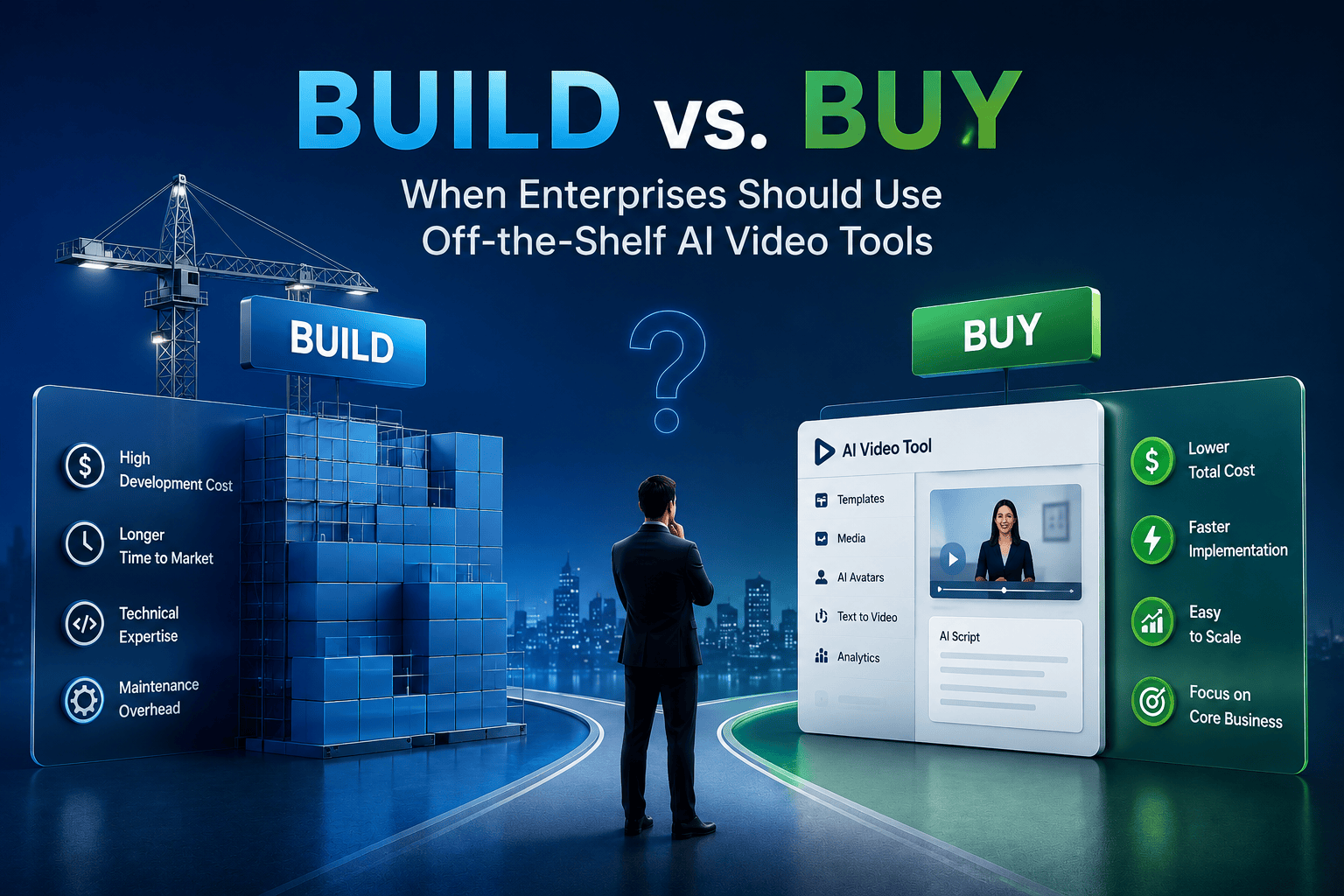
A marketing team needs a hundred product video variations for a new campaign. An engineering lead is asked whether that means commissioning a custom generative video pipeline or simply subscribing to a tool that already does it. This is the build vs. buy question that keeps surfacing across enterprise AI decisions in 2026, and for AI video specifically, the answer usually comes down to a smaller, more concrete question than most teams initially frame it as: is video generation a feature you need, or an asset you’re trying to build a durable advantage on. Platforms like Higgsfield give access to AI Video Generator that answer the first question well. Custom development exists for the second.
Why Has Build vs. Buy Become a Live Question for AI Video Specifically?
Enterprise AI adoption has matured past the point where every capability automatically meant a custom build. Recent industry research suggests roughly 70 percent of enterprise AI use cases are adequately served by off-the-shelf solutions, and companies piloting a buy-first approach before committing to custom development have reported meaningfully higher first-year ROI. Video generation sits squarely in this shift, since the underlying models powering both off-the-shelf tools and custom pipelines increasingly come from the same handful of foundation providers, which narrows the gap between what a subscription gets you and what a bespoke build gets you for many common use cases.
This shift matters particularly for teams that spent the last few years assuming custom infrastructure was the default answer to any new AI capability. The reality in 2026 is closer to a spectrum than a binary choice, and video generation happens to sit on the end of that spectrum where the off-the-shelf option has caught up fastest, largely because consumer and prosumer demand has pushed vendors to refine these platforms far more aggressively than most internal enterprise teams could match on their own timeline.
What Does Building Custom AI Video Capability Actually Cost?
A single-purpose custom generative AI build, integrating a foundation model into a proprietary pipeline with a custom interface, typically runs from the low tens of thousands into six figures depending on scope. A production-grade system with full integrations, evaluation infrastructure, monitoring, and compliance architecture can run into the hundreds of thousands. On top of the initial build, annual maintenance, the engineering team, infrastructure, and ongoing iteration, commonly adds another six figures a year at meaningful scale. The break-even point against a comparable subscription cost typically falls somewhere between eighteen and twenty-four months, after which custom development can become cheaper than continued licensing, provided the use case still justifies dedicated engineering attention that long.
What Does Buying an Off-the-Shelf AI Video Generator Actually Cost?
Subscription-based AI video tools in 2026 generally range from around twenty-five to ninety-five dollars a month for professional tiers, with enterprise plans scaling based on volume and features. That cost profile means a team can be generating finished video within days of signing up, compared to the months of development, testing, and integration a custom build requires before producing anything usable. For teams that need output now rather than a competitive moat built over years, that timeline difference is often the deciding factor on its own.
This cost gap compounds further once iteration is factored in. A custom pipeline still needs testing, refinement, and often a second or third development pass before it reliably produces usable output, each of those passes adding weeks and additional engineering cost. A subscription-based platform absorbs that iteration cost inside the monthly fee, since the underlying model has already been trained and refined by the vendor across a much larger volume of usage than any single enterprise’s internal pilot could generate on its own.
What Determines Which Side of the Decision an Enterprise Actually Falls On?
The honest signal isn’t cost alone, it’s whether the underlying need involves proprietary data, deeply custom workflows, or specific integration requirements that an off-the-shelf platform genuinely cannot handle. A marketing team generating campaign video variations from product photos has none of those constraints. A team building a video generation feature that has to plug directly into a proprietary content management system, enforce brand-specific generation rules at the model level, or handle sensitive customer data inside the generation pipeline itself is facing a fundamentally different problem, one that off-the-shelf tools were never built to solve. The distinction is less about company size or budget than it is about the actual shape of the requirement in front of the team making the decision.
| Custom AI video development | Off-the-shelf AI Video Generator | |
| Upfront cost | Tens of thousands to $250,000+ | Subscription, often 25-95/month per tier |
| Time to first usable output | Months, including integration and testing | Days |
| Annual maintenance | Often six figures at scale | Included in subscription |
| Best suited for | Proprietary workflows, deep system integration | General campaign, social, and marketing video needs |
| Break-even vs. the alternative | Roughly 18-24 months, if the need persists | Immediate, since there’s no upfront build cost |
When Does Building Custom AI Video Infrastructure Actually Make Sense?
Custom development earns its cost when video generation needs to sit inside a proprietary system a company already runs, when generation rules need to enforce very specific brand or compliance constraints at the infrastructure level, or when the volume and specificity of output genuinely exceeds what any general-purpose platform is designed to handle. Enterprises with an established AI engineering team already maintaining other custom systems are also better positioned to absorb the ongoing maintenance a custom video pipeline requires, since the incremental cost of adding one more system to an existing team is lower than standing up that capability from nothing.
When Does an Off-the-Shelf AI Video Generator Make More Sense Than Building?
For the far more common case, a marketing or content team needing to produce campaign video, social content, or product demos quickly and at volume, an off-the-shelf tool wins on almost every practical dimension. Higgsfield’s AI Video Generator gives access to several leading video models, including Seedance 2.0, Kling 3.0, Veo 3.1, Sora 2, and Wan 2.7, from a single subscription, which means a team gets access to a range of model quality tiers without negotiating separate API contracts or maintaining separate integrations for each one. For most marketing use cases, this alone removes the majority of what a custom pipeline would otherwise need to be built to solve.
What Does a Buy-First Pilot Approach Actually Look Like?
The pattern that tends to work best in practice is starting with an off-the-shelf tool to validate the actual need before committing engineering resources to a custom build. A marketing team can run a real campaign through an AI Video Generator, measure actual output volume and quality against what the campaign needed, and only then evaluate whether a custom pipeline would meaningfully improve on that baseline. This sequencing avoids the common failure mode of committing six figures to custom development before confirming the underlying need was ever going to justify that investment in the first place.
How Does an AI Video Generator Fit Into an Enterprise’s Broader AI Strategy?
This is worth stating plainly, since Higgsfield is sometimes assumed to be a single-purpose video tool. Higgsfield AI is a native AI creative suite, which offers advanced AI image, video, and voice generation, editing, and upscaling tools, meaning a marketing or content team piloting video generation can extend the same evaluation to image and voice content without standing up three separate pilots. For an enterprise that eventually determines a proprietary use case genuinely justifies custom generative AI development, that pilot data, real output volume, real quality benchmarks, becomes exactly the evidence needed to scope a custom build accurately rather than guessing at requirements upfront.
What Should Enterprises Verify Before Committing to Either Path?
Before buying, confirm the platform’s data handling terms match company policy, particularly for any workflow touching customer-facing or brand-sensitive content, and verify subscription costs actually scale sensibly at the volume the team expects to need. Before building, get a realistic estimate of both the upfront build cost and the ongoing annual maintenance, since underestimating the second figure is the most common reason custom AI projects run over budget. Either path benefits from a short, honest pilot before a large commitment, which is exactly what a buy-first approach is designed to provide.
Does Buying Off-the-Shelf Mean Giving Up Control or Differentiation?
Not for most use cases, and this is a common misconception worth addressing directly. Creative control over the actual output, the script, the brand voice, the specific product being showcased, comes from how a team uses a tool like Higgsfield, not from whether they built the underlying infrastructure themselves. Differentiation for most marketing and content use cases comes from the ideas and execution, not from owning a proprietary video generation pipeline that produces functionally similar output to what a subscription already provides. Differentiation genuinely requiring custom infrastructure is real, but it’s rarer than the initial instinct to build usually assumes.
What Should an Enterprise Look for When Evaluating an AI Video Generator?
A few things matter more here than raw model quality alone. Access to multiple model tiers in one subscription matters, since different campaigns benefit from different quality and cost trade-offs. Clear data handling and security documentation matters for any enterprise evaluation, regardless of how the tool gets used. And genuine ease of adoption matters most for validating the buy-first pilot quickly, since the entire point of starting with an off-the-shelf tool is getting real usage data fast, not spending weeks on implementation before the pilot even begins.
It’s also worth evaluating how a platform handles the transition if a pilot does eventually justify custom development. A tool like Higgsfield that exposes clear usage data, generation counts, model performance across different content types, cost per output, gives an enterprise team exactly the evidence a custom development scope needs, rather than requiring a separate discovery phase to reconstruct requirements that a well-instrumented pilot would have already answered.
What Are the Key Takeaways for Enterprises Facing This Decision?
- Roughly 70 percent of enterprise AI use cases are adequately served by off-the-shelf tools, and video generation is increasingly one of them.
- Custom AI video development typically costs tens of thousands to hundreds of thousands upfront, plus significant annual maintenance, with a break-even point around 18-24 months against subscription costs.
- An AI Video Generator makes sense for general marketing, social, and campaign video needs; custom development makes sense when proprietary data, deep integration, or specific compliance constraints genuinely require it.
- A buy-first pilot approach validates real need with real usage data before committing engineering resources to a custom build, reducing the risk of over-investing in infrastructure a use case never justified.
Note on positioning: Given DenebrixAI’s core business is custom generative AI development, this article deliberately avoids framing Higgsfield as a substitute for their services. Instead, it positions a buy-first pilot as the responsible first step that generates the exact evidence needed to justify (or rule out) a custom build, explicitly linking back to DenebrixAI’s own development services for enterprises whose pilot confirms a genuine custom need. This framing is what makes the piece publishable on their own site rather than reading as competitive content.
Frequently Asked Questions
Is it ever worth starting with a custom build instead of piloting an off-the-shelf tool first?
Rarely, unless the use case already involves proprietary data or a compliance requirement that clearly rules out an off-the-shelf platform from the start. For most cases, piloting first provides real usage data that makes a later custom build, if still justified, far easier to scope accurately.
How long does it typically take to see ROI from an off-the-shelf AI Video Generator?
Given the low upfront cost and fast setup, most teams see usable output within days and can evaluate real ROI within the first billing cycle, a dramatically shorter timeline than the months typically required before a custom build produces its first usable output.
Does using an off-the-shelf tool now prevent an enterprise from building custom infrastructure later?
No. A buy-first pilot generates exactly the usage data and requirements clarity that makes a later custom build, if genuinely justified, more accurately scoped than committing to development based on assumptions alone.
What’s the biggest mistake enterprises make in this decision?
Committing to custom development before validating that the underlying need has enough volume and specificity to justify the cost, which is precisely the risk a short, low-cost pilot with an off-the-shelf tool is designed to catch before six figures get spent on a build that may not have been necessary in the first place.

Comments are closed