
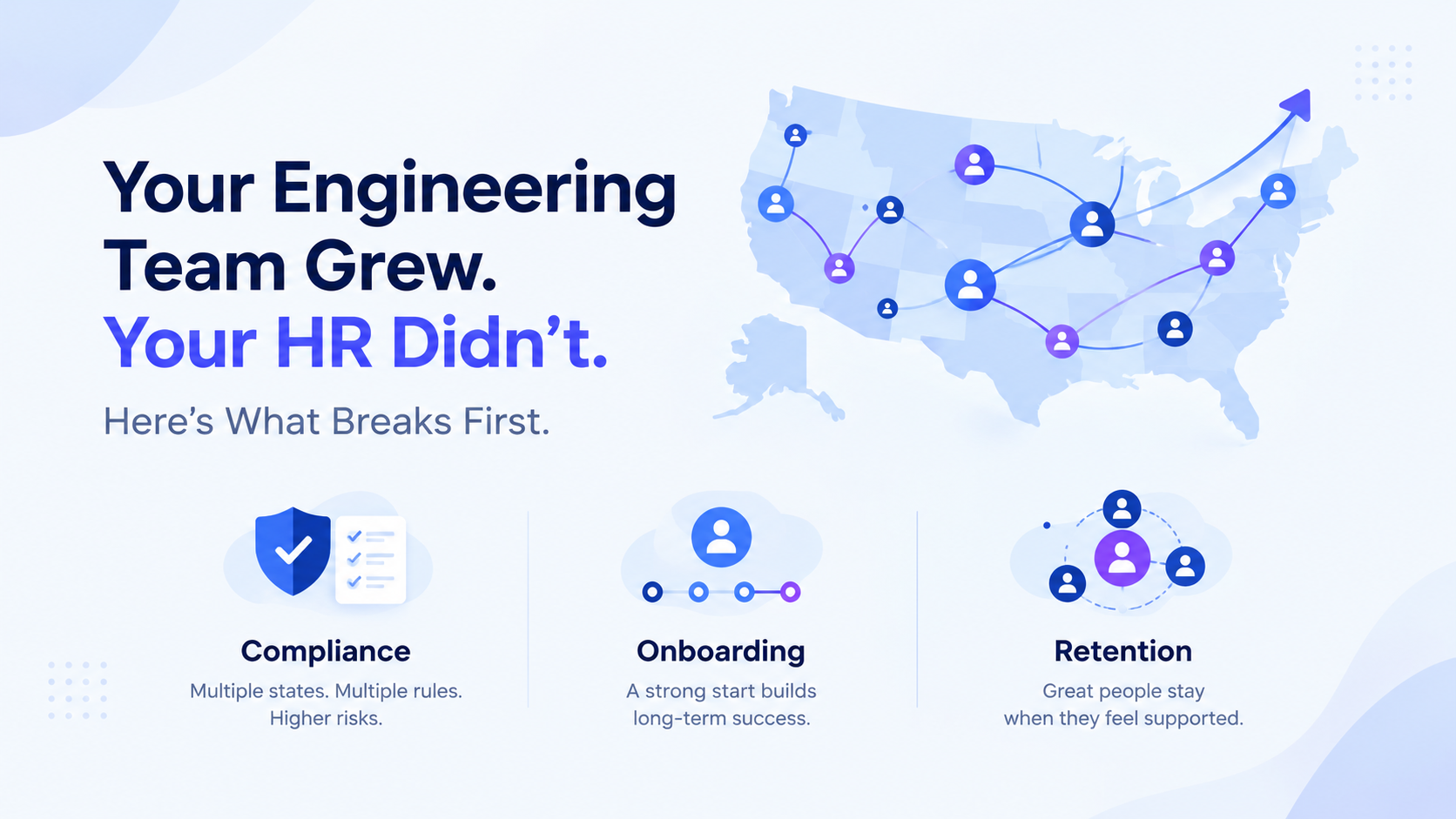
Plenty of technical founders treat HR like a library that misbehaves now and then. You leave it alone until something fails in production. Early on, that’s fine. Five engineers sit in one state, everyone knows everyone, and Slack carries most of the load. Then the company hires quickly, people spread across six states. Every shortcut from the early days needs paying for at once.
The failure points aren’t the ones most founders guess. Nothing explodes. Small, boring problems pile up instead, and each seems harmless alone. By the time someone tallies them, the total is serious.
The first thing to go is compliance you did not know you had
When a business operates within one state, it generally follows a single set of state employment laws. Add a senior engineer in California, a designer in New York and a support lead in Texas, and three sets apply. Every state requires its own payroll tax registration. Final paychecks, overtime and paid sick leave follow different rules in each, and so do the notices you must post. Where the employee lives decides which laws apply, regardless of where your company is based. Payroll software will process a paycheck in a state you never registered with and say nothing about it.
Worker classification is the biggest quiet risk. Growing businesses often hire independent contractors to save time. The aim is to avoid the administrative work involved in employing staff across state lines and keep their payroll headcount manageable. Often it isn’t. If someone works full time, uses your tools and takes direction from your managers, they look like an employee, and labeling them a contractor can leave you owing back taxes and back wages. The IRS and Department of Labor scrutinise how businesses classify workers. Some states also enforce tougher classification standards than federal law. It is the kind of problem that stays invisible until it is a bill, usually a large one that arrives with penalties and interest attached.
Doing this properly isn’t difficult. It gets missed because no one is responsible for it and everyone figures the payroll vendor has it handled. The vendor runs payroll, and that’s the extent of it. The tool will not register your business in additional states, monitor state-specific leave requirements, or flag when a long-term contractor’s working arrangement may meet the legal criteria for employee status.
The second thing to go is onboarding
In a remote company, a new engineer learns what the place is like entirely from how you bring them in. There’s no office to hide the gaps. In person, a rough first week gets rescued by a coworker who notices and helps. Over video and chat, nobody notices. A laptop that arrives late, accounts that don’t work and a blank calendar for the first two weeks all register with the new hire, and they start forming opinions about how the company runs.
The remedy is simple, but it needs to happen ahead of the start date. Logins and permissions should work on the first morning. Behind the scenes, the paperwork basics need handling: the I-9, correct classification and state setup. Spell out what you expect at 30, 60 and 90 days, and have a real conversation at each point. Remote teams can’t treat this as optional. Those first ninety days decide whether a costly hire turns productive or spends the time doubting the decision to join.
Why technical teams feel this harder
Engineering talent costs a lot to find and a lot to lose. Say you spend two months filling a senior role and the person leaves in their first quarter because the start felt disorganized. You lose the ramp-up cost, and you also restart the search in a market that was already tough. The role has now turned over once, and the team watched someone walk out. Weak HR turns your hardest hires into your most repeated ones, and repeated senior searches are among the costliest things a growing company can do to itself.
There is a compounding effect in the other direction too. Companies with effective
onboarding and compliance processes retain employees. Over time, these employees can recommend qualified candidates and strengthen the company’s reputation, making future senior-level recruitment easier. It is the same talent pipeline either way. The difference is whether it leaks at the point where most firms lose people. It is the first ninety days, not the interview. Most founders obsess over the top of that funnel, the sourcing and the interviewing, and under-invest in the part that actually decides whether the hire sticks.
What growing tech companies actually need
They don’t need a full HR department. A software company of ten or forty people can’t justify one. Hiring a junior HR employee alone may not be enough. They may lack the experience to manage compliance across multiple states, develop benefits plans, or handle complex decisions involving dismissals and employee complaints. Assigning these responsibilities to someone at an early career stage can also expose the business to legal risks.
What fits that gap is senior expertise available for the questions that carry real risk, without the cost of a full-time executive. That is the model behind fractional HR for remote teams: someone who has done this before, handling the compliance, building the onboarding systems, and taking the hard calls, scaled based on the company’s actual needs, without committing to a full-time salary before the workload justifies it. For a distributed team especially, an HR partner who already works remotely fits the way the rest of the company runs.
The point is not that HR is exciting. Neglecting these responsibilities becomes more costly as the business grows, making early planning essential for sustainable expansion. Get the compliance right before the next state, get onboarding right before the next hire, and the team you worked so hard to build actually holds together instead of quietly coming apart at the seams you could not see.
FAQs
1. What happens when an engineering team grows without proper HR support?
Rapid growth can create payroll compliance issues, inconsistent onboarding, worker misclassification risks, and employee retention problems. These issues become harder and more expensive to fix as the team expands.
2. Why is HR compliance important for remote engineering teams?
Remote employees may be subject to employment laws in their own states. Businesses need to manage applicable payroll registrations, wage requirements, paid leave policies, and worker classification rules.
3. What are the most common remote employee onboarding mistakes?
Common mistakes include delayed equipment, missing account access, incomplete employment paperwork, unclear performance expectations, and a lack of structured check-ins during the first 90 days.
4. How does poor onboarding affect employee retention?
Poor onboarding can leave new hires feeling unsupported and uncertain about their roles. A structured onboarding process helps employees understand expectations, build relationships, and become productive sooner.
5. What is fractional HR for technology companies?
Fractional HR provides access to experienced HR professionals on a part-time or flexible basis. It helps growing companies manage compliance, onboarding, employee relations, and HR processes without immediately hiring a full-time HR executive.
6. When should a technology company hire HR support?
A company should consider professional HR support when it begins hiring across multiple states, experiences rapid headcount growth, faces complex employee issues, or lacks the internal expertise to manage compliance effectively.
7. Can payroll software manage all multi-state HR compliance requirements?
No. Payroll software can automate payroll calculations and support tax administration, but businesses may still need to handle state registrations, employment policies, classification decisions, and other legal obligations separately.

Comments are closed