
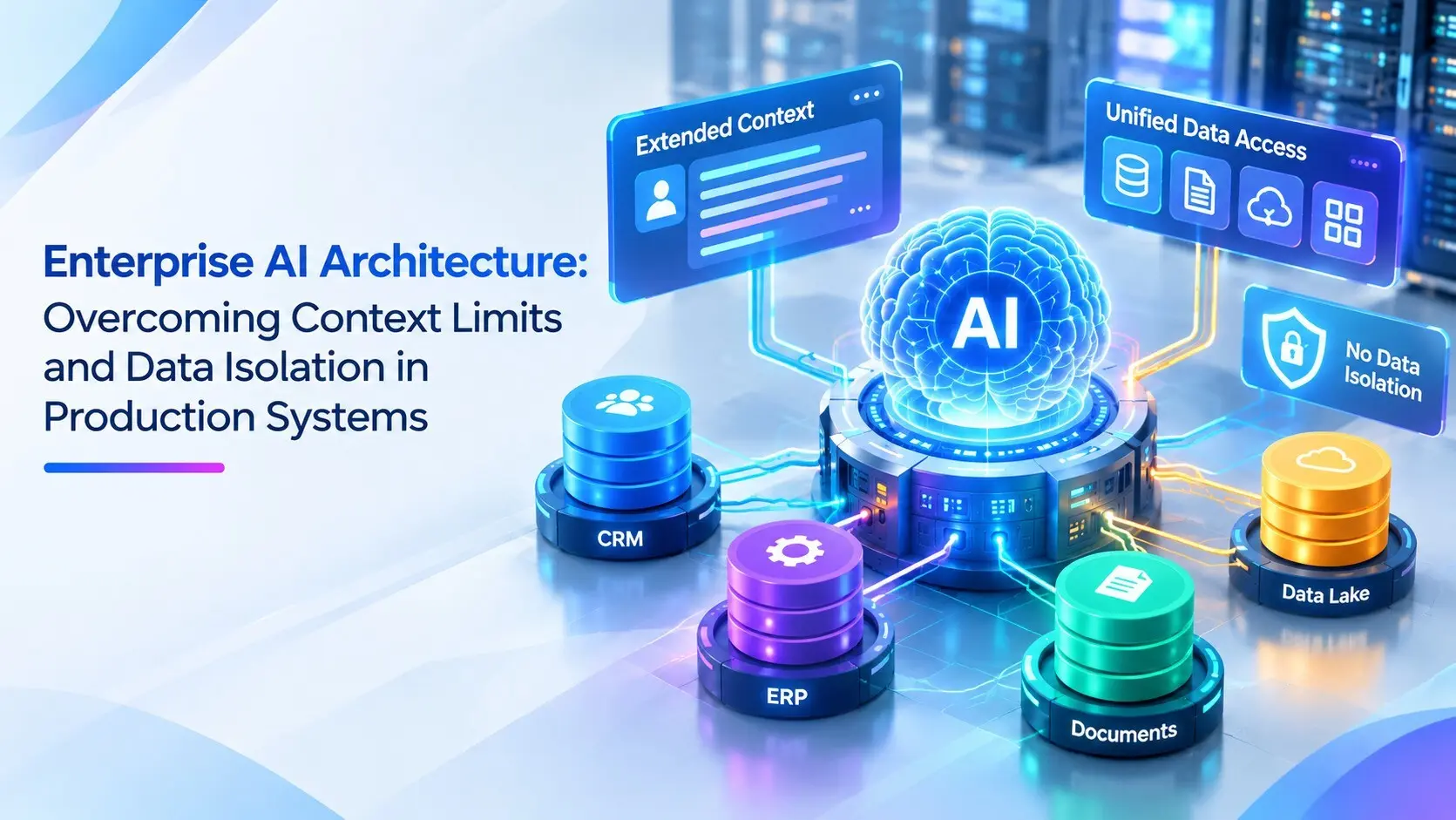
Integration of generative AI within the enterprise has moved from an auxiliary approach to a mainstream operational one. Whereas the initial concept proofs validated the abilities of large language models in drafting text and summarizing documents, the engineering teams now encounter considerable challenges while integrating these models into critical enterprise processes. The production environment requires stringent guarantees in terms of accuracy, governance, availability of information in real time, and security controls, which are not inherent to foundation models.
Foundation models such as GPT-4o, Claude 3.5 Sonnet, or Llama 3 are inherently static systems since they have boundaries in terms of their training cutoff and context window size. In enterprise environments, where there are constant updates in policies, products, and regulations, the unaided models can provide obsolete and speculative outputs. The issues can be resolved by having strong orchestration pipelines that can provide the necessary context to the language models.
Eliminating Model Hallucinations Through Dynamic Grounding Protocols
Responses of large language models are generated probabilistically, meaning that text is created on the basis of the structure learned during pre-training in token-by-token form. In enterprise applications like underwriting of commercial insurance policies, analysis of the results of clinical trials, or conducting audits for compliance, the fact that models work probabilistically is a structural weakness. Models are unable to use the proprietary sources of truth within organizations, resulting in extrapolations and minor inaccuracies.
Direct access of large language models to corporate infrastructure calls for a process that helps in integrating static parameters with dynamic information. Modern system design relies on Retrieval augmented generation architectures to dynamically fetch precise reference material before an inference call is completed. In other words, there is a step when unstructured data, such as policies, architecture documents, and service tickets, is turned into vectors with the help of the vector engine like Qdrant and Milvus, providing real-time semantic searches. The search step gives the model text pieces that will go into the context window and ensure that all the responses will be based on organizational data.
The more advanced systems surpass the older semantic vector matching technique by utilizing hybrid searching. The dense vector retrieval, along with the sparse keyword search, like BM25, ensures that abstract queries and technical keywords (e.g., component codes, error messages, and customer ID numbers) are matched. Adding the neural reranking model such as Cohere Rerank or BGE-Reranker enhances the selected texts before offering them for prompt context usage.
Data Pipeline Engineering: Chunking, Indexing, and Synchronization
The accuracy of the language model’s output is dependent on the extent to which the ingestion and chunking of the data are done. Chunking techniques that rely on breaking down documents in terms of number of characters are likely to split sentences in half or separate tables from their headers. Data pipelines for organizations have to use semantic chunking methodologies that account for hierarchy within the document, maintaining associations between headers, bullet points, and data.
Metadata enrichment beyond chunking is essential in optimizing the queries. Marking up the ingested chunks with information like time of creation, document version, department, and security status helps filter metadata at run-time to avoid outdated documentation interfering with the outputs and saving on the computational cost.
- Chunking of Semantic Boundaries: Text segmentation is done according to the semantic boundaries like headings, paragraphs, and code snippets rather than the fixed number of characters for the sake of complete sentences.
- Metadata Embedding Hierarchically: Adding parent headings, document ids, and access metadata to the text chunks for retaining the context in case of extraction of the text only.
- Delta Synchronization in Automatic Mode: Using event-driven pipeline for automatic reindexing of modified documents using platforms like Apache Kafka or AWS Lambda without requiring indexing of the entire knowledge base.
- Parsing of Multi-Modal Documents: Layout information is extracted from the complex PDF documents through document layout models.
Enforcing Security Controls and Role-Based Access at the Retrieval Layer
Deploying generative systems at an organizational enterprise scale poses huge data governance risks if internal permissions are not taken into account. For an enterprise knowledge engine storing human resources documentation, executive strategic roadmaps, and engineering codebase, any confidential information must never be returned to users who are not authorized to see it. Filtering the confidential data by means of prompt engineering is fundamentally flawed as the language model may be circumvented with prompt injection attacks and non-standard query phrases.
In production, permission filtering happens right in the retrieval layer before the vector search is executed. Based on metadata, using the tokens for authentication provided by either OAuth 2.0 or SAML, the system then filters out the set to retrieve only those documents that are available to the requesting user as candidates for search. The above separation technique ensures that no private information is sent to the prompt space of the language model.
Transitioning from Static Retrieval to Autonomous Agentic Workflows
The enterprise architecture of modern times is moving away from basic ask and answer type of systems to more sophisticated architectures of autonomous agents. Agentic system makes use of the language model as the decision engine that can assess the task at hand, select the tool, make API calls and perform iterative searches. Instead of accepting the first reply generated through the search query, the agent has the ability to check whether the gathered context is sufficient, make additional queries, or seek human intervention.
| Architectural Dimension | Passive Retrieval Engines | Autonomous Agentic Frameworks |
|---|---|---|
| Execution Pattern | Single-pass query and generation | Multi-turn reasoning loop with iterative tool execution |
| Operational Scope | Information lookup and document summary | Task execution across fragmented enterprise tools |
| Search Capability | Static single-query vector lookup | Dynamic multi-step search query decomposition |
| Human Interaction | Passive response delivery to user | Active human-in-the-loop validation for critical decisions |
Maintaining System Performance and Governance Across the Application Lifecycle
In order for enterprise AI apps to operate successfully, there needs to be ongoing evaluation and MLOps discipline. The retrieval ability and the generation ability usually start to diverge because of data growth and changing patterns of queries in organizations. Engineering teams of enterprises use automated evaluation frameworks—Ragas or TruLens frameworks, for example—to check such important metrics as context relevancy, faithfulness, and answer correctness. This disciplined approach guarantees no performance degradation during upgrades and changes in knowledge bases.
The implementation of operational observability by using tracing tools such as LangSmith, Arize Phoenix, and OpenTelemetry helps in finding latency problems, analyzing vector index performance, and managing token usage costs. It is possible to develop AI systems that deliver scalable automation without compromising on high security through structured data ingestion, security-aware vector search, and MLOps monitoring by businesses.
Frequently Asked Questions
What is an enterprise AI architecture framework?
An enterprise AI architecture framework connects AI models, business data, and applications. It helps companies build secure, reliable AI systems that work smoothly across different departments.
What does an enterprise AI architecture diagram show?
An enterprise AI architecture diagram shows how data moves between business systems, databases, and AI models. It explains how different components work together to deliver accurate and secure results.
What are the common AI architecture patterns?
Common AI architecture patterns include RAG, agentic AI, microservices, and event-driven systems. Each helps businesses manage data, automate tasks, and build scalable AI applications.
What role does an LLM play in RAG implementation?
An LLM uses information retrieved from trusted sources to generate relevant answers. RAG helps the model access updated business data and reduces the chances of incorrect responses.
How does enterprise AI architecture handle context limits?
Enterprise AI architecture uses techniques like document chunking, semantic search, and RAG to find relevant information. This helps AI models process large amounts of business data without exceeding their context limits.

Comments are closed