
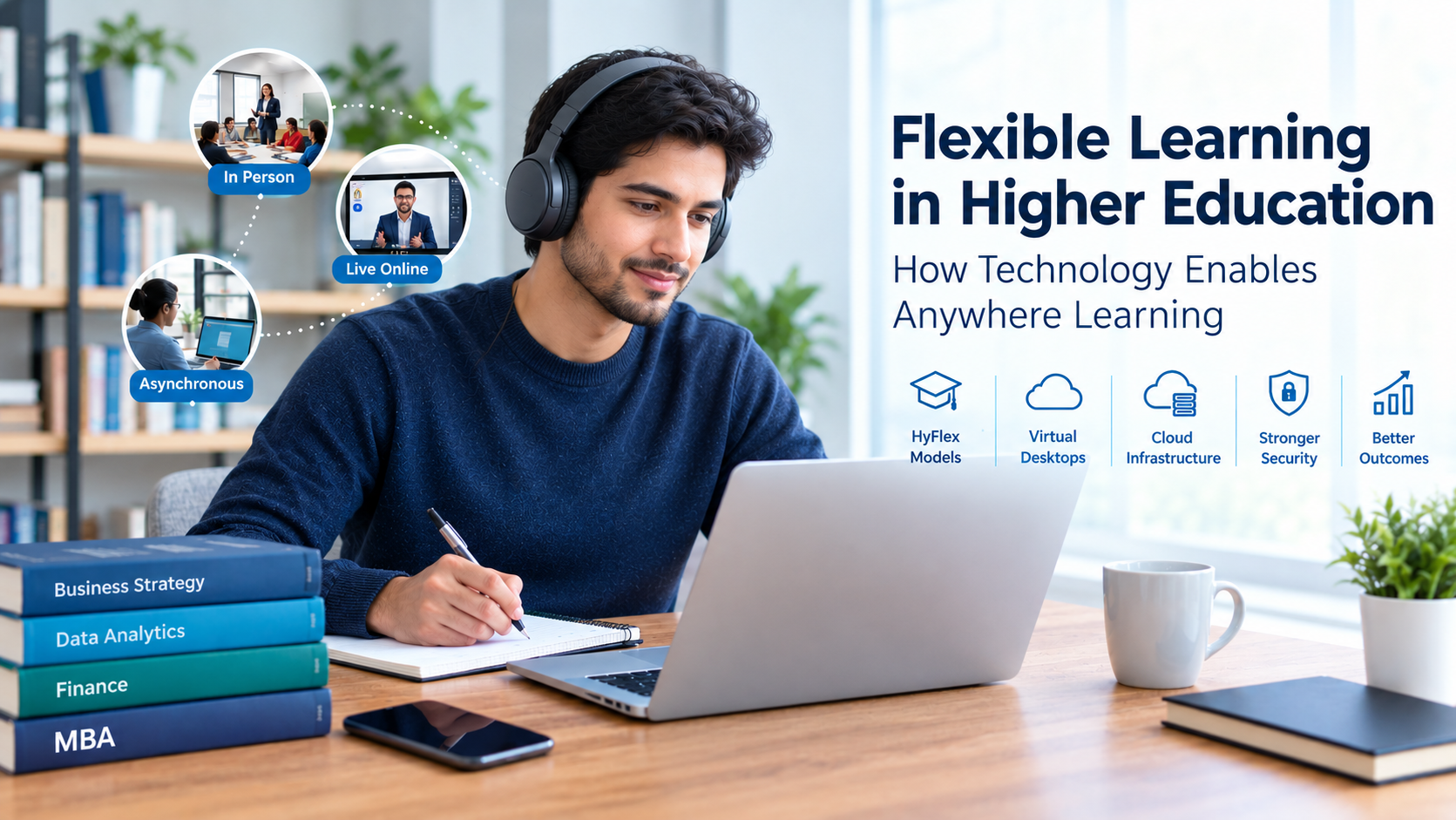
Higher education is shifting fast to meet the demands of busy learners. Working professionals and MBA candidates need degree programs that adapt to unpredictable work shifts, family commitments, and geographic distance. Flexible learning options allow students to control when and where they complete coursework without sacrificing quality. This structural shift helps universities reach broader student demographics and empowers learners to manage their schedules effectively.
It gives students peace of mind when balancing demanding career requirements alongside academic deadlines. Removing rigid campus presence demands helps working professionals remain enrolled and perform better.
Modern HyFlex Models in Business Education
HyFlex course designs give students freedom over their daily attendance methods. A recent industry report observed that the HyFlex teaching model provides students with the option to attend a class in person, attend live through a video conferencing platform, or engage with a webinar or transcript later.
Busy graduate students benefit immensely from this multi-track participation strategy. They can switch between live online discussions and recorded content based on weekly workload changes. This freedom helps students maintain momentum during intense work projects or business travel.
Having direct control over attendance modes improves student engagement in complex courses. Business schools report higher course satisfaction when students adapt their participation week by week.
Bridging Tech Gaps with Virtual Infrastructure
University IT departments must deliver specialized academic software to students off campus. Traditional computer labs require physical attendance, creating unnecessary bottlenecks for remote MBA students. Modern universities solve this issue by modernizing their campus network architecture.
Students need fast access to heavy analytical software from their personal laptops at home. Adopting desktop virtualization in cloud computing allows campus IT departments to separate software environments from physical hardware efficiently. Remote learners gain instant access to digital workstations without buying expensive computers.
This setup maintains uniform software performance across different student devices. IT administrators, increasingly supported by AI agent development for automated monitoring, push updates across all user profiles simultaneously without needing physical device access. This approach keeps software secure and current without extra hassle.
Remote virtualization lowers hardware requirements for students joining from distant locations. Students log into powerful business analytics environments using standard web browsers.
Expanding Advanced Analytics Beyond Campus Hardware
Specialized coursework in finance and data analytics requires heavy processing power. A Higher Ed publication explained that virtualization in higher education refers to separating software from physical hardware so applications or desktops can be accessed remotely.
High-performance computing tools no longer require physical visits to university computer labs. Cloud lab experts noted that by adopting cloud-based virtual desktops with GPU capabilities, institutions expand advanced learning without the traditional limits of campus hardware.
Students executing complex data simulations benefit directly from offloading heavy processing tasks to remote servers. Business schools run enterprise level software suites without forcing students to upgrade personal hardware.
Financial Efficiency and Cost Reductions for Institutions
Running traditional IT labs creates heavy financial overhead for colleges. Shifting to virtualized desktop services helps schools optimize operational spending.
- One technical case study showed Sask Polytech reduced 70% of endpoint costs and saved $1 million through virtual desktop adoption.
- Universities extend hardware replacement lifecycles by running applications in virtual environments.
- Campus administrative staff cut down on manual software installation times across physical lab computers.
Lower campus costs allow universities to invest funds back into academic resources and student support services. Managing campus technology budgets becomes far more predictable over multi-year cycles.
Boosting Student Retention and Learning Outcomes
Learning platforms hosted on scalable remote infrastructure support millions of students daily. Market statistics showed that in 2024 alone, over 190 million students accessed learning management systems hosted on cloud platforms.
Academic performance improves when digital tools integrate smoothly into coursework. An educational research study found that virtualisation improves learning effectiveness and scalability when pedagogically integrated.
Higher retention rates correlate strongly with software accessibility and seamless digital interfaces. Students complete assignments on time when technical barriers fall away. Flexible access keeps adult learners motivated throughout challenging graduate programs.
Protecting Digital Assets and Student Data
Expanding remote access opens new cybersecurity considerations for higher education IT departments. Protecting online portals against cyber threats like ransomware protects student records and institutional privacy.
Strong security practices maintain confidence among distance learners and faculty members alike. Higher education technology analysts highlighted that institutions that can keep pace with threat vectors by protecting digital assets will increase and preserve the community’s trust.
Centralized data management simplifies compliance with educational privacy mandates. Information security teams monitor access logs from one dashboard rather than securing hundreds of separate lab endpoints. Secure cloud environments minimize data leaks from lost personal laptops.
Flexible learning frameworks give students the freedom to balance higher education with professional careers. Remote access technology creates equal learning opportunities regardless of physical location. As academic programs adopt modular formats and cloud tools, degree completion becomes far more accessible. Universities that embrace flexible learning prepare their students for modern, digital workplace environments.
FAQs
What is the HyFlex learning model?
HyFlex is a teaching approach that gives students three ways to attend class in person, live through videoconferencing, or later through recorded content/webinars. This increases flexibility for MBA students and working professionals.
How does desktop virtualization benefit students?
Desktop virtualization separates software from physical hardware, allowing students to access powerful analytics tools and business software from their personal laptop or a standard browser without buying expensive computers.
Are remote/virtual learning setups secure?
Yes, universities use centralized data management and monitoring dashboards to track access logs in one place. This approach is more effective than securing hundreds of separate lab endpoints individually and also reduces the risk of data leaks from lost devices.
What financial benefits do cloud-based virtual desktops offer institutions?
Virtual desktop adoption significantly lowers endpoint hardware costs for schools, extends hardware replacement cycles, and reduces manual software installation time. For example, Sask Polytech cut 70% of endpoint costs and saved $1 million.
What impact does flexible learning have on student retention?
When technical barriers are removed and digital tools integrate smoothly into coursework, students complete assignments on time, engagement improves, and adult/working learners stay motivated throughout graduate programs.

Comments are closed