
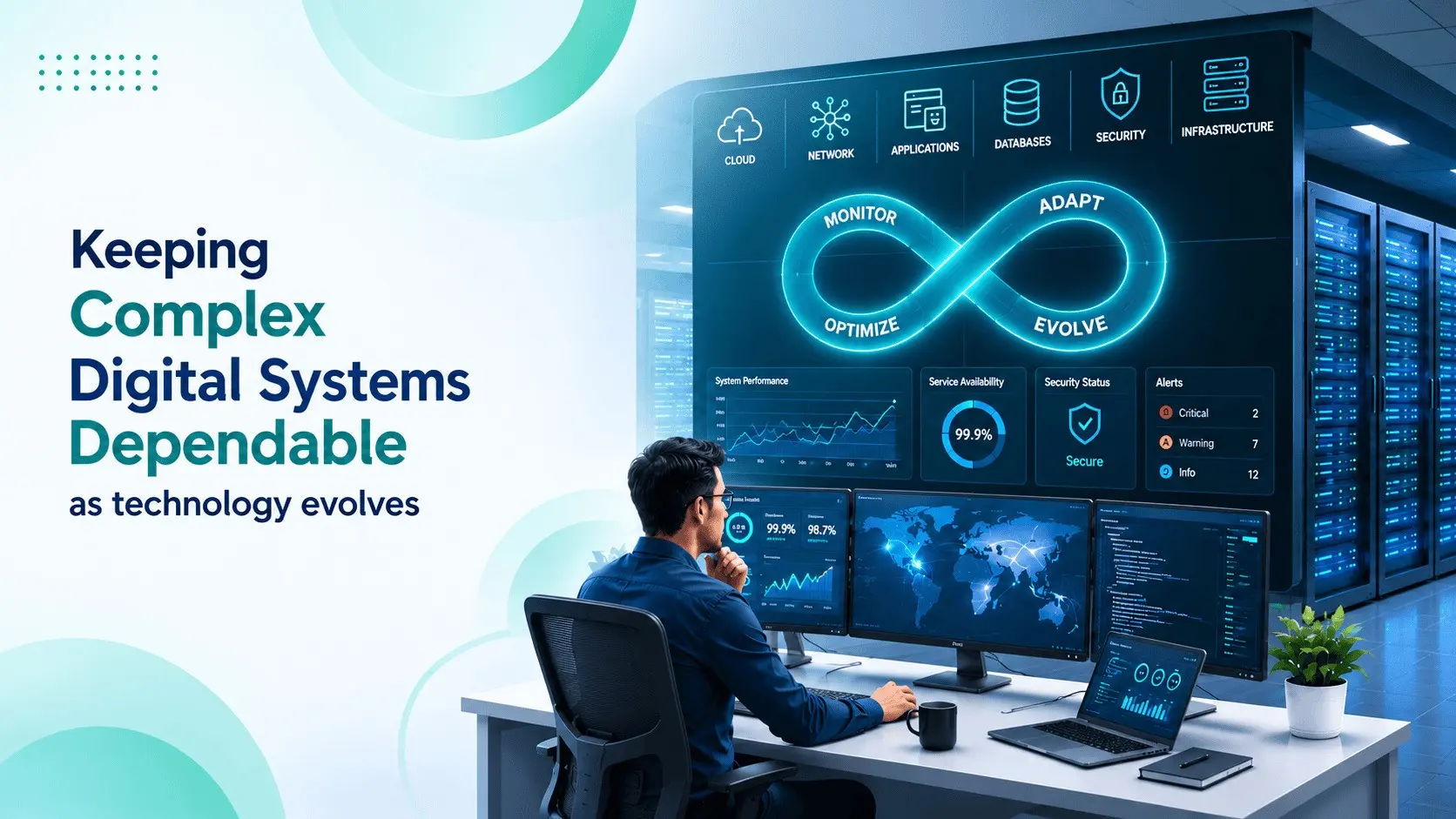
Reliable digital infrastructure requires continuous monitoring, proactive maintenance, and effective strategies for managing increasingly complex technology environments.
Digital systems are now absolutely fundamental to the way modern organizations operate. Whether it’s the customer-facing apps and online services, the internal databases, or the cloud infrastructure, the whole of the organization is built around digital systems.
As those systems become more complex, the challenge of maintaining their reliability becomes ever greater. The pressure on them is increasing all the time with new tools, new user expectations, security issues, and increased workloads.
Keeping complex digital systems reliable requires much more than just fixing the issues when they arise. It’s about building reliable foundations, monitoring performance, having plans in place for the unexpected, and then regularly reviewing how the various parts of the system work together.
An organization that takes a proactive approach can adapt to change without necessarily having to make stability an afterthought.
Why Is System Reliability Crucial?
Even a fairly short service outage can have a massive impact on a business. Customers can’t do their buying, staff can’t get to their applications, and the various automated processes will all have stopped.
In any industry where digital services are supporting the operation of the business, a disruption can have a real impact on productivity, on revenue and on customer confidence. The issue is that modern systems don’t tend to operate as stand-alone applications.
A single service may be dependent on a number of databases, external APIs, cloud platforms, and networking components. If one of those dependencies goes down or performs poorly, the impact can ripple out across the wider environment.
This interwoven architecture makes reliability far more difficult to maintain. A small problem in one area can easily manifest as an unforeseen failure somewhere else, especially when you’re dealing with large volumes of data and users distributed across the globe.
Organizations therefore need to understand not only whether individual components are working, but also how the whole system acts when everything functions normally.
Dealing With Complexity
Technology moves on so fast that organizations will often introduce new platforms and services in the hope of increasing their efficiency. Containerization, microservices, automation, and cloud-native tools can all make a digital environment far more flexible, but they also add a whole bunch of new things that you then have to configure, monitor, and maintain.
An increasing number of services can create a real communication problem between Dev and Ops. The various services will have different deployment windows, different dependencies, and different performance requirements. Without proper documentation and good processes in place, even the most mundane of changes can be a nightmare to get right.
This is where the benefit of experienced technical guidance comes in. An organization looking at the level of support that a site reliability consulting firm can provide may be looking to improve their operational practices, enhance their system observability, and reduce the frequency and/or impact of outages. An external consultant can help to identify weaknesses in the infrastructure and help to establish more consistent reliability engineering practices.
Long-term reliability absolutely shouldn’t be predicated on external support alone. The internal teams need to understand the systems they’re working with, have up-to-date documentation, and have the skills to deal with incidents.
External consultancy is most effective when it enables the organization to build capabilities that are of value after the project in question has concluded.
The Importance Of Having Safe Software Updates
Regular software updates are essential for security, performance, and compatibility. The downside, of course, is that every change introduces some level of risk. A new app release could have some unforeseen bugs in it, could change the behavior of things that were previously working, or could have a bad interaction with some other system component.
Organizations can mitigate these risks by adopting controlled deployment practices. Automated testing will pick up issues before any change ever gets to production, and staging environments can be used to test changes under conditions that are as close as possible to real-world usage.
Gradual deployment strategies can provide another level of protection. Rather than releasing a change to all users at once, you can release it to a small subset, watch it for a while, and then progressively release it if it performs well.
If problems do arise, then you can roll back. Clear communication is just as important. Dev, Ops, Security, and Business need to be aware of when major changes are going to happen and how those changes will impact the users and any services that are dependent upon them.
In order to keep complex digital systems reliable as technology progresses, you need to be constantly looking at the architecture, the monitoring, the security, the incident response, and the operational stuff.
The more interconnected your infrastructure becomes, the more you have to look beyond the individual application and understand how the whole environment behaves under different circumstances.
FAQs:
Why does fleet branding matter for home service businesses?
Consistent fleet branding turns every service van into a moving billboard, building local recognition and trust that help home service businesses win more jobs.
How quickly do people notice vehicle graphics on the road?
Viewers can absorb your colors, company name, and trade in under 3 seconds, so bold, simple vehicle graphics work best for other drivers stopped at red lights.
Where should contractors place a logo and phone number on a van?
Place your logo and phone number on flat door panels, away from handles and body molding, so they stay clearly readable at 45 mph and avoid distorted lettering.
How can an established contractor rebrand without losing loyal customers?
Audit your trucks, uniforms, and invoices, refine heritage colors, use bold typography, and roll out new graphics gradually so loyal customers stay comfortable.
Can professional branding help contractors charge higher prices?
Yes. Customers tend to accept higher bids from companies that look organized, so matching trucks, uniforms, and paperwork can support premium service pricing.

Comments are closed