
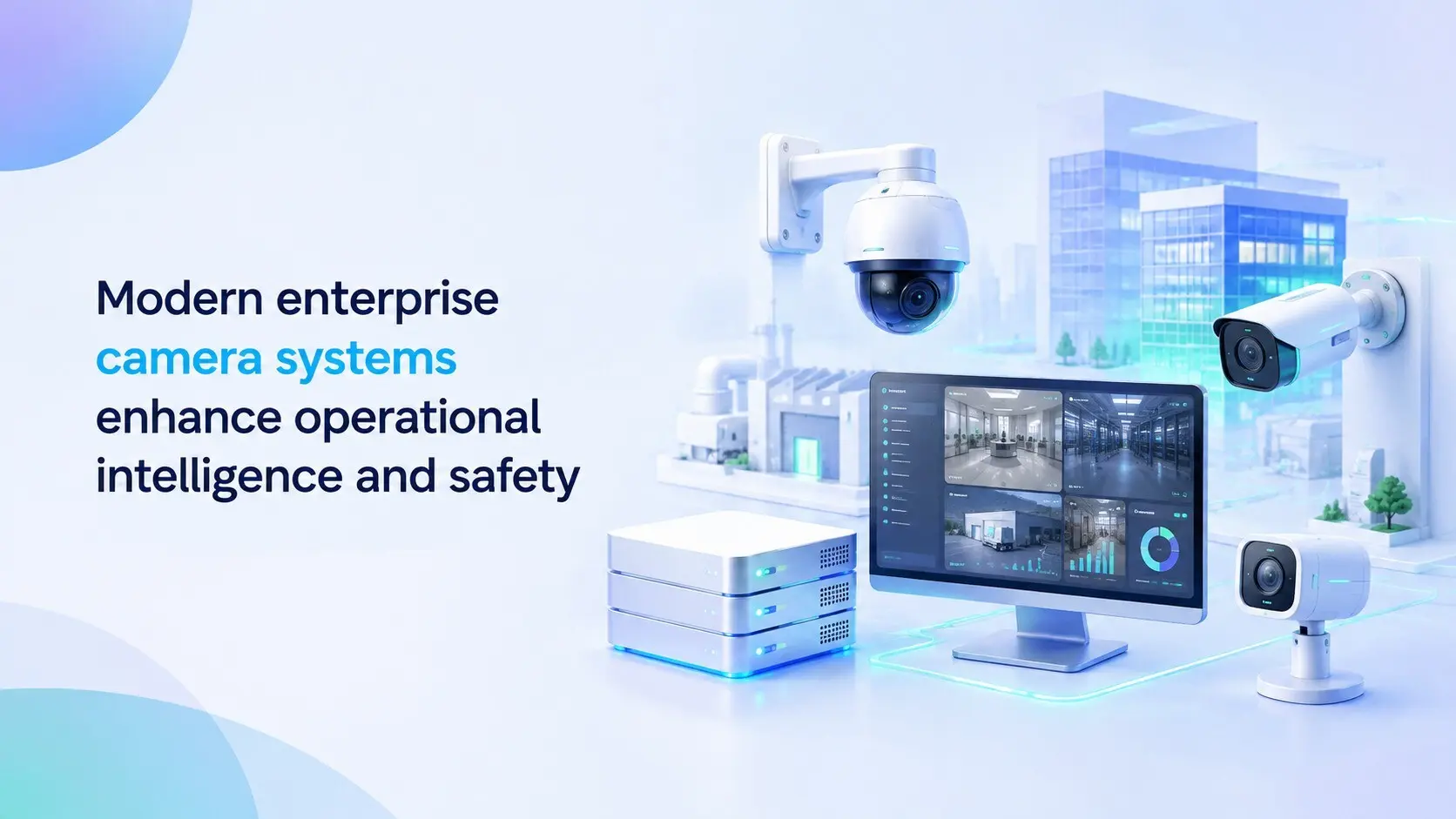
Commercial facilities deploy smart optical monitoring to strengthen site security. These advanced visual systems simultaneously gather actionable intelligence for daily business operations.
You need your facility to operate efficiently with no interruptions or blind spots in security. Running an enterprise site is not a job for conventional loss prevention.
Today the security camera has evolved from being a mere surveillance device to a powerful management tool. Switching from manual record-keeping to operational visibility gives your team hands-free protection for assets and productivity for everyday operations.
Why should long-term facility planning prioritize multi-use visual systems?
Upgrading building infrastructure requires a clear strategy that delivers continuous value across multiple departments. Incorporating modern business video surveillance creates a unified foundation for both safety protocols and operational insights. Facility leadership gains clear visibility into daily movement patterns while maintaining strong perimeter protection.
Long-term planning allows management to eliminate redundant hardware purchases. Standardizing smart optical devices gives operations managers and security officers access to the same high-resolution data streams.
One of the ways to future-proof your site infrastructure is by selecting platforms for monitoring that are scalable. New hardware can be updated with new software without having to be replaced in a few years. As your business grows and you need wider camera coverage, the modular nature of your network will enable your team to install more cameras in new wings of the building or new properties.
How do you integrate smart cameras with access control systems for threat prevention?
Connecting visual monitoring with access control turns reactive guard duty into immediate threat prevention. Automated alerts verify credentials in real time whenever an unauthorized person attempts entry through restricted doorways.
Direct connection of entry logs to live visual feeds minimises response time in case of unauthorized access. According to a new study by the Smart Security Industry Association (SSIA), more than 70 percent of commercial properties currently operate with a single visual surveillance and access control system. This integrated design delivers your security team real-time visual audit and electronic access logs.
Centralized management panels allow staff to cross-reference doorway activity instantly. Video recording sequences are automatically started when a door is left open for longer than programmed. Live footage from mobile devices can be seen to assess the door alarms before sending out physical officers for security teams.
Streamlining site access procedures
Automated visitor management systems reduce manual check-in delays at main reception desks. Smart cameras read license plates or match visitor passes, granting entry while maintaining accurate digital records. Front-desk staff spend less time verifying IDs manually and more time assisting visitors.
Modern door controllers work alongside optical sensors to prevent unauthorized tailgating into sensitive areas. When multiple individuals pass through a single badge scan, optical analytics send an alert to security operators.
- Verify credentials automatically: Match electronic badge scans with real-time video frames to confirm identity.
- Automate entry gates: Recognize approved delivery vehicles using optical license plate recognition technology.
- Flag suspicious attempts: Send instant notifications to administrative staff when invalid credentials trigger alarms.
- Maintain audit logs: Store visual records alongside electronic card access events for streamlined security reviews.
What can visual analytics do for customer flow and queue management?
Gathering spatial data from customer traffic helps managers balance staffing levels with visitor demand. Visual sensors track heat maps and movement paths across retail floors, service counters, and waiting areas. Operational leaders use this continuous stream of spatial data to refine interior layouts and maximize service efficiency.
Monitoring line lengths in real time prevents long wait times from driving customers away. Smart software measures queue depth and calculates average wait times automatically across high-volume checkout areas. Store managers receive early warnings before checkout lines reach critical lengths.
Operational teams are automatically alerted when queues are over pre-set thresholds. Direct notifications alert supervisors to open new registers or for staff to shift from lower priority backroom activities. Labor is staffed as needed and/or reduced quickly, without increasing the total cost.
Optimizing layout and floor space efficiency
Spatial analytics reveal unused space and congested high-volume areas in your business environment. The spatial awareness contributes to making decisions on the layout of merchandise displays or moving customer service desks. Removing walkways with high traffic makes for a more pleasant experience for visitors.
Long-term trends are used to make more strategic decisions about where to store items in the inventory and how to set up displays for the season. Visual heat maps provide an accurate picture of visitor activity and where foot traffic overpasses popular exhibits.
Monitor the flow of people: Identify areas where people are walking a lot, to maximize the placement of products and floor planning.
Track wait times: Integrate line threshold alerts to staff support when there is a sudden rush of customers.
Analyse dwell time: Compare engagement time on key service areas or promotional displays.
Balance labor schedules: Schedule labor to match peak traffic for operations.
How do you meet compliance standards and NDAA security regulations?
Regulatory compliance forms the backbone of enterprise facility risk management. Federal directives and official security frameworks require physical access protections to integrate smoothly with IT policies. Standards published by the National Institute of Standards and Technology mandate that commercial facilities unify physical and environmental protection controls directly with access control policies.
To meet the National Defense Authorization Act (NDAA) guidelines, audit-ready sourcing of all security assets is required. Commercial facilities need to pick the cameras and processing chips from trusted vendors to ensure that their corporate networks are not compromized by vulnerabilities in the supply chain. Contracting with verified vendors keeps your infrastructure compliant with federal procurement rules.
Network video recorders need to be protected from cyber attacks through encrypted data transport and multiple authentication factors. The IT security groups keep the surveillance video network separate from public Wi-Fi hotspots to prevent attackers from trying to infiltrate the network. Firmware updates close any system vulnerabilities before they are exploited by an outside threat to access the footage.
Safeguarding data privacy and regulatory alignment
It is imperative to have automated masking in public monitoring areas if privacy of visitors is to be maintained. High-tech software makes faces indistinct in non-sensitive zones and provides clear images in limited areas of security archives. Privacy protection provides a sense of security to the occupants of the building, meets statutory compliance requirements and specifications.
Define retention policies to ensure storage is kept to a minimum and still compliant with industry auditing requirements. Automated deletion schedules ensure your facility is compliant with the regulations and minimize costly cloud server overhead.
Documentation of compliance procedures will help safeguard your organization during formal safety audits. Periodic evaluations of your systems demonstrate that your current security policies for hardware, software and physical access are current with security standards.
Multi-purpose visual monitoring enhances physical protection and provides important daily operation information. Smart video and spatial analytics provide you a full picture of what’s happening on any site in your enterprise with streamlined management.
Aligning these visual platforms with strict compliance standards keeps your facility secure against physical and digital risks. Any level of site surveillance upgrade will convert your security hardware into a dependable motor for lasting operation.
FAQs:
What are the benefits of multi-use visual systems in facilities?
Multi-use visual systems unite physical safety with operational insights, eliminating extra hardware costs while providing scalable, long-term facility coverage.
How do smart cameras integrate with access control systems?
Smart cameras sync entry logs with live footage in real time, automatically triggering video recordings and alerts when unauthorized access attempts occur.
How does visual analytics improve customer queue management?
Visual sensors measure line depth automatically, sending real-time alerts to managers to open extra registers and balance labor during high-volume periods.
What is required for security camera NDAA compliance?
NDAA compliance requires sourcing camera hardware and chips from verified vendors to prevent supply chain risks and protect corporate network data security.
How do modern surveillance cameras protect visitor privacy?
Smart cameras use automated video masking to blur faces in non-sensitive public zones, while automated deletion schedules manage privacy compliance.

Comments are closed