
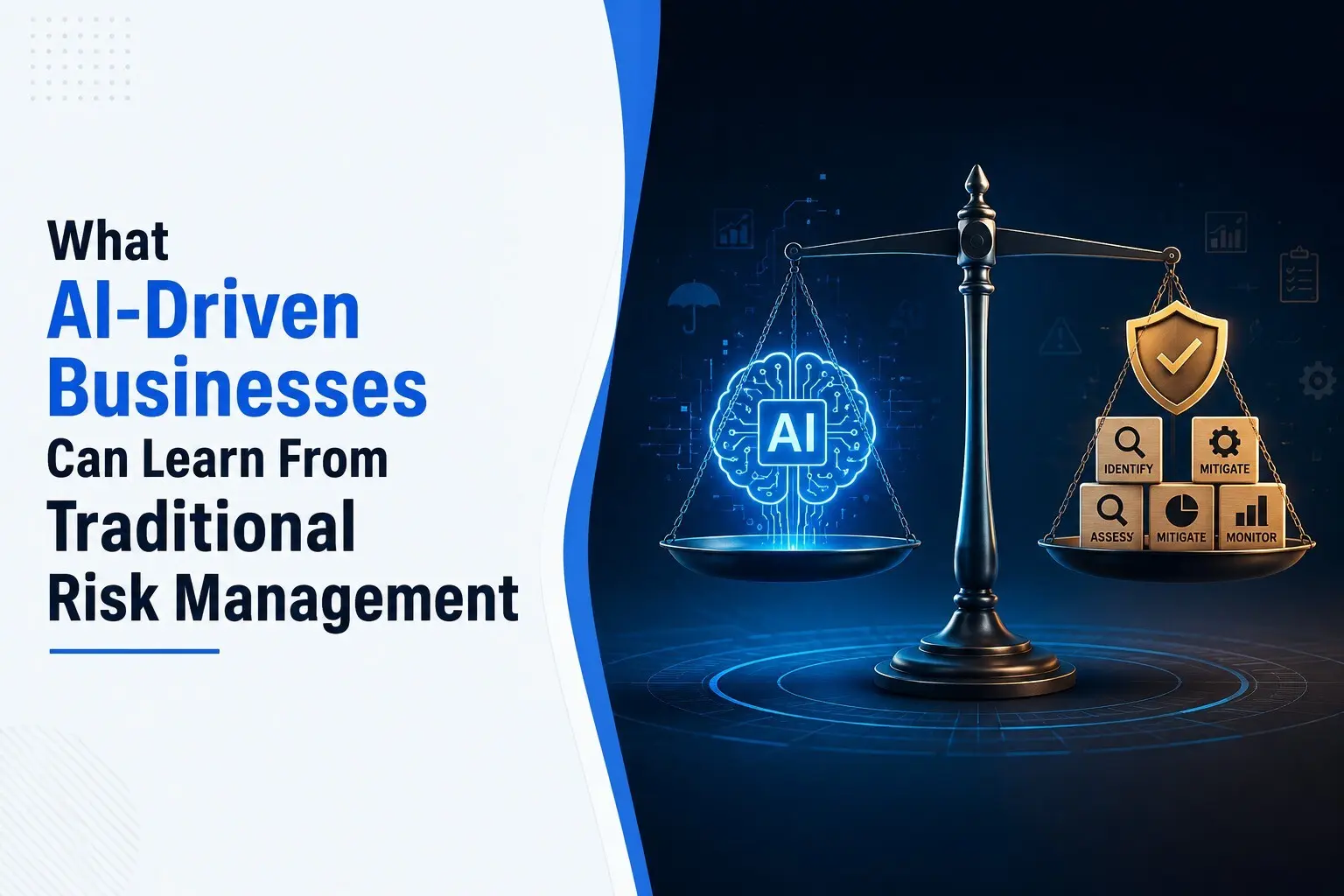
AI-driven companies often dismiss established risk functions as legacy overhead, only to discover that model failures resemble risks the discipline has named for decades. The technology is different, but questions about accountability, acceptable exposure, control failure, and escalation remain stubbornly familiar.
Traditional risk management gave organisations a shared vocabulary, assigned ownership, and made boards accountable for material exposure. Many AI teams began without those foundations because experimentation moved faster than governance, and early systems appeared limited in scope.
That gap matters as models move into pricing, approvals, customer support, and other operational decisions. The real question isn’t whether an old framework should govern new technology unchanged. It’s which parts can survive weekly releases, shifting data, and systems that alter their behaviour without a conventional software update.
What Traditional Risk Management Was Built to Do
The traditional discipline developed around relatively stable operations, insurable hazards, and annual audit cycles. Fires, equipment failures, credit defaults, and workplace incidents could be assigned to departments, evaluated against historical records, and reviewed periodically. Its structure reflected risks that were assumed to be discrete, measurable, and locally owned.
The Core Cycle From Identification to Reporting
The classic model follows a five-stage loop:
- Risk identification: Define an event that could prevent an objective from being achieved.
- Risk assessment: Estimate its likelihood and potential impact.
- Risk mitigation strategies: Select controls and assign responsibility.
- Monitoring: Check whether exposure or control performance has changed.
- Reporting: Escalate material findings to management or the board.
The four standard responses are to avoid, reduce, transfer, or accept risk. Each response depends on risk appetite: the level of exposure an organisation will tolerate in pursuit of an objective.
The five C’s come from credit assessment: character, capacity, capital, collateral, and conditions. Although narrower than a complete risk framework, they preserve an important principle. Judgement about incentives, resilience, and circumstances belongs alongside numeric scoring.
Where ERM and IRM Diverge From the Classic Model
Traditional risk management is typically siloed and focused on hazards or insurable losses. Enterprise risk management (ERM) aggregates exposures across departments, examines portfolio effects, and connects risk appetite to strategic decisions. COSO’s ERM guidance accordingly presents ERM as part of strategy and performance, not merely a documentation exercise.
Integrated risk management goes further operationally. ERM reports consolidated exposure upward, while integrated risk management embeds controls, data, and workflows into operational systems and GRC tooling. The distinction is execution: ERM informs decisions across the enterprise, whereas IRM makes risk processes part of everyday work.
Where the Traditional Model Starts to Break Down
Two structural weaknesses become visible in fast-changing businesses. First, backward-looking risk measures often assume the future will resemble the observed past. Second, siloed risk management moves information through assessment and reporting cycles that are slower than the systems being assessed. AI intensifies both problems because its behaviour depends on changing inputs as well as code.
Fat Tails and Correlated Shocks
Variance and standard deviation describe frequent, relatively small movements effectively when outcomes stay near a normal distribution. They’re less reliable when extreme outcomes occur more often than that distribution predicts. Measures presented through services such as Morningstar Risk can support comparison, but they don’t remove the assumptions beneath the calculation.
Benoit Mandelbrot’s work on fat tails challenged the idea that extreme market movements were negligible exceptions. During 2008-2009, losses across supposedly diversified S&P 500 exposures also showed how risks that appear independent during normal periods can become correlated under stress.
When correlated losses hit at once, retail safe-haven demand spikes, and physical inventory moves faster than any quarterly register can record, which is why bullion listings described as Gold Eagles for sale clear quickly in those windows and why investors who shop Gold American Eagles do so in days rather than on a reporting cycle. The broader lesson is that correlation changes at the moment diversification is expected to provide protection.
Annual Reviews Against Weekly Deployments
A quarterly self-assessment can’t represent a model that is redeployed every week. By the time teams update a spreadsheet, validate entries, and circulate the report, the underlying data, prompts, dependencies, or decision thresholds may already have changed.
This creates a governance delay rather than a paperwork problem. Risk information reaching the board only through scheduled reporting describes the recent past. Continuous monitoring is needed to show whether present behaviour is approaching or crossing an agreed limit.
Mapping AI Risk Onto Familiar Risk Categories
AI doesn’t require organisations to discard strategic, operational, financial, compliance, and technology categories. Instead, risk identification must place emerging risks inside those categories while recognising that their mechanisms and evidence have changed. The categories remain useful because they clarify consequences and ownership.
Model Drift and Automation Dependency
Model drift is operational performance degradation caused by changes in inputs, user behaviour, or the relationship between data and outcomes. No code change is required. An annual control test can therefore pass even while live output is becoming less reliable.
Automation dependency concentrates operational exposure. If one model sits in the path of pricing, approvals, or support, its failure interrupts a business process. Risk governance should treat that failure as a continuity event with a fallback process, not merely an IT ticket.
Cybersecurity risk also extends into the model layer. Prompt injection manipulates instructions, model extraction targets embedded capability, and poisoned inputs corrupt subsequent output. These mechanisms need explicit ownership even if the existing register retains a broader technology-risk category.
Data Provenance and Compliance Exposure
Unverified training data behaves like a supply chain exposure. The organisation relies on an external input whose origin, permissions, or integrity may be unclear. Unlike a defective physical component, learned material can’t simply be recalled from a trained model.
Algorithmic compliance still maps to regulatory risk, but a policy document doesn’t prove that a consequential decision was controlled. Human review and safeguards are the evidence: they show where intervention occurs, who can override output, and how exceptions are recorded.
Practices Worth Carrying Into an AI Operation
The strongest traditional practices create decision rights rather than delay. Organisations can retain these artefacts while changing how often they’re updated and how directly they connect to live systems.
A practical carry-forward model includes:
- Extend the existing taxonomy: Add model drift, data provenance, automation dependency, and model-layer cybersecurity without building a disconnected AI register.
- Write measurable risk appetite: Define the error, hallucination, or automated decision thresholds that trigger human intervention. Vague statements about “low tolerance” can’t govern production output.
- Assign one accountable owner: Give each model to a person with authority to change, suspend, or retire it. A committee can review exposure, but it can’t replace ownership.
- Convert controls into key risk indicators: Monitor live thresholds rather than relying on annual sample testing and periodic attestation.
- Report movement, not colours: Show the board exposure trends, threshold breaches, unresolved exceptions, and dependency concentration instead of a static red-amber-green register.
- Make monitoring continuous: Feed production evidence back into the register so it operates as a live instrument.
Structured AI oversight connects those practices to business objectives and escalation rights. McKinsey or Ernst & Young terminology can inform reporting conventions, but no external template can decide an organisation’s acceptable exposure. That judgement belongs to its leadership and named risk owners.
Borrowing the Discipline Without the Delay
The limitations of traditional risk management are mainly limitations of speed, aggregation, and integration. Its taxonomy, appetite statements, named owners, and board visibility remain valuable because they establish accountability before an incident forces the issue.
AI-driven businesses should preserve the underlying logic of identifying, assessing, mitigating, monitoring, and reporting while replacing periodic review with live evidence. A company that releases models weekly but reviews risk annually hasn’t inherited an unavoidable weakness. It has chosen a governance cadence that doesn’t match its operating model.
FAQs:
What are the five stages of the risk management process?
The five stages are risk identification, assessment, mitigation, monitoring, and reporting. Together they find, measure, control, and escalate risk upward.
What are the four ways to respond to risk?
The four standard responses are avoid, reduce, transfer, or accept risk. Each depends on risk appetite, the level of exposure an organisation will tolerate.
What is model drift in AI?
Model drift is performance decline caused by changes in inputs, user behaviour, or data relationships. No code change is needed, so annual tests can miss it.
Why does traditional risk management struggle with AI?
It relies on backward-looking measures and slow, siloed reporting. AI behaviour shifts with changing data, so quarterly reviews can’t match weekly releases.
How can AI businesses apply traditional risk management?
Extend the existing risk taxonomy, set measurable risk appetite, name one owner per model, and replace periodic reviews with continuous monitoring and KRIs.

Comments are closed