
What is artificial intelligence? Your bank flags a strange charge before you even notice it. Your phone unlocks the moment it sees your face. Neither happens because someone wrote a rule for every case. It happens because of artificial intelligence, or AI.
In simple words, artificial intelligence is software that can do things that usually need a human brain, like understanding language, recognizing a face, or making a call with only part of the picture. Normal software just follows the steps it’s given. AI is different. It’s trained on examples instead. It looks at a large set of past cases, finds patterns, and applies them to something new.
A few ideas sit underneath all of this. Machine learning trains software on past data until it can do a task on its own. Deep learning does the same thing, but at a much bigger scale, stacking layer after layer of calculations so a system can pick a voice out of noise or a face out of a dark photo. Generative AI takes what a model has learned and uses it to make something new, like writing, images, or code.
Key takeaways
- AI learns from examples. It isn’t programmed with a fixed rule for every case.
- Every AI system running today, from face unlock to fraud alerts, is narrow AI. It does one job.
- Machine learning, deep learning, and generative AI aren’t three separate things. They sit inside each other.
- AI agents can plan, decide, act, and adjust on their own. This is the fastest-growing area of AI right now.
- The big risks are bias, privacy, security, wrong answers, and systems nobody can explain. That’s why groups like NIST built a risk framework.
What Is Artificial Intelligence?
At its simplest, AI is the science of building machines that can do things that normally require human intelligence: understanding language, recognizing images, solving problems, and making decisions with incomplete information. The term itself is nearly 70 years old. John McCarthy coined it in a 1955 proposal for what became the 1956 Dartmouth Conference, an event most historians treat as the field’s founding moment, according to Stanford University’s obituary of McCarthy.
How the law defines it
That everyday definition works fine for a conversation. Regulators needed something sharper before they could write rules that hold up, and the two most important attempts don’t agree.
Executive Order 13960 defines an AI system as a machine-based system that, given a set of human-defined objectives, generates outputs like predictions, recommendations, or decisions that affect real or virtual environments wording pulled almost directly from Section 238(g) of the 2019 National Defense Authorization Act. Nothing in there requires the system to act on its own or keep changing after launch. A basic recommendation engine qualifies just as much as a self-driving car does.
Article 3(1) of the EU AI Act sets a narrower bar: a system counts only if it operates with some degree of autonomy and may keep adapting once deployed. That second part is the real split between the two laws. A model that keeps changing its behavior after release is much harder to certify once and walk away from, which is why the EU built its whole risk-tier system around that idea. The European Commission’s summary of the regulatory framework covers those tiers, plus which uses are banned outright and which face binding rules as “high-risk.”
AI vs. Machine Learning vs. Deep Learning
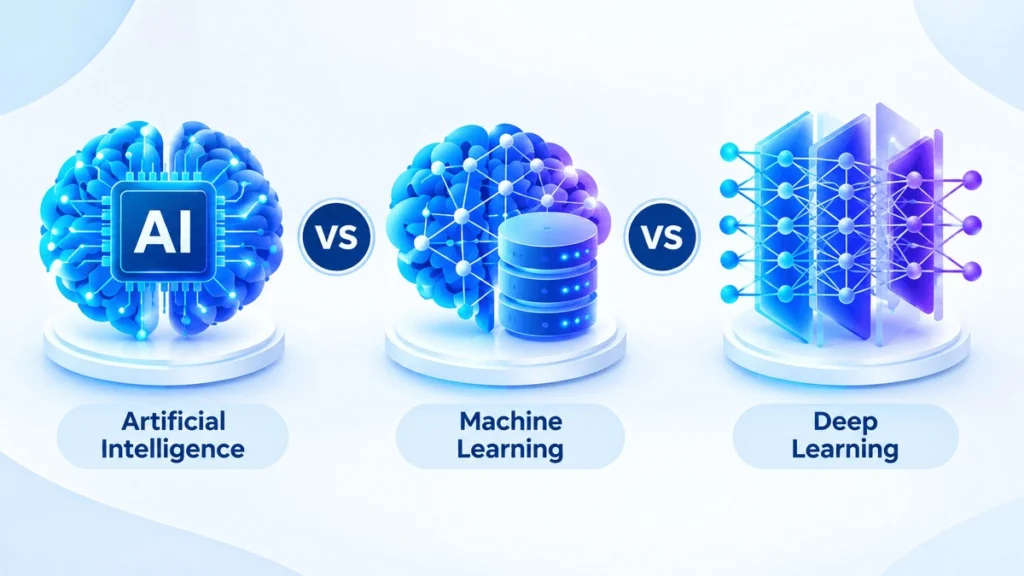
| Aspect | Artificial Intelligence (AI) | Machine Learning (ML) | Deep Learning (DL) |
| Definition | The broader field of creating systems that perform tasks requiring human-like intelligence. | A subset of AI where systems learn patterns from data to make predictions or decisions. | A subset of ML that uses multi-layer neural networks to learn complex patterns from large datasets. |
| Relationship | AI is the broader concept. | ML is a branch of AI. | DL is a branch of ML. |
| Learning method | Can use rules, logic, search, ML, and other techniques. | Learns from data using statistical and algorithmic methods. | Learns automatically through multiple layers of neural networks. |
| Examples | Virtual assistants, recommendation systems, autonomous systems. | Spam detection, fraud detection, product recommendations. | Image recognition, speech recognition, generative AI systems. |
Types of Artificial Intelligence
AI is grouped in two ways: by how smart it is and by how it handles memory.
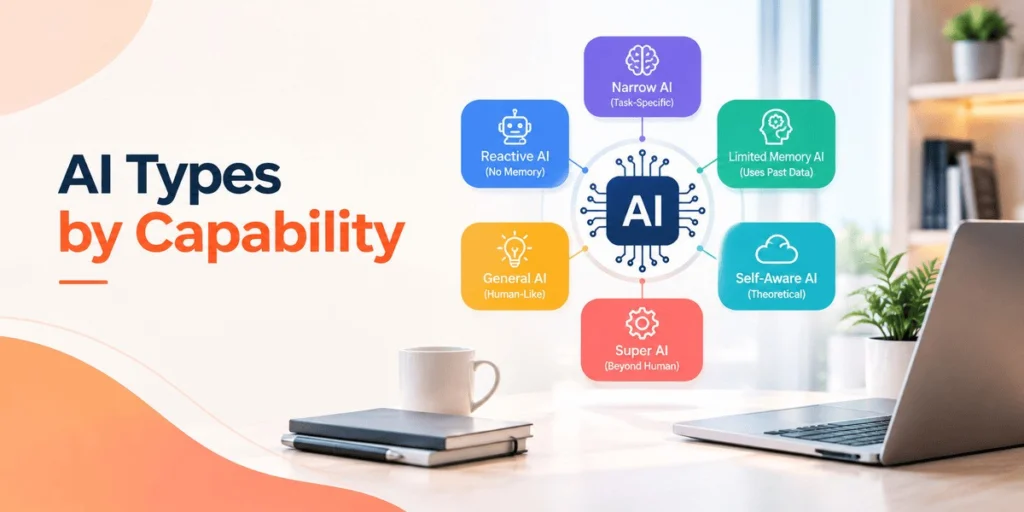
By capability
| Type | What It Means | Current Status | Examples |
| Narrow AI (ANI) | AI designed for a limited range of tasks or capabilities. It can perform specific tasks very well but does not have general human-like intelligence. | Exists today | ChatGPT, Gemini, recommendation systems, facial recognition |
| Artificial General Intelligence (AGI) | A hypothetical AI that could learn, reason, adapt, and solve problems across a broad range of tasks at a human-like level. | Does not currently exist | No confirmed example |
| Artificial Superintelligence (ASI) | A hypothetical AI that would surpass human intelligence across virtually all intellectual abilities. | Theoretical | No confirmed example |
Weak AI vs. strong AI
IBM uses this second pair of labels alongside the ANI/AGI/ASI split, and many people search both phrasings, so it’s worth knowing they mean roughly the same thing. Weak AI is another name for narrow AI: one task, no real understanding. Strong AI is the umbrella term for AGI and ASI below: systems that would actually reason and generalize rather than just matching patterns.
By functionality
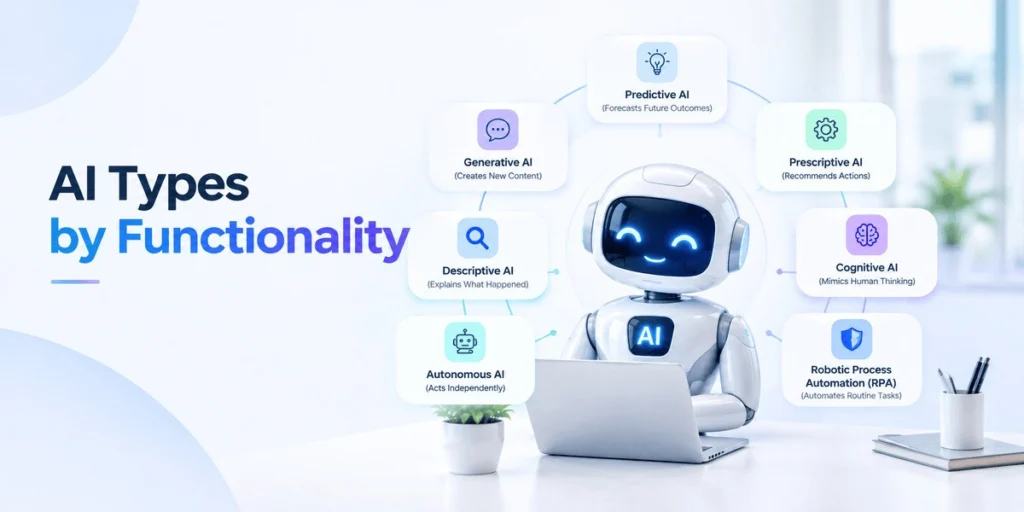
| Type | How It Works | Current Status | Example |
| Reactive Machines | Responds to current inputs without using stored past experiences to improve its response. | Exists today | IBM Deep Blue |
| Limited Memory | Uses information from previous data or recent context to produce outputs or make decisions. | Exists today | Self-driving systems, modern AI models |
| Theory of Mind | Would understand beliefs, intentions, perspectives, and emotional states of other people. | Research / theoretical | No confirmed example |
| Self-Aware AI | Would have awareness of its own internal state or consciousness. | Theoretical | No confirmed example |
How Does AI Work?
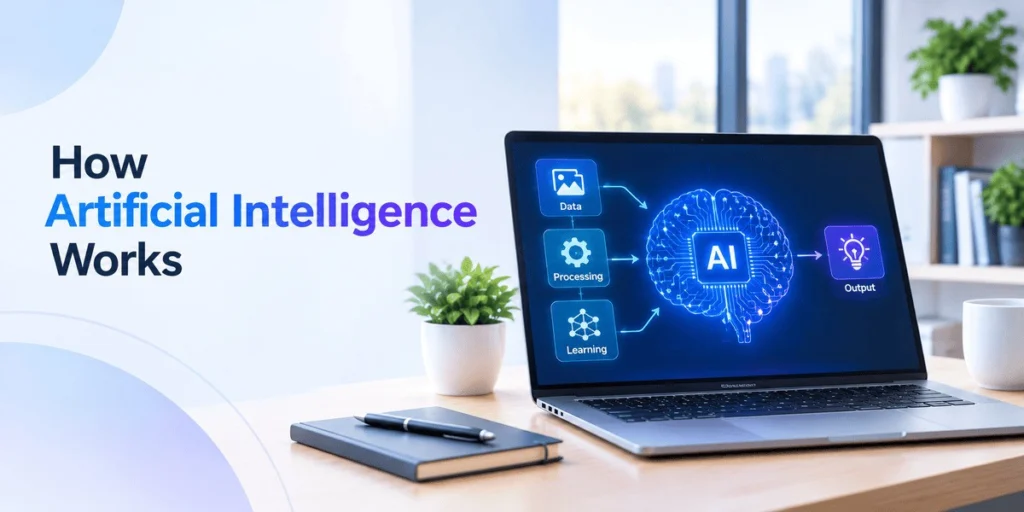
First, you have to collect and clean the data. Computers can’t learn anything without something to study. Engineers pull data from normal places, like receipts, website clicks, chat logs, or photos. But raw data is messy. It’s full of typos, missing pieces, and duplicates, so you can’t just dump it into an algorithm. Teams clean it up, remove the junk, and label it so the system knows what it’s looking at. Google’s own machine learning documentation makes this point clearly: clean data early, or the model picks up bad habits it never unlearns.
Next comes training. Engineers feed the cleaned data into the model and let it guess, get things wrong, and adjust. Under the hood, a model is really just a huge set of internal numbers, called parameters or weights, that decide how much one piece of input matters to the final answer. Training is the slow process of nudging those numbers until the guesses start lining up with reality. Some tasks use supervised learning, some use unsupervised learning, and some use reinforcement learning; more on all three below. Simple tasks can run on plain machine learning. Bigger jobs need deep learning, which stacks layers into neural networks loosely modeled on how brain cells connect.
Then the system gets good at spotting patterns. After thousands of practice rounds, it remembers which small details connect to which answers. Show it something brand new, and it traces those same signals to make a fast call, catching a stolen card before the money’s gone, or telling a storm apart from clear skies on radar.
Finally, someone has to test it and improve it. No model is ready the moment training ends. Teams run it against fresh data it’s never seen, look for mistakes or bias, then fine-tune the settings so it runs faster and uses less power. And because nobody wants to trust a system that can’t explain a loan rejection or a medical flag, teams build in ways to check a model’s reasoning, something we’ll come back to under ethics. Frameworks like NIST’s AI Risk Management Framework exist to help keep all of this safe and fair before a tool ever reaches the public. Getting an AI system to work comes down to four steps: gather data, run practice rounds, find patterns, then give an answer.
Major Areas of AI
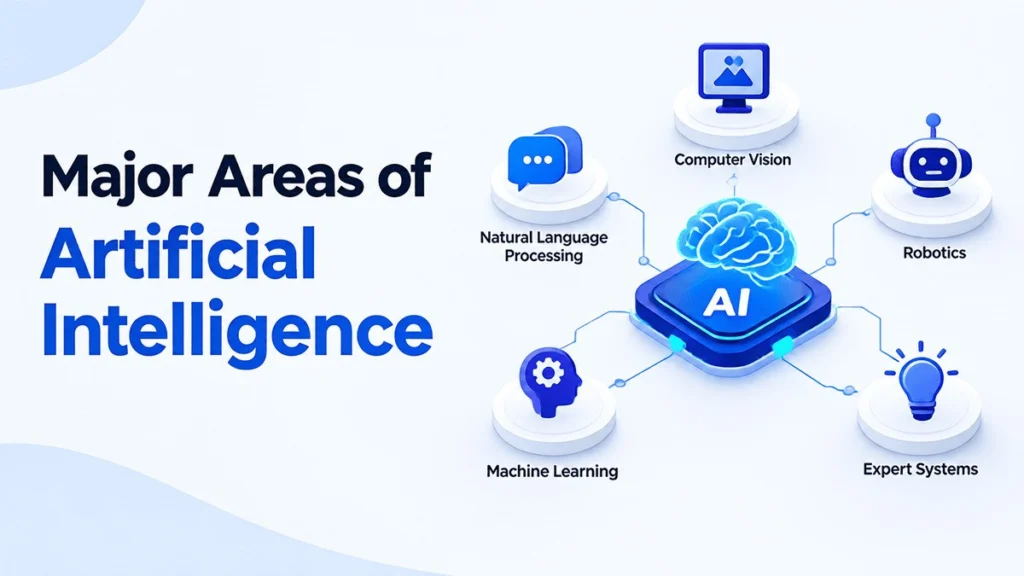
AI isn’t one single technology. It’s a group of fields that work together.
Machine Learning
Machine learning means software teaches itself through experience instead of a programmer writing out every step. Feed it ten thousand rows of used-car sales, and it starts connecting mileage, age, and price on its own.
We break this into three approaches: supervised learning, where you give the system labeled examples, like flashcards with the answer on the back; unsupervised learning, where you dump in raw, unlabeled data and let it find the patterns itself; and reinforcement learning, where a system tries actions inside a sandbox and learns the best strategy through a running score of wins and losses.
Deep Learning
Deep learning is machine learning taken a step further. Older programs needed a person to clean the data and point out useful clues first. Deep learning skips that by running data through layered neural networks loosely based on how brain cells connect: information goes in, passes through several hidden layers, and comes out as a final answer. IBM’s explainer on deep learning notes that stacking these layers is what lets machines handle messy, huge jobs, like reading a chest scan, understanding an accent, or keeping a car centered in its lane.
Natural Language Processing
Natural language processing (NLP) lets computers make sense of how people actually talk: slang, sarcasm, half-finished thoughts, regional phrases. It runs the autocomplete in your search bar, your spam folder, and your translation app.
According to IBM’s overview of natural language processing, the field’s biggest jump came from Large Language Models, trained on billions of pages of text, which let them pick up context, answer questions naturally, and draft an email without sounding like an old 1990s assistant.
Computer Vision
Computer vision teaches a machine to actually understand a photo or video feed, not just seeing a grid of numbers. Algorithms tell a bike apart from a mailbox, read a speed limit sign, or track someone walking past a storefront. Google Cloud’s Vision AI documentation notes this shows up in everyday places: phone face scanners and factory lines spotting dented cans, among others.
Robotics
Robotics pairs a physical arm or machine with smart software so it can react to what’s actually happening around it, not just repeat one motion. Old factory robots jam up if a part is even slightly out of place. Newer ones use cameras, laser sensors (LiDAR), and bump sensors to adjust in real time. NIST’s robotics and smart manufacturing program has shown how feeding live sensor data straight into a robot’s controls keeps it from injuring workers or damaging stock in a busy warehouse.
Generative AI
Generative AI flips the whole idea. Most older AI sorts or labels things that already exist, like deciding if an email is spam. Generative AI creates something brand new: a poem, working code, an image from a prompt. Building one of these tools takes three steps: training builds a base model on a huge dataset; tuning narrows it toward specific behavior, often through fine-tuning on a smaller labeled dataset, RLHF (where the model gets rewarded for answers people rate highly), or RAG (where it pulls in outside documents at answer time instead of relying only on memory); and generation is the final step, where the tuned model turns a prompt into new output.
Three architectures sit behind most tools you use today: variational autoencoders (from 2013), diffusion models (from 2014, which generate images by learning to remove noise), and transformers, the design behind most modern language models, which weigh every part of a prompt against every other part at once.
IBM’s overview of generative AI explains how this lets a system produce answers that sound logical and creative, not just plausible. Businesses also use generative AI for marketing to create content, personalize customer experiences, and support campaign workflows.
AI Agents and Agentic AI
AI agents and agentic AI make up one of the fastest-growing, least understood corners of the field.
A basic chatbot answers a question. An agent takes that answer and acts on it, booking a flight, updating a spreadsheet, filing a ticket without someone walking it through every step. Businesses can use these systems through AI agent development services for complex workflows.
Four things separate an agent from a chatbot: it plans, breaking a big goal into smaller ones; it reasons, deciding what to do next based on context; it acts, using real tools and APIs; and it adapts, adjusting on the fly without retraining. When several agents work together toward one shared goal, that’s agentic AI.
McKinsey’s State of AI in 2025 survey found that 88% of companies now use AI in at least one part of the business. Among the ones working with agents specifically, 23% say they’ve already scaled an agentic system into production, and another 39% are still testing one out.
AI Examples in Daily Life
Think about the chat apps people open every afternoon. Stuck on an email to a coworker, or need a recipe using whatever’s in the fridge? Open ChatGPT, Gemini, or Copilot, type your question, and it searches through everything it learned in training to return an answer in a few seconds.
Home gadgets work the same way. Ask a voice assistant to set a timer or turn off a lamp, and the microphone picks up your voice, filters out the background noise, turns it into text, and does the job. Streaming apps run on the same pattern-matching: they track what you watch, guess your taste, and push similar shows to the top.
A lot of AI runs quietly in places you never see; card fraud detection (more on that under Finance) is one example. Your phone gallery uses image recognition to sort every photo of your dog into one album. Speech recognition turns a messy voice memo into text you can actually read.
AI Ethics and Governance
As AI makes more decisions that affect real people, three things matter more every year.
Explainability
A model that can’t explain its own decision is hard to trust, especially when it’s deciding something like a loan or a medical flag. That’s the whole point of explainable AI: letting a person trace how a model got to its answer.
Two common tools, SHAP and LIME, work by testing how a model’s output shifts when you tweak individual inputs, then showing which ones mattered most. DARPA funded early large-scale research into this with its Explainable AI program, launched back in 2014.
Fairness
At its core, machine learning is statistical pattern matching. That becomes a real problem when the training data is biased, since it can put one group at a disadvantage in hiring or lending, for example. Fixing this means auditing the data closely and building teams diverse enough to catch blind spots before launch.
Governance
Someone has to be responsible when an AI system gets something wrong, and there has to be a way to track that over time.
NIST’s AI Risk Management Framework, released in 2023, gives organizations a voluntary way to govern, map, measure, and manage AI risk. In Europe, the EU AI Act goes further and makes rules binding for higher-risk systems, while GDPR controls how personal data can be used to train or run AI in the first place.
Hallucination
This is when a generative model gives a confident, well-written answer that’s just wrong, or made up entirely. It happens because these models are built to sound plausible, not to check facts against a database, so an invented answer can read exactly as convincing as a true one. It’s one of the biggest reasons AI output in high-stakes settings still needs a human to check it.
Applications of Artificial Intelligence
Healthcare
Clinics run X-rays and MRIs through computer vision tools to catch a hairline crack or a small lung spot before a tired doctor misses it. At the bedside, machine learning flags a sudden drop in blood oxygen or warns a nurse about a bad drug combination before the pills leave the tray. As of June 2026, the FDA’s AI-Enabled Medical Device List shows 1,614 approved devices, and about 76% of them, or roughly 1,230, are built for radiology, according to reporting from The Imaging Wire.
Business
Automated document processing scans a receipt, pulls out the line items, and updates the books without anyone typing a number by hand. Companies are also rolling out AI agents built on generative AI tools that pull sales numbers, run reports, and draft manager summaries with far less hand-holding than before.
Finance
Banks use AI to watch card activity around the clock, since fixed rulebooks can’t keep up with clever fraud. Machine learning tracks your normal spending which grocery store, which gas station and if your card suddenly buys luxury goods overseas at 3 a.m., it can block the charge before the money’s gone. The same tools power risk analysis for loans, algorithmic trading that reacts to price moves in milliseconds, and facial recognition checks that compare a selfie to an ID photo during account setup.
Manufacturing
Predictive maintenance catches a failing part before it snaps. Sensors track vibration, heat, and speed on a machine and feed it straight into a model, so if a bearing starts running slightly off, the system flags it for replacement before the line stops. High-speed cameras scan items on the belt for cracks or loose bolts, and robots move finished goods between stations.
NIST’s robotics and smart manufacturing program page covers the same idea, pairing sensors with robots to keep a factory floor running without surprise breakdowns.
Transportation
Self-driving technology aims to reduce crashes and traffic. Cars combine cameras, radar, and LiDAR with computer vision to read road signs, stay in their lane, and brake for a pedestrian at night. Delivery companies use similar prediction models to route trucks around construction and bad weather.
The NHTSA closely monitors all of this, ensuring public road tests follow federal safety rules before wider rollout.
Customer Service
Businesses now use AI to handle routine questions the moment a customer reaches out.
Older chatbots broke down over a single typo. Newer ones, built on generative AI, handle slang and messy spelling just fine, looking up an order, processing a return, or resetting an account without making anyone wait on hold.
This helps the support team too: some service teams report resolving tickets faster once generative tools pull up order history and draft replies automatically, though exactly how much faster depends on the report and the setup. Tougher issues, like a missing refund, still get handed off to a real person.
Benefits of AI
| Benefit | How AI Helps |
| Automation and productivity | Automates repetitive tasks and helps teams complete work faster. |
| Faster data analysis | Processes large amounts of data to find patterns and useful insights. |
| Decision support | Analyzes data and predictions to support better decisions. |
| Personalized experiences | Tailors recommendations, content, and services to individual users. |
| Generative AI applications | Creates text, images, code, audio, and other types of content. |
Risks and Limits of AI
| Risk or Limitation | What It Means |
| Bias and fairness | AI can produce unfair results when its data or design contains bias. |
| Data privacy | AI systems can raise privacy concerns when processing personal information. |
| Security | AI systems can face attacks, misuse, and other security vulnerabilities. |
| Incorrect outputs | AI can produce inaccurate or unreliable information that needs human review. |
| Job displacement | Automation can change job roles and reduce demand for some tasks. |
| Lack of transparency | Some AI systems are difficult to understand, making their decisions harder to explain. |
History of Artificial Intelligence
People have imagined thinking machines since ancient Greece, but real work on them only began once computers showed up in the 1950s. In about seventy years, AI went from a small university project to a chess match on TV to an app on your phone.
1950 — Alan Turing. Turing, the codebreaker behind cracking ENIGMA in WWII, asked a simple question: can machines think? Instead of arguing philosophy, he proposed a test. A judge chats blind with a human and a machine, and if he can’t tell them apart, the machine passes. It’s still called the Imitation Game.
1955–56 — Dartmouth and the first program. John McCarthy coined the term “artificial intelligence” in 1955 while pitching a project at Dartmouth, then ran a small workshop there in 1956. That same year, Allen Newell, J. C. Shaw, and Herbert Simon built the Logic Theorist, usually called the first real AI program.
Late 1950s–60s — Early machines. Frank Rosenblatt built the Mark 1 Perceptron, a machine loosely based on brain cells that could learn from its mistakes. Around the same time came ELIZA, an early chatbot that mimicked a therapist, and Shakey the Robot, the first machine that could reason about the space around it instead of just following a script.
1969 — The first AI winter. Marvin Minsky and Seymour Papert published Perceptrons, showing simple networks couldn’t even solve basic logic problems. Funding dried up almost overnight.
1980 — Backpropagation. Neural networks came back once researchers worked out backpropagation, a way for a network to check its own errors and correct itself. Computers could suddenly learn much harder patterns, and money followed.
1997 — Deep Blue beats Kasparov. People assumed a computer could never beat a chess grandmaster, since the game leans so hard on intuition. IBM’s Deep Blue, checking around 200 million positions a second, proved them wrong and beat Garry Kasparov in New York.
2011 — Watson wins Jeopardy!. IBM’s Watson beat champions Ken Jennings and Brad Rutter, scanning offline encyclopedia data in a split second to buzz in first. IBM later turned Watson into its enterprise AI line, now sold as watsonx.
2016 — AlphaGo solves Go. Go has more possible positions than atoms in the universe, so brute force alone can’t win it. Google DeepMind’s AlphaGo learned from old matches, then played millions of games against itself, and beat grandmaster Lee Sedol 4–1 with moves nobody saw coming.
2022 — ChatGPT and generative AI. This is the turning point most people actually noticed. AI stopped just sorting old data and started making new things, essays, scripts, code, in seconds. This is generally seen as the moment generative AI left research labs and landed in everyday offices and classrooms.
2024 — Multimodal and smaller models. Chat tools started handling photos, speech, and video together, so you could show it a broken bike chain and ask what’s wrong. Companies also began shipping smaller models built to run on a phone or laptop instead of a huge cloud server.
2025–26 — Agents take over chores. AI stopped just answering and started acting. Give it a messy task, like booking a flight or fixing a billing error, and it opens the right apps and works through it on its own. AI chips are also showing up inside everyday laptops now, so some of this runs locally instead of over the cloud.
AI Careers and Salaries
The field has split into several distinct jobs rather than one generic AI role. An AI engineer builds and ships models into real products, while a machine learning engineer works more narrowly on training and tuning the models themselves. A data scientist sits upstream of both, cleaning data and running the analysis that determines which approach is even worth building. Around those three, more specialized roles have grown up: an NLP engineer works on language systems such as chatbots and translation, a computer vision engineer builds image and video recognition tools, and a robotics engineer pairs AI software with physical hardware for things like warehouse automation.
Python is the default language across nearly all of these jobs, because it reads easily and because almost every serious machine learning library was built for it. Beyond Python, Lisp still matters historically as one of the first AI languages, Prolog turns up in logic-heavy systems, and R, Java and C++ remain common in statistics-heavy or performance-critical work.
Salaries in this field move quickly and vary sharply by region, seniority and company size, so every figure below is a snapshot rather than a rate card.
| Role | Figure | Source and date |
| Data scientist | $120,230 median; $67,240 at the 10th percentile, $199,130 at the 90th | U.S. Bureau of Labor Statistics, May 2025 |
| Computer and information research scientist | $140,300 median | U.S. Bureau of Labor Statistics, May 2025 |
| AI engineer | ~$145,800 average, typical range $117,300–$183,900 | Glassdoor, self-reported, accessed September 2026 |
| Machine learning engineer | ~$164,700 average, typical range $132,400–$207,600 | Glassdoor, self-reported, accessed September 2026 |
Two limitations to keep in mind with those numbers. The BLS figures are survey-based government data covering occupations it formally tracks, and they do not yet include “AI engineer” as its own category. The Glassdoor figures are submitted anonymously by users and are not verified, so they tend to skew toward larger employers and higher-paying metros. The BLS also projects data scientist employment growing 35% between 2025 and 2035, much faster than the average across all occupations.
Conclusion
So, what is artificial intelligence, really? It’s a computer trained on past examples instead of a fixed list of rules. That’s the whole idea. Every system you actually use today, from a bank’s fraud alert to your phone’s face scan, is still narrow AI. It does one job well and nothing else.
That’s exactly why it needs careful handling. A tool built for one job can still get that job wrong in a way that costs someone real money, time, or trust. The people building these systems have to test for bias, protect people’s data, and be ready to explain a decision when someone asks why.
None of that makes AI good or bad on its own. It’s a tool. Like any tool, its value depends on how carefully it’s built and used.
FAQs
What is artificial intelligence in simple words?
It’s making computers smart enough to solve problems and learn from facts, doing jobs that used to need a human brain.
What is an example of artificial intelligence?
Unlocking your phone with face recognition, or a maps app picking the fastest route. Streaming apps also use it to guess what you’ll want to watch next.
Is AI good or bad?
Neither, really. It’s a tool. It helps doctors catch illness earlier, but it also brings real risks, like biased outcomes and job loss.
What’s the difference between AI and automation?
Automation follows fixed rules and does the same thing every time. AI learns from data and changes its output as new information comes in.
Can AI be trusted?
It depends entirely on how it was built and tested. Explainable AI tools, plus frameworks like NIST’s AI Risk Management Framework, exist specifically to make AI systems easier to trust and audit.
Is AI regulated?
It depends where you are, and the rules are shifting fast. In the U.S., NIST’s framework is still voluntary, though some states and agencies are adding their own rules. The EU AI Act goes further, with binding rules for higher-risk systems. On jobs specifically, the World Economic Forum’s Future of Jobs Report 2025 projects AI and automation will displace about 92 million roles worldwide by 2030 but also create around 170 million new ones over the same stretch. A net gain, but a real shift in what kinds of jobs exist.
Sources
1. Stanford University, “Stanford’s John McCarthy, seminal figure of artificial intelligence, dies at 84,” 2011. https://news.stanford.edu/2011/10/25/stanfords-john-mccarthy-seminal-figure-artificial-intelligence-dies-84/
2. European Commission, “AI Act — Regulatory framework on AI,” Digital Strategy portal. https://digital-strategy.ec.europa.eu/en/policies/regulatory-framework-ai
3. EUR-Lex, Regulation (EU) 2016/679 (General Data Protection Regulation). https://eur-lex.europa.eu/eli/reg/2016/679/oj
4. NIST, “AI Risk Management Framework.” https://www.nist.gov/itl/ai-risk-management-framework
5. NIST, “Robotic Systems for Smart Manufacturing” program page. https://www.nist.gov/programs-projects/robotic-systems-smart-manufacturing
6. DARPA, “Explainable Artificial Intelligence (XAI)” program page. https://www.darpa.mil/research/programs/explainable-artificial-intelligence
7. Ribeiro, Singh, and Guestrin, “’Why Should I Trust You?’: Explaining the Predictions of Any Classifier” (LIME), 2016. https://arxiv.org/abs/1602.04938
8. Lundberg and Lee, “A Unified Approach to Interpreting Model Predictions” (SHAP), 2017. https://arxiv.org/abs/1705.07874
9. U.S. Food and Drug Administration, “Artificial Intelligence-Enabled Medical Devices.” https://www.fda.gov/medical-devices/software-medical-device-samd/artificial-intelligence-enabled-medical-devices
10. NHTSA, “Automated Vehicles for Safety.” https://www.nhtsa.gov/vehicle-safety/automated-vehicles-safety
11. U.S. Bureau of Labor Statistics, Occupational Outlook Handbook, “Data Scientists.” https://www.bls.gov/ooh/math/data-scientists.htm
12. U.S. Bureau of Labor Statistics, Occupational Outlook Handbook, “Computer and Information Research Scientists.” https://www.bls.gov/ooh/computer-and-information-technology/computer-and-information-research-scientists.htm
13. Glassdoor, “AI Engineer Salaries” (self-reported). https://www.glassdoor.com/Salaries/ai-engineer-salary-SRCH_KO0,10.htm
14. Glassdoor, “Machine Learning Engineer Salaries” (self-reported). https://www.glassdoor.com/Salaries/machine-learning-engineer-salary-SRCH_KO0,25.htm
15. World Economic Forum, “Future of Jobs Report 2025: 78 Million New Job Opportunities by 2030.” https://www.weforum.org/press/2025/01/future-of-jobs-report-2025-78-million-new-job-opportunities-by-2030-but-urgent-upskilling-needed-to-prepare-workforces/
16. McKinsey & Company, “The State of AI in 2025: Agents, Innovation, and Transformation.” https://www.mckinsey.com/capabilities/quantumblack/our-insights/the-state-of-ai

Comments are closed