
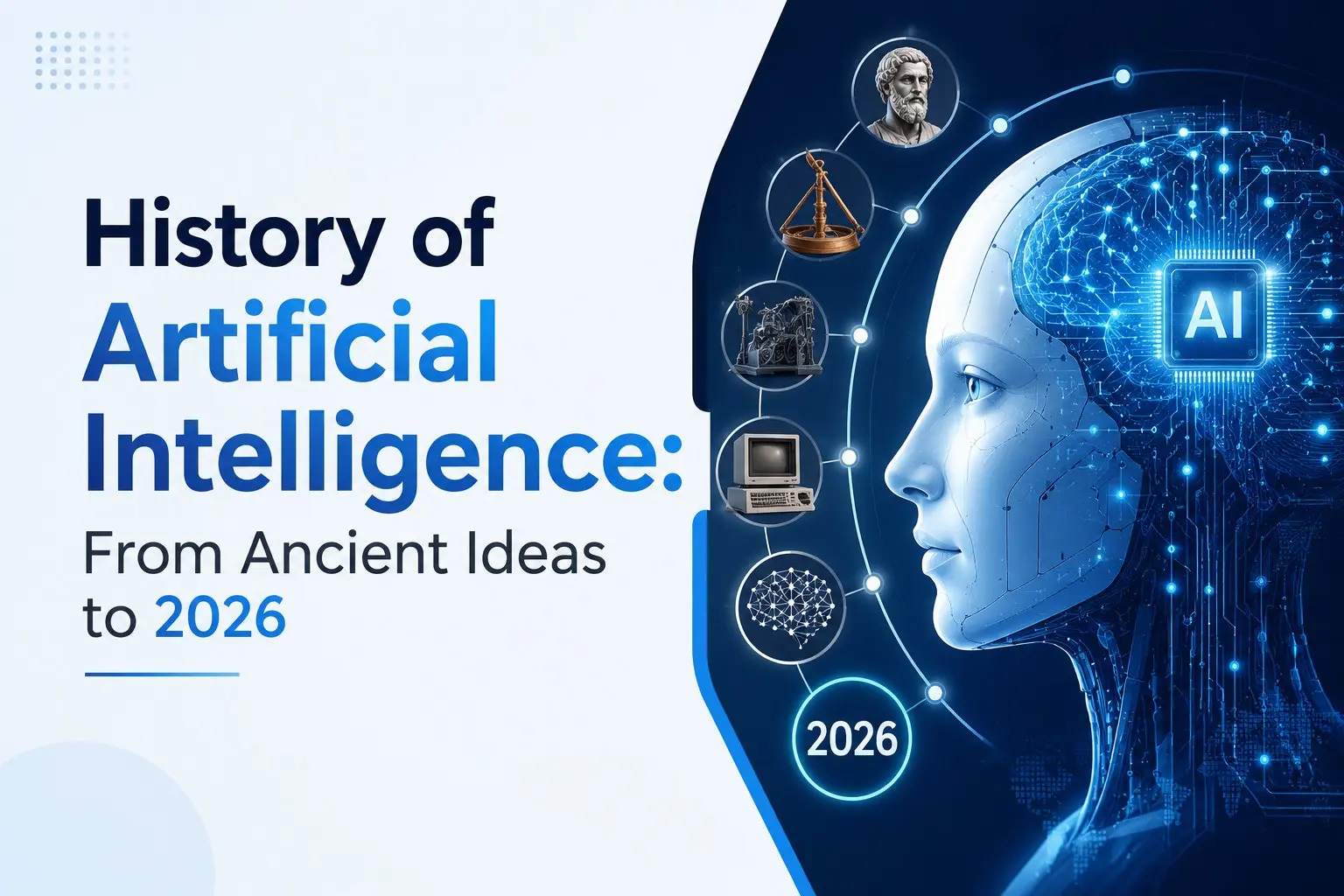
The history of artificial intelligence began with ancient myths and early logic, exploring the origins of artificial intelligence long before AI became an official field at the Dartmouth workshop 1956. This comprehensive history and evolution of AI shows the long-term development of artificial intelligence from early logic to modern breakthroughs.
Long before anyone typed a prompt into a chatbot, Greek storytellers were dreaming up bronze guardians and mathematicians were trying to turn thought into arithmetic. Since the field got its name, it’s swung back and forth between huge promises and hard reality.
We’ll take it in order. That means Alan Turing, the Dartmouth workshop, two AI winters, the deep learning jump of 2012, and the chatbots and agents we use now.
Key Takeaways
• When considering how long has AI been around or how old is AI, theoretical ideas span centuries, but the modern history of AI research began in the 1950s
• It was John McCarthy who coined the term artificial intelligence in the 1955 Dartmouth proposal.
• The 1956 Dartmouth workshop helped turn AI into a research field of its own.
• The leading method keeps changing: hand-written rules, expert systems, statistics, neural networks, and now very large generative models.
• Hype has crashed into reality at least twice. Those dry spells, when funding shrank, are called AI winters.
• Deep learning took over after AlexNet in 2012, when big datasets, GPUs, and better training tricks arrived together.
• The transformer (2017) is the design behind today’s large language models.
• ChatGPT and image generators brought AI into everyday life in 2022.
• Since 2024, the talk has been about multimodal models, reasoning, open models, and agents.
What Is Artificial Intelligence?

Artificial Intelligence is the part of computer science that tries to get machines to do things we’d normally call intelligent. Learning from experience, understanding language, spotting a face in a crowd. Nobody agrees on a tighter definition, and the goalposts keep moving. Once a computer does something reliably, people tend to stop calling it AI.
Five related terms come up all through this story. Here’s each point written as a single line.
| Term | In one sentence |
| Artificial intelligence | The broader field focused on creating systems that can perform tasks intelligently. |
| Machine learning | Systems that identify patterns in data and improve without relying solely on manually programmed rules. |
| Deep learning | A machine learning approach that relies on neural networks built with several layers. |
| Generative AI | Models designed to generate original content such as text, images, audio, video, or code. |
| AI agents | Systems that pair a model with tools so they can carry out tasks. |
For more detail, see our AI vs. Machine Learning vs. Deep Learning breakdown.
When Did AI Start and Who Created Artificial Intelligence?
The idea is ancient, but AI as a research field starts in 1956. The name comes from a 1955 proposal, and the workshop it paid for took place in the summer of 1956. Understanding how artificial intelligence started helps clarify when was AI invented and when was AI made. The groundwork came earlier, from centuries of logic and math and from the computers and neural models of the 1930s and 1940s.
AI History at a Glance: The 7 Major Eras

| Era | Approx. period | Defining idea |
| Foundations | Before 1950 | Logic, mathematics, and the theory of computation |
| Symbolic AI | 1950s–1970s | Rules, search and symbolic reasoning |
| Expert systems | 1970s–1980s | Write specialists’ knowledge down as rules |
| Statistical AI | 1990s–2000s | Let machines learn patterns from data |
| Deep learning | 2010s | Neural networks at large scale |
| Generative AI | 2020s | Machines that create text, images, code, and media |
AI moved from hand-written rules to learning from data, then to deep networks, transformers, and generative models, and now to systems that can use tools and finish multi-step tasks. This progression traces the entire history of AI technology and the continuous development of AI across seven distinct eras.
AI Before 1950: The Foundations
Early Ideas of Artificial Beings and Machines
Greek myth has Talos, a bronze giant who circled Crete each day to guard it. The smith god Hephaestus supposedly built golden helpers that moved on their own. Nobody could build such things, of course. But the stories show that the idea of a made mind is a lot older than the tools to make one.
Real gadgets did arrive. Hero of Alexandria described mechanical devices in the first century AD. In 1206, the engineer Al-Jazari documented water-powered machines, including a boat with a band of mechanical musicians. Then in 1920 Karel Čapek’s play R.U.R. gave the world the word “robot.” None of these machines could do more than repeat their moves, but they got people wondering whether a machine ever could.
Logic, Mathematics and Mechanical Calculation
The other root of AI is math. Aristotle wrote down rules for valid arguments, and Euclid showed how to build proofs from a handful of axioms. Later, in ninth-century Baghdad, the scholar Al-Khwarizmi described step-by-step methods for calculation. His name became the word “algorithm.” In the 1600s, Descartes compared animals to machines, and Leibniz dreamed of a language of pure reasoning where an argument could be settled by working out the sum. He also built a calculator that could multiply.
Charles Babbage designed the Analytical Engine in the 1830s and never finished it. Ada Lovelace saw in 1843 that it might handle symbols as well as numbers, yet she insisted it couldn’t create anything new on its own. People still argue over that. George Boole turned logic into algebra in 1854, and in 1937 Claude Shannon showed that Boolean logic could describe electrical switches. That link between logic and circuitry matters a great deal later on.
The origin of AI didn’t come from one big discovery, but from several fields that shaped the earliest beginnings of artificial intelligence. Logic for writing reasoning as symbols, algorithms for exact procedures, probability for weighing shaky evidence (Bayes’ theorem dates to 1763), and computability theory for what a machine can and can’t calculate. Electronic computers finally gave all of it the speed it needed.
Alan Turing’s Work on Machine Intelligence
Turing is hard to skip. His 1936 paper described an imaginary machine, now called the Turing machine, that captures what any computer can compute. Alonzo Church got to a similar place by a different route, and together their idea is known as the Church–Turing thesis.
In 1950, he published his influential paper “Computing Machinery and Intelligence” in a leading academic journal. It opens by asking whether machines can think, then dodges the question. Turing thought “think” was too slippery, so he proposed a game. A judge chats with two hidden players, one human and one machine. If the judge can’t tell which is which, the machine passes.
That’s the Turing Test. Critics say it measures acting, not understanding, and they have a point. Yet more than 75 years on, people still use it as the reference point. King’s College Cambridge, keeps Turing’s typescript in its archive.
The Rise of Electronic Computers
Ideas about intelligence weren’t enough. AI needed machines that could do an enormous number of operations, fast. The Second World War accelerated that work. Konrad Zuse finished the Z3, a programmable electromechanical computer, in Germany in 1941. British engineers, including Tommy Flowers, built the Colossus machines in 1943 and 1944 to help break German ciphers. In the United States, ENIAC came online in 1945 to calculate artillery tables.
Those early computers had to be rewired by hand for every new job. The stored-program design fixed that by keeping instructions in memory next to the data, and the Manchester Baby ran the first stored program in 1948. By the early 1950s, researchers could finally experiment. Christopher Strachey, for instance, wrote a draughts program in 1951.
Early Neural Networks
In 1943, Warren McCulloch and Walter Pitts published “A Logical Calculus of the Ideas Immanent in Nervous Activity.” They treated a nerve cell as a unit that switches on when its inputs cross a threshold, and they showed that networks of such units could compute logical functions. Most histories call it the first artificial neuron.
Donald Hebb suggested in 1949 that connections between neurons get stronger with use. In 1951, Marvin Minsky and Dean Edmonds built SNARC, a network of about 40 units that learned its way through a maze. Then in the late 1950s, Frank Rosenblatt introduced the perceptron, a machine that adjusted its connection weights to sort simple patterns. The press loved it, and predictions ran well ahead of the evidence.
Cybernetics and Information Theory
Norbert Wiener named cybernetics in his 1948 book of the same title. The field looked at control and communication in animals and machines, with feedback at the center: a system compares what it’s doing with what it should be doing, then corrects itself. In the same year, Claude Shannon published “A Mathematical Theory of Communication,” which defined information in units you could measure. Both ideas nudged scientists toward seeing thought as a kind of information processing.
1950–1956: The Birth of Artificial Intelligence
Early Learning Programs
By the early 1950s, a few groups were building programs that learned or played games. Arthur Samuel had a checkers program running at IBM by 1952, and it got better by playing against itself. In a 1959 paper, he described the work as “machine learning,” and the phrase stuck.
The Dartmouth Proposal and Workshop
In 1955, John McCarthy, then a young math professor at Dartmouth College, wrote a proposal with Marvin Minsky, Nathaniel Rochester and Claude Shannon. They asked for money to run a two-month summer study of “artificial intelligence.” The proposal is credited with the first use of the term. Its authors were betting that any part of learning, or any other feature of intelligence, could be described so precisely that a machine could copy it.
The Dartmouth Summer Research Project on Artificial Intelligence took place in the summer of 1956 in Hanover, New Hampshire, and ran for several weeks. Strictly speaking it was a workshop, not a conference, and a loose one. People drifted in and out, and nobody went home with a breakthrough. What it did produce was a name, a community and a shared set of goals, which is why most histories treat 1956 as the start of AI as a field. Dartmouth tells its side of the story on its page about how AI was coined there, and its AI initiative still calls the campus the birthplace of AI.
Why that name? History of Data Science notes that researchers at the time used rival labels such as cybernetics, automata theory, and complex information processing. McCarthy wanted something neutral that didn’t belong to any one camp.
Logic Theorist and the First AI Programs
When historians ask what was the first AI or when was the first AI created, they usually highlight Logic Theorist, developed between 1955 and 1956 by Allen Newell, Herbert Simon, and J. C. Shaw as the first artificial intelligence program. It proved 38 of the first 52 theorems in Whitehead and Russell’s Principia Mathematica. Simon reportedly told his students that he and Newell had invented a thinking machine over the winter break. That’s a bold claim, but it’s why many historians call Logic Theorist the first AI program. In 1957, the pair followed it with the General Problem Solver, which tried to tackle many kinds of problems with one general method.
1956–1973: The First AI Boom
Symbolic AI and Problem Solving
Early AI ran on symbols. Programs stored knowledge as rules, then searched through huge numbers of possible answers, guided by heuristics, which are rules of thumb that trim the search. People now call this “good old-fashioned AI.” It did well on puzzles, proofs and board games. McCarthy created the Lisp language in 1958, and it stayed a main AI tool for decades. Labs sprang up at MIT, Stanford and Carnegie Mellon, and agencies like DARPA paid the bills.
AI Splits Into Research Areas
By the mid-1960s, AI wasn’t one project any more. People worked on separate problems with different tools. Some focused on search and planning. Others took on language: Joseph Weizenbaum’s ELIZA (1966) imitated a therapist by matching patterns in text, and Terry Winograd’s SHRDLU (1970) obeyed English commands in a tiny world of blocks. Larry Roberts’s 1963 thesis at MIT started work on computer vision by trying to recognize three-dimensional block shapes.
ELIZA taught its creator something uncomfortable. Weizenbaum later wrote that his own secretary asked him to leave the room so she could talk to it in private, even though she knew it was just a program.
Early AI Robotics
Robotics grew as its own thread. In 1961 the Unimate arm started work on a General Motors assembly line, one of the first industrial robots. Then from 1966 to 1972 SRI built Shakey, a wheeled robot that combined vision, planning and movement to finish tasks in a set of rooms. It got its name because it wobbled. The Stanford Cart, developed through the 1960s and 1970s, managed by 1979 to cross a room full of obstacles on its own, though very slowly.
The 1970s: The First AI Winter
By the early 1970s, results were lagging far behind promises. Programs that shone in small demos fell apart on real problems, and critical reviews piled up. The ALPAC report of 1966 slammed machine translation. Minsky and Papert’s 1969 book Perceptrons showed the limits of single-layer networks. In 1973, the mathematician Sir James Lighthill reviewed UK research and was not kind.
The causes stacked up. Computers were too small and slow for real-world scale. The number of possible choices grew faster than search methods could follow, a problem called combinatorial explosion. Systems like SHRDLU worked in toy worlds and transferred poorly, and rule-based methods struggled with noisy, incomplete data. Add public forecasts of near-human machines that nobody could meet, and the funding followed the mood. UK research fell sharply after 1973, and DARPA trimmed some programs in 1974.
Lighthill argued that AI had missed its “grandiose” goals, and he singled out combinatorial explosion as a core obstacle. His report led to deep cuts in Britain and fed into reduced US support in 1974. Researchers also stumbled on a strange pattern, later named Moravec’s paradox: chess turned out easier for machines than something a toddler does with no effort, like recognizing a face.
The 1980s: Expert Systems
Business interest came back with expert systems. These programs store what specialists know as rules, then use an inference engine to apply them. At Stanford, a team including Edward Feigenbaum and Edward Shortliffe produced DENDRAL, which helped identify chemical compounds, and MYCIN, which suggested diagnoses and treatments for bacterial infections. DENDRAL’s story starts in the mid-1960s. Building systems like these became known as knowledge engineering.
The biggest business success was XCON, which Digital Equipment Corporation used from about 1980 to configure computer orders. It was credited with big savings, and soon companies were setting up their own AI groups and buying Lisp machines.
Governments jumped in as well. Japan launched its Fifth Generation Computer Systems project in 1982, aiming for machines that reason with logic programming in the Prolog language. The United States and United Kingdom scrambled to answer with programs of their own.
1987–1990s: The Second AI Winter
It didn’t last. Expert systems were expensive to build and even harder to update, and they broke whenever a case fell outside their rules. The market for specialized Lisp machines collapsed in 1987 as ordinary workstations got cheaper and faster. A year later, DARPA’s Strategic Computing Initiative stopped new spending on AI, and Japan’s Fifth Generation project fell short of what it had promised.
For much of the 1990s, plenty of researchers avoided the words “artificial intelligence” altogether. They said machine learning, informatics or intelligent systems instead, partly to keep the grants coming.
Why the AI Winters Happened
| Period | Main problem | What came next |
| First AI winter | Limited computing, weak real-world performance and unrealistic expectations | Expert systems |
| Second AI winter | Expert systems were expensive and hard to maintain | Statistical ML and neural methods |
Some people wonder if today’s boom could end the same way. Honestly, nobody knows, and we’re not calling the present an AI winter.
1980s–2000s: Statistical AI and Neural Networks Return
Neural network research kept limping along through the winters. John Hopfield described a network that could store and recall patterns in 1982. Geoffrey Hinton and Terrence Sejnowski came up with the Boltzmann machine in 1985. Then in 1986, David Rumelhart, Hinton and Ronald Williams published “Learning representations by back-propagating errors” in Nature. Backpropagation lets a network tweak its internal connections, layer by layer, to shrink its mistakes. The movement built around it was called connectionism.
Other tools were maturing too. Judea Pearl’s 1988 work on probabilistic reasoning brought Bayesian networks into AI. Richard Sutton’s temporal-difference learning (1988) and Chris Watkins’s Q-learning (1989) pushed reinforcement learning forward, where a system learns from rewards. Gerald Tesauro’s TD-Gammon reached expert-level backgammon in the early 1990s. In 1989, Yann LeCun trained a convolutional network at Bell Labs to read handwritten digits, and in 1997 Sepp Hochreiter and Jürgen Schmidhuber published the long short-term memory (LSTM) network, which later became central to speech and language work.
So AI didn’t vanish after the winters. It just stopped advertising itself. Statistical machine learning replaced hand-written rules for lots of tasks. Support vector machines (1995) and probabilistic models handled speech recognition, handwriting recognition, spam filtering and data mining. Google’s PageRank, introduced in 1998, ranked web pages. Online stores built recommendation systems, and banks screened for fraud.
The big public moment came in May 1997, when IBM’s Deep Blue beat world chess champion Garry Kasparov by 3½ points to 2½. Kasparov suspected humans were helping the machine, and IBM denied it. Deep Blue actually relied on special hardware and very fast search, not learning.
Decades later the neural network pioneers got their recognition. The 2024 Nobel Prize in Physics went to John Hopfield and Geoffrey Hinton for foundational discoveries that enable machine learning with artificial neural networks.
2000–2011: Data, GPUs and Machine Learning
The 2000s brought more data, cheaper computing and better algorithms. The Roomba arrived in 2002. Then in January 2004, NASA’s Spirit and Opportunity rovers landed on Mars, and NASA engineers reported that several autonomous navigation capabilities were used in space for the first time, including vision-based hazard avoidance.
Driving became the new test. In DARPA’s 2004 Grand Challenge, no vehicle finished the desert course, and the best one only covered about seven miles. A year later, five vehicles made it, and Stanford’s Stanley won. In 2006, Hinton and colleagues published work on deep belief networks, showing that networks with many layers could be trained in stages. NVIDIA released CUDA in 2007, which made graphics chips far easier to use for general computing.
In 2009, Fei-Fei Li and colleagues presented ImageNet, a large collection of labeled images they’d started building in 2007. Two years later IBM’s Watson beat two former champions on the quiz show Jeopardy!, and Apple put Siri on the iPhone 4S.
Two changes underneath all this mattered more than any single result. Hardware went from mainframes and specialized Lisp machines to cheap processors and then GPUs. And data changed the way AI was built. Early on, humans told computers exactly what to do. Later they handed over labeled examples. Now the biggest models learn from huge piles of unlabeled text and images, mostly by guessing missing pieces, which is called self-supervised learning. Modern businesses can apply these techniques through AI/ML development services to build and deploy custom AI systems.
2012: The Deep Learning Breakthrough
Neural networks weren’t new in 2012. Backpropagation was already 26 years old, and LeCun’s convolutional networks had been reading digits since 1989. What changed was that a few missing pieces showed up at the same time.
First, computing power. GPUs, made much easier to program by CUDA, could train networks far bigger than ordinary processors could handle. Second, data. ImageNet offered over a million labeled images, enough for a big network to learn from without just memorizing. Third, better training tricks: ReLU activations, a method called dropout, and convolutional designs that made deep networks less painful to train. On top of that, the yearly ImageNet contest gave everyone a public scoreboard, so progress was easy to see. The older networks weren’t wrong. They were starved.
That year Alex Krizhevsky, Ilya Sutskever and Geoffrey Hinton entered a deep convolutional network, AlexNet, in the ImageNet contest, and it beat its rivals by a wide margin. Their paper, “ImageNet Classification with Deep Convolutional Neural Networks,” describes a model with 60 million parameters trained on GPUs.
2013–2016: Deep Learning Goes Mainstream
Within a few years, deep learning was leading image recognition, speech recognition and machine translation. Word embeddings such as word2vec (2013) turned words into numbers that capture meaning. Generative adversarial networks (Ian Goodfellow, 2014) could produce realistic images, and residual networks (2015) made much deeper models trainable. The ACM’s Turing Award for 2018 went to Hinton, Yann LeCun and Yoshua Bengio for their deep learning work.
Games gave the next shock. DeepMind’s AlphaGo beat European champion Fan Hui 5–0 in 2015, then top player Lee Sedol 4–1 in March 2016. Go has far too many possible positions for brute-force search, and lots of experts thought this result was still years off. Google Research explains how AlphaGo worked: one neural network suggested moves, another judged positions, and a tree search tied them together.
AlphaGo also showed off reinforcement learning, where a program tries things, gets a reward or a penalty, and adjusts. The idea goes back to Samuel’s checkers program and Q-learning, and it’s still used to tune chatbots and to train reasoning models.
2017–2020: The Transformer Era
In 2017, researchers at Google published “Attention Is All You Need,” which introduced the transformer. If you want one bridge between the deep learning of the 2010s and today’s generative AI, this is it.
Before 2017, language models mostly read text one word at a time, using recurrent networks and the LSTM. That was slow, since each step had to wait for the one before. Long passages were a problem too, because the start of a sentence tended to fade by the time the model got to the end. The transformer got around this with self-attention. Every word in a passage can be compared with every other word at once, and the whole thing can be trained in parallel on GPUs. Training got much faster and far easier to scale.
Then things moved quickly. Google released BERT and OpenAI released GPT-1 in 2018. Both pretrained a transformer on huge amounts of text, then adapted it to specific jobs. GPT-2 followed in 2019 and wrote surprisingly fluent text. OpenAI held back the full model at first because it worried about misuse.
In 2020, OpenAI described GPT-3, a language model with 175 billion parameters, in “Language Models are Few-Shot Learners.” The paper showed that a big enough model could pick up a new task from a few examples in its prompt, with no retraining.
2020–2023: The Generative AI Boom
Image and Code Generation
OpenAI’s DALL-E turned text descriptions into images in January 2021, and GitHub Copilot, built on a model trained on code, appeared later that year. In 2022, DALL-E 2, Midjourney and Stable Diffusion put diffusion-based image generation in everyone’s hands. Diffusion models learn to turn random noise into a picture, one small step at a time. Generative AI was clearly more than a text trick.
ChatGPT
On 30 November 2022, OpenAI released ChatGPT as a free research preview, built on the GPT-3.5 model. This moment marked the defining turning point in the deep learning and generative AI era, transforming experimental lab research into everyday global technology. The chat format was the real change. Ordinary people could ask follow-up questions and correct the system, no technical skill needed. It was reported to reach 100 million users in about two months, one of the fastest takeoffs of any consumer app.
GPT-4 and the 2023 Race
OpenAI released GPT-4 in March 2023, and it could take images as well as text. Rivals moved fast. Meta released LLaMA in February, followed by Llama 2 in July with downloadable weights. Google launched Bard in February and swapped it for the Gemini models in December. Anthropic released Claude in March. In November, governments met at Bletchley Park in the UK for the first AI Safety Summit.
2024–2026: Multimodal AI, Reasoning and Agents
Multimodal AI
Early language models only handled text. Now a single model can take in text, images, audio and video. Google built its Gemini models to be multimodal from the start, OpenAI previewed the text-to-video model Sora in February 2024, and its GPT-4o model in May 2024 worked across text, audio and images.
Reasoning Models
A newer group of systems spends extra computation at inference time to do better on hard problems in math, coding and science. OpenAI previewed its o1 model in September 2024. In January 2025, DeepSeek released R1, a reasoning model trained largely with reinforcement learning and published with open weights. Its method was later described in Nature, and the original paper is public.
AI Agents and Coding Tools
In 2025 and 2026, attention moved toward agents: systems that plan, use software tools and carry out multi-step tasks, like writing and testing code.For the latest developments, see our AI news. OpenAI released GPT-5 in August 2025, and coding assistants became one of AI’s biggest uses. Developers can now use a range of AI tools and software for coding and other tasks. The International AI Safety Report 2026, led by Yoshua Bengio and written by more than 100 experts, came out in February 2026. It found that capabilities were still rising and that agents were becoming more autonomous.
Open-Weight and Smaller Models
Open-weight releases, where developers publish a model’s trained parameters, became common. Meta’s Llama family, DeepSeek and Alibaba’s Qwen are well-known examples. They made experimenting cheaper, and they also fueled a debate about safety and misuse. At the same time, companies built smaller models that run on phones and laptops, like Google’s Gemini Nano and Apple’s on-device models.
AI Regulation
The European Union’s AI Act, the first broad legal framework for AI, entered into force on 1 August 2024. It takes a risk-based approach, and its rules are being phased in over several years.
AI in Science
AI also moved into the lab. DeepMind’s AlphaFold 2 predicted protein structures at the CASP14 competition in 2020 with accuracy close to laboratory methods. In October 2024, the Nobel Prize in Chemistry went to David Baker for computational protein design, and to Demis Hassabis and John Jumper of DeepMind for protein structure prediction. That same week, the physics prize went to Hopfield and Hinton.
Where AI History Is Heading

Recent work has moved toward multimodal models, reasoning systems, agents, smaller models and AI for science. These are still part of an ongoing story, not a settled final chapter. Most AI today is narrow, and artificial general intelligence (AGI), a system that would match people across nearly any task, is still a research goal that experts disagree about.
Alongside the technical work, four public debates now shape where AI goes next: jobs, regulation, energy and safety. None of them has a settled answer yet.
Jobs and the Future of Work
Every major technology has raised the same worry: will machines take the work? Many economists think AI is different because it can reach skilled office jobs, not only routine factory tasks. In January 2024, the IMF estimated that almost 40% of jobs worldwide are exposed to AI, and about 60% in advanced economies. As the IMF explained in its analysis of AI and the global economy, “exposed” doesn’t mean “lost.” Roughly half of the exposed jobs in advanced economies could gain from AI, while in the rest AI might take over key tasks and reduce demand for workers or lower pay.
The IMF also warned that inequality could widen, because richer countries and higher-income workers are better placed to benefit. It called for social safety nets and retraining. Optimists point to earlier waves, such as spreadsheets and the internet, which reshaped jobs more than they erased them. Skeptics reply that this wave could move faster. Forecasts have missed in both directions before, so it’s wise to treat any single number with care.
Regulation
Governments are still working out how much to regulate, and how. Organizations also need practical strategies to adopt AI, manage risks, and align AI systems with business goals. AI consulting services can support this process. The European Union went first with the AI Act, which entered into force in August 2024. It sets stricter rules for higher-risk uses, bans a small set of practices, and is being phased in over several years.
The United States has taken a different path. It has no single comprehensive federal AI law, and a patchwork of state rules has grown up instead. In March 2026 the White House released a legislative framework urging Congress to replace that patchwork with one federal approach, as this law firm briefing describes. Supporters say one national rulebook avoids confusion and helps innovation. Critics worry that a light-touch federal rule could leave gaps, and they see states as useful testing grounds. Other countries are choosing their own mixes, and international talks that began at Bletchley Park in 2023 are still searching for common ground.
Energy and the Environment
AI runs in data centres, and data centres run on electricity. According to the International Energy Agency, data centres used about 415 terawatt-hours in 2024, roughly 1.5% of the world’s electricity. Its base case sees that rising to around 945 terawatt-hours by 2030, slightly more than Japan uses today, with AI as the biggest driver. The IEA also notes that this demand is concentrated: nearly half of US data centre capacity sits in five regional clusters, which puts real strain on local grids.
People disagree on how worried to be. Some analysts expect efficiency gains in chips, cooling and training methods to cancel out part of the growth. Others point out that more efficient AI tends to get used more, and that the emissions depend on where the power comes from. Supporters add that AI may itself help, by improving grid planning or speeding up work on new materials. The honest summary is that the direction is up, and the size of the increase is still uncertain.
Safety and Alignment
Safety is the debate with the longest roots, going back to Turing and Wiener, who both worried about machines that act in ways their makers didn’t intend. The International AI Safety Report 2026, led by Yoshua Bengio, found that capabilities were still rising and that agents were becoming more autonomous. Researchers often sort the risks into three groups: misuse by bad actors, systems that fail or behave in unintended ways, and wider effects on society.
Alignment research tries to make a system’s goals match what people actually intend. Its tools include training with human feedback, deliberate stress-testing and work to understand what happens inside a model. There’s a real split in emphasis. Some researchers focus on harms already visible today, such as bias, scams and misinformation. Others focus on longer-term risks from far more capable systems. Many argue that both deserve attention.
AGI: An Open Question
Whether today’s methods can lead to AGI is still disputed. Some researchers expect it within years, others think it needs new ideas, and some doubt the goal is well defined. The historical record offers one useful lesson. Confident forecasts, in either direction, have often aged badly, so the sensible stance is to watch the evidence and stay ready to update.
Major AI Research Areas in Brief

| Area | Historical role |
| Machine learning | Shifted AI toward systems that learn from data. |
| Natural language processing | Taught computers to work with human language, from ELIZA to today’s chatbots. |
| Computer vision | Let machines interpret images, from block shapes in 1963 to AlexNet. |
| Robotics | Connected AI with physical machines, from Shakey to Mars rovers. |
| Generative AI | Let systems create text, images, code and more. |
Key People in AI History
When exploring who invented AI, who created AI, or who made AI, there is no single AI inventor, but key pioneers led the movement.

| Person | Known for |
| Alan Turing | The Turing machine and the 1950 imitation game paper. |
| Warren McCulloch and Walter Pitts | The first mathematical model of a neuron (1943). |
| John McCarthy | Coined “artificial intelligence,” organized Dartmouth and created Lisp. |
| Marvin Minsky | Built SNARC, co-wrote the Dartmouth proposal and co-authored Perceptrons. |
| Allen Newell and Herbert Simon | Logic Theorist and the General Problem Solver. |
| Frank Rosenblatt | The perceptron. |
| Joseph Weizenbaum | ELIZA, the early chatbot. |
| Edward Feigenbaum | Expert systems such as DENDRAL and MYCIN. |
| Geoffrey Hinton | Backpropagation, deep learning and AlexNet; shared the 2024 Physics Nobel. |
| Yann LeCun and Yoshua Bengio | Convolutional networks and deep learning; shared the 2018 Turing Award with Hinton. |
| Fei-Fei Li | ImageNet. |
| Demis Hassabis | AlphaGo and AlphaFold at DeepMind; shared the 2024 Chemistry Nobel. |
Artificial Intelligence History Timeline

| Year | Milestone | Why it matters |
| 1943 | McCulloch and Pitts artificial neuron | Early mathematical model of a neuron. |
| 1950 | Turing’s “Computing Machinery and Intelligence” | Proposed the imitation game (Turing Test). |
| 1956 | Dartmouth workshop | AI became a named research field. |
| 1958 | Lisp | A key AI programming language for decades. |
| 1966 | ELIZA | Early natural-language interaction with a computer. |
| 1973 | Lighthill report | Major funding setback, especially in the UK. |
| 1980s | Expert systems | AI entered commercial use. |
| 1986 | Backpropagation popularized | Made training multi-layer networks practical. |
| 1987 | Lisp machine market collapse | Marked the start of the second AI winter. |
| 1997 | Deep Blue beats Kasparov | A computer beat the world chess champion in a match. |
| 2004 | Mars rovers Spirit and Opportunity | Autonomous navigation used on another planet. |
| 2011 | Watson wins Jeopardy! | Large-scale question answering in a public contest. |
| 2012 | AlexNet | Deep learning breakthrough in image recognition. |
| 2016 | AlphaGo beats Lee Sedol | Deep learning plus reinforcement learning mastered Go. |
| 2017 | Transformer | The architecture behind modern language models. |
| 2018 | BERT and GPT-1 | Pretrained transformers became the standard approach. |
| 2020 | GPT-3 and AlphaFold 2 | Language models scaled up, and AI reached protein structure. |
| 2022 | ChatGPT | Brought conversational generative AI to a mass audience. |
| 2023 | GPT-4 and a crowded field of rivals | Capable general-purpose models became widely available. |
| 2024 | EU AI Act, o1, Nobel prizes | Regulation, reasoning models and recognition for AI research. |
| 2025–26 | DeepSeek-R1, GPT-5, agents | Reasoning, open weights and more autonomous systems. |
Myths vs. Facts: Early AI
| Myth | Fact |
| Dartmouth produced a major AI breakthrough. | Not really. The 1956 workshop didn’t produce a working breakthrough or a single landmark program. Its bigger contribution was giving the field a name, bringing researchers together and setting out a shared research agenda. |
| Deep Blue was an early machine learning system. | No. IBM’s Deep Blue relied mainly on specialized hardware, fast search and a large database of chess knowledge. It beat Garry Kasparov in 1997, but it didn’t learn the way modern machine learning systems do. |
| AI started with ChatGPT. | ChatGPT made generative AI widely accessible, but the field is decades older. Modern AI research is usually traced to the 1956 Dartmouth workshop, with important foundations going back to the 1930s and 1940s. |
| The AI winters meant AI research stopped completely. | Research never really stopped. Funding and public interest fell, but researchers kept working on neural networks, statistical methods, robotics and other approaches that later helped drive the next AI boom. |
Conclusion
The history of artificial intelligence runs from bronze giants and clockwork musicians to Turing’s 1950 question, the 1956 Dartmouth workshop, two winters, deep learning, and today’s generative, agent-style systems. Every stretch left something behind: logic, neural networks, statistics, big data, cheap computing power.
One pattern keeps repeating. Progress comes in bursts, and each burst brings confident predictions that time then tests. Along the way, the method shifted from hand-written rules to learning from data, and then to models that create things and use tools.
So the next time a headline says AI will change everything by next year, it’s worth remembering how many earlier headlines said the same. The next chapter is still being written.
Frequently Asked Questions
Who invented artificial intelligence?
Nobody did it alone. Alan Turing laid much of the theoretical groundwork, and John McCarthy is credited with first using the term “artificial intelligence.” Newell, Simon, Minsky and many others built the early field.
When did AI start?
The idea is ancient. As a research field, AI dates from the 1956 Dartmouth workshop, with foundations from the 1930s and 1940s.
What was the first AI program?
Many historians point to Logic Theorist (1955–56), which proved mathematical theorems. Samuel’s checkers program and Strachey’s draughts program are other early examples.
What was the first chatbot?
ELIZA, written by Joseph Weizenbaum at MIT in 1966. It worked by matching patterns in what the user typed.
What was the first AI winter?
A stretch from the mid-1970s when funding and interest dropped after critical reviews, especially the 1973 Lighthill report.
What caused the second AI winter?
Expert systems turned out costly and brittle, the Lisp machine market crashed in 1987, and big government programs cut spending or missed their goals.
Are we heading toward another AI winter?
Nobody knows. It depends on how far capability, cost, reliability and real-world use go. The earlier winters are a good reminder to be careful with forecasts.
When did machine learning become important?
Through the 1990s and 2000s, when statistical methods started replacing hand-written rules in things like speech recognition and spam filtering.
Why was 2012 important for AI?
That’s when AlexNet won the ImageNet contest by a wide margin. Big datasets, GPUs and better training methods had all shown up together, and deep learning took off.
What is a transformer?
A neural network design from 2017 that uses attention to relate all parts of an input at once. It made training faster and easier to scale, and most large language models are built on it.
When did generative AI become mainstream?
Generative models existed earlier, GANs in 2014 for example. Generative AI reached the public with image models and ChatGPT in 2022.
How do AI, machine learning, deep learning and generative AI relate?
Machine learning is a part of AI, deep learning is a part of machine learning, and generative AI is mostly built with deep learning.
What is the difference between symbolic AI and machine learning?
Symbolic AI runs on rules that people write. Machine learning lets a system find its own patterns in data.
What are AI agents?
Systems that use a model plus software tools to plan and carry out multi-step tasks, rather than just answering one question.
Is AGI part of the history of AI?
Yes, as a goal. The Dartmouth founders hoped machines could match human intelligence broadly. AGI hasn’t been achieved, and experts disagree on when, or whether, it will be.
Sources
• Dartmouth College: Artificial Intelligence Coined at Dartmouth
• Dartmouth AI Initiative: Our Story
• History of Data Science: Dartmouth Summer Research Project: The Birth of Artificial Intelligence
• Stanford One Hundred Year Study on AI (AI100): Appendix I: A Short History of AI
• A. M. Turing, Mind (1950): Computing Machinery and Intelligence
• King’s College Cambridge, Turing Digital Archive: Original typescript record
• McCulloch and Pitts, Bulletin of Mathematical Biophysics (1943): A Logical Calculus of the Ideas Immanent in Nervous Activity
• Rumelhart, Hinton and Williams, Nature (1986): Learning representations by back-propagating errors
• DataCamp: AI Winter overview
• NobelPrize.org: The Nobel Prize in Physics 2024 press release
• Utrecht University: Nobel Prize in Chemistry 2024 for AlphaFold2 and protein design
• NASA Technical Reports Server: Autonomous Navigation Results from the Mars Exploration Rover Mission
• Krizhevsky, Sutskever and Hinton, NeurIPS (2012): ImageNet Classification with Deep Convolutional Neural Networks
• Google Research: AlphaGo: Mastering the ancient game of Go and the Nature paper page
• Vaswani et al. (2017), arXiv: Attention Is All You Need
• Brown et al. (2020), arXiv: Language Models are Few-Shot Learners
• OpenAI: Introducing ChatGPT
• European Commission: AI Act enters into force
• DeepSeek-AI, Nature (2025): DeepSeek-R1 incentivizes reasoning in LLMs through reinforcement learning and arXiv preprint
• International AI Safety Report: 2026 edition

Comments are closed