

Who owns AI? Nobody owns all of it. No single person, company, or government owns artificial intelligence itself. What companies own are specific pieces: the trained models, the data, the chips, the cloud servers, and the products built on top. So the honest answer to who owns AI is a split answer, and the split is the whole story.
That split confuses people because AI feels like one thing. You open one app and it writes, draws, codes, and answers. But behind that one app sit many owners: one owns the model, another owns the cloud, a third owns the chips, and a fourth owns the data. The government of a small Caribbean island owns the .ai domain ending that so many AI companies use. When people ask who owns AI, they usually picture one owner. The truth is a map of owners.
Key takeaways
- The question of who owns AI has no one-name answer. The math and the research are public. Companies own specific models, weights, data, and products.
- OpenAI is controlled by the OpenAI Foundation, a nonprofit. Microsoft is its biggest outside investor, with about 27 percent.
- Anthropic is backed by Amazon (up to $4 billion) and Google. Google owns Gemini, Meta owns Llama, and Elon Musk’s xAI owns Grok.
- The .ai domain belongs to Anguilla. AI output has no copyright protection on its own in the United States. Your own creative input is what can be protected.
1. Who owns AI? Nobody owns the idea itself
Asking who owns AI is like asking who owns mathematics. The underlying ideas belong to no one. The transformer, the architecture behind nearly every major language model today, came from a paper Google researchers published openly in 2017. That is the short answer to who owns artificial intelligence: no one owns the idea.
What companies own is the execution. OpenAI does not own the idea of a large language model. It owns GPT, the trained model, its weights, and the product built around it. Google does not own deep learning. It owns Gemini, the infrastructure it runs on, and the data used to train it.
Artificial intelligence is not one product. It is a stack of layers, and each layer has different owners: chips at the bottom, then data centers and cloud, then training data, model weights, and software, and at the top the apps people actually use. When you ask who owns AI, ask which layer you mean, because the answer changes at every layer.
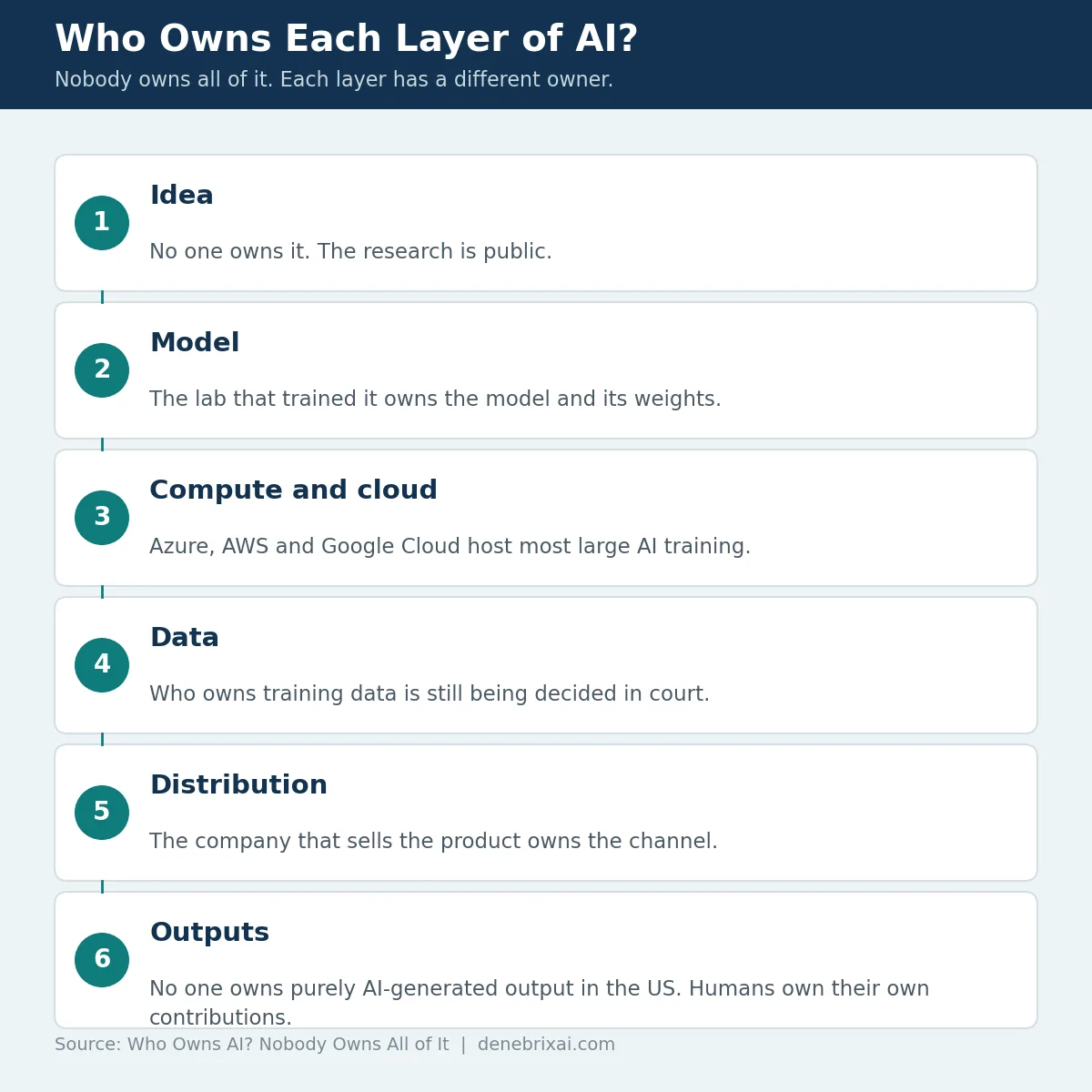
Owning a thing and controlling it are not the same. A company can own a model and still depend on someone else’s cloud to run it. A lab can share its model weights freely and still set the license terms. That is why who owns AI is a split question, and why the split matters more than any single name.
2. Who owns AI companies and models
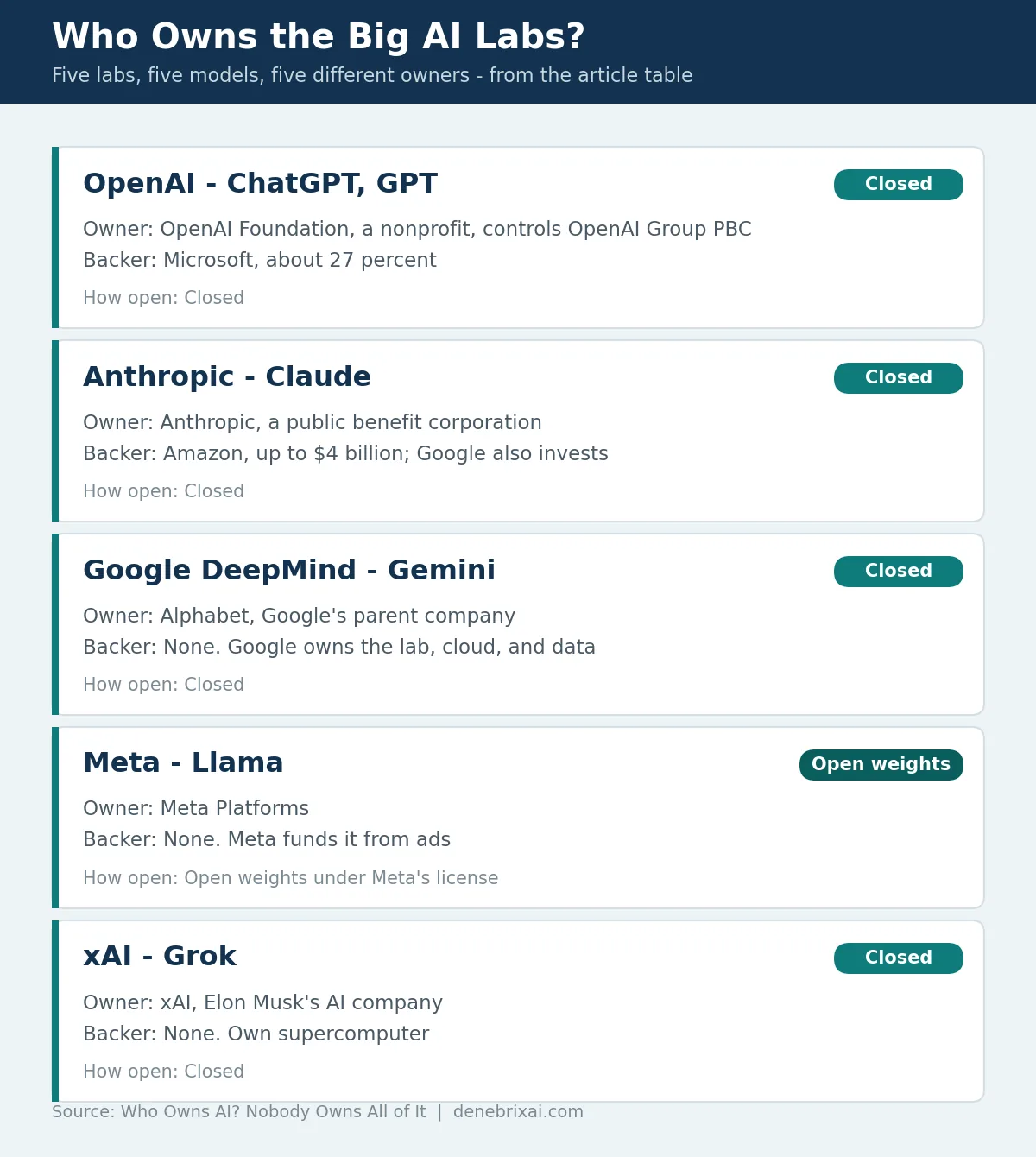
The most visible part of who owns AI is a small group of companies. Their tools look similar, but their ownership structures are very different.
| Company | Main model | Who owns it | Key backer or partner | How open is it |
|---|---|---|---|---|
| OpenAI | ChatGPT, GPT | OpenAI Foundation, a nonprofit, controls OpenAI Group PBC | Microsoft, about 27 percent | Closed |
| Anthropic | Claude | Anthropic, a public benefit corporation | Amazon, up to $4 billion; Google also invests | Closed |
| Google DeepMind | Gemini | Alphabet, Google’s parent company | None. Google owns the lab, cloud, and data | Closed |
| Meta | Llama | Meta Platforms | None. Meta funds it from ads | Open weights under Meta’s license |
| xAI | Grok | xAI, Elon Musk’s AI company | None. Own supercomputer | Closed |
OpenAI: a nonprofit in control, Microsoft as the biggest investor
OpenAI has the most unusual structure in the group. It began in 2015 as a nonprofit, added a for-profit subsidiary in 2019 to raise money for training, and kept the nonprofit in control. Under the structure announced in October 2025, the nonprofit is now the OpenAI Foundation, and the for-profit is now OpenAI Group PBC, a public benefit corporation. The Foundation appoints every board member, can replace directors at any time, and holds a 26 percent equity stake worth about $130 billion. OpenAI’s own structure page sets this out in full. So who owns AI at OpenAI? The Foundation does.
Microsoft, its biggest outside investor, holds about 27 percent of the Group, valued at about $135 billion, with exclusive IP rights and Azure API access until artificial general intelligence arrives, IP rights running through 2032, and a $250 billion Azure services contract from OpenAI. Microsoft’s own announcement confirms these terms. Microsoft owns a large share and the distribution channel, but not control: the board proved that in November 2023, when it briefly removed chief executive Sam Altman and he returned within days.
Anthropic: Amazon’s cloud, Google’s money, its own mission
Anthropic makes Claude. Amazon announced in September 2023 that it would invest up to $4 billion for a minority ownership position, and AWS became Anthropic’s primary cloud provider. Anthropic trains and deploys its models on Amazon’s Trainium and Inferentia chips, reaching AWS customers through Amazon Bedrock. Google is also an investor.
Anthropic is a public benefit corporation, and a Long-Term Benefit Trust holds authority over board elections. Anthropic’s announcement describes the deal in its own words. That mix is typical of who owns AI today: independent labs funded by the giants they compete with.
Google DeepMind: one company owns the whole chain
Google DeepMind is the simplest ownership story, because one company owns every layer. Google bought DeepMind, a London research lab, in 2014, and merged it with its Google Brain team in April 2023 to form Google DeepMind, which builds Gemini. Google also owns the cloud Gemini runs on, the search and video data that feeds its training, and the products where Gemini appears.
Meta: the open-weights exception
Meta takes a different route with Llama. It publishes the model weights, the learned numbers that make up a trained model, so developers can download, run, and adapt them. That is called open weights, and it differs from the closed approach of the other labs. But open weights are not open source: Meta does not release the training data or the full training pipeline, and the Llama license carries its own conditions. Meta still owns Llama. It shares the weights because its business runs on advertising, not on selling model access.
xAI: one founder, one chatbot
Elon Musk’s xAI owns Grok, its chatbot. The company is private, and Musk is its founder and public face. Grok runs on xAI’s own supercomputer and is sold as a service, including inside the X social platform. The company now presents itself on its own site under the name SpaceXSI.
What the table leaves out
The five labs above are not the whole story, but the pattern holds: the ai owners in the table, the owners of ai in practice, own the models, the compute, and the distribution.
3. Who owns .ai
This is the part of the question most people get wrong. If you ask who owns AI and mean the .ai ending, the answer is Anguilla. The .ai ending is not owned by an AI company. It is the country-code domain for a small Caribbean island. IANA, the body that coordinates domain names, lists the Government of Anguilla as the manager of .ai, and the registry’s lookup service runs on infrastructure from Identity Digital. IANA’s .ai delegation record shows the manager and the technical setup.
So Anguilla owns the .ai domain: the domain belongs to the country and its government manages it. AI companies rent .ai addresses the way any business rents a domain name. A startup that calls itself something.ai owns its website address, not the .ai ending and certainly not AI itself. But the owner of the domain and the owner of the technology are two different things, and confusing them is the most common mistake in the debate about who owns AI.
4. Who owns AI outputs
Models are one thing. Outputs are another. When you ask an AI tool to write text or draw an image, who owns the result? The question of who owns AI outputs is really two questions: who owns the model, and who owns the human work around the output.
In the United States, the answer comes from the US Copyright Office. Its January 2025 report, Part 2 on copyright and AI, concludes that copyright protects the original expression in a work created by a human author, even if the work also includes AI-generated material. Copyright does not extend to purely AI-generated material, or to material where there is insufficient human control.
Prompts alone do not provide enough control. But a human author can still own copyright in their own expressive contributions, in the creative selection and arrangement of material, and in creative modifications of what the model produced. The Copyright Office report sets out these conclusions in full.

That gives you a practical rule. If you write a prompt, take the raw output, and publish it unchanged, you have little or no copyright claim over it. If you select, edit, arrange, and reshape the output into something of your own, the human parts are yours. The more you direct and change the result, the stronger your claim. So if you ask who owns AI output after you have shaped it, the answer is: you own your part, and no one owns the raw machine part.
Training data is the harder half of this question, and the training-data half of who owns AI is still open. Writers, artists, and musicians have filed lawsuits saying their copyrighted work was used to train generative AI tools without permission or payment. No final ruling in the United States has settled whether training on copyrighted material is fair use, or whether AI companies owe creators compensation. The Copyright Office’s third part of its report, on generative AI training, was released in pre-publication form in May 2025, and the courts are still working through the cases.
Patents follow the same rule: an AI system cannot be listed as an inventor under current United States patent law, so a human inventor who uses AI as a tool can still patent an invention, and companies protect their AI work with a mix of patents, trade secrets, and open-source licenses.
The question of who owns generative ai outputs has no final answer yet. The question of who owns genai is the same question, asked with a shorter word, and the answer is the same: the model owner owns the model, the human owns the human part, and the training-data part is still in court.
5. Who owns AI, and who controls it
Ownership is one thing. Control is another, and who owns AI is only half the story. Three layers decide who controls AI, and who owns AI at each layer: compute, cloud, and chips.
The cloud layer is the most concentrated. Almost every large model is trained and served on Microsoft Azure, Amazon Web Services, or Google Cloud. Startups that look independent usually rent their compute from one of those three: OpenAI runs on Azure, Anthropic runs on AWS, and Google runs on its own cloud. A new lab cannot train a frontier model in a garage, because training needs data centers, power, cooling, and thousands of specialized chips running for weeks. The cloud providers own that capacity, and they set the price and the terms.

The chip layer is even narrower. Nvidia makes the chips that train and run the vast majority of large AI models, and it holds a near monopoly on the state-of-the-art chips used for AI training. That makes Nvidia a choke point: a company that owns no AI model at all still shapes who can build one. AMD and Intel compete, and Amazon builds its own Trainium and Inferentia chips, but none has broken Nvidia’s position.
Open source does not break this control. Meta can share Llama’s weights for free, but developers still need compute to run them at scale, and many open-source AI projects run on compute credits or revenue sharing with the same tech giants they were supposed to escape. Ask who runs AI day to day and the answer is the same group: the engineers at the big labs and the cloud providers who keep the servers running. Who controls artificial intelligence is therefore a question with two answers: the companies that own the infrastructure, and the governments that set the rules for it.
6. What this means for you
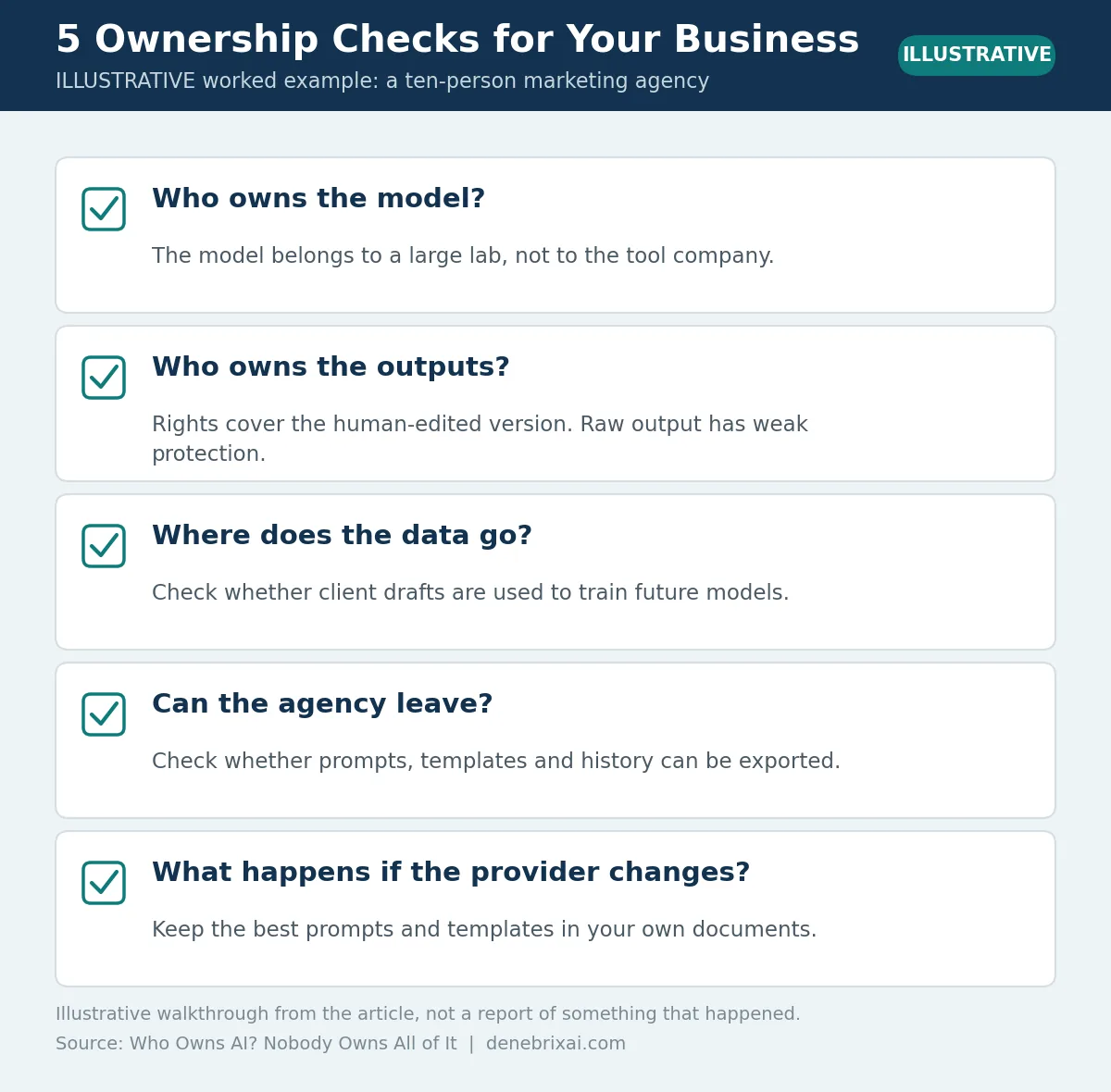
You do not need to own a model to use AI well. You need to know who owns the pieces you depend on, because that tells you what can change without your permission. The five checks below take ten minutes.
Worked example (ILLUSTRATIVE)
Imagine a ten-person marketing agency that wants to use an AI writing tool to draft client blog posts. This is an illustrative walkthrough, not a report of something that happened.
- Who owns the model? The agency finds the model belongs to a large lab, not to the tool company, so the tool company can change models and the output style with it.
- Who owns the outputs? The terms give the agency rights to text it creates with the tool, but only for the human-edited version. Raw output, published unchanged, has weak copyright protection.
- Where does the data go? The agency checks whether its client drafts are used to train future models. If yes, it switches that setting off.
- Can the agency leave? It checks whether it can export its prompts, templates, and history. If the tool locks that data in, the agency is renting, not owning, its own workflow.
- What happens if the provider changes? The agency keeps its best prompts and templates in its own documents, not only inside the tool.
None of these checks needs a lawyer. Together they tell the agency whether it controls its own work or merely borrows someone else’s. That is the real test of who owns AI for a business: not who owns the model, but who owns the work you make with it.
The same checks apply if you use AI for marketing: our guide to generative AI for marketing and our AI video generator weekly content calendar show how to keep control of your own material.
Conclusion
So, who owns AI? Nobody owns all of it, and that is the answer that matters. The idea is public. The models belong to a small group of companies, and the cloud and the chips belong to an even smaller group. The .ai domain belongs to Anguilla. The outputs belong to no one until a human adds something of their own. And responsibility follows ownership: the question of who owns AI has a twin, who is responsible for ai when something goes wrong, and the answer is the companies that build the models and the people who use them.
That split is the system. AI was built in public, funded by private money, and deployed on infrastructure owned by a few giants. Knowing who owns AI does not change the technology, but it changes how you use it, and that is what AI ownership means for most readers. Check who owns the model, read the terms on outputs and data, keep your own work exportable, and remember that the person who presses the button owns the result. The AI owned by big companies runs the world, but the work you make with it is still yours to control.
FAQs
Who owns AI?
No single person, company, or government owns artificial intelligence. The idea and the research are public. Companies own specific models, weights, data, cloud infrastructure, and products: OpenAI owns GPT, Google owns Gemini, Anthropic owns Claude, Meta owns Llama, and xAI owns Grok. The question of who owns AI has no one-name answer.
Who is the owner of artificial intelligence?
There is no single owner of artificial intelligence. The technology is a stack of layers, and each layer has different owners: chip makers own the hardware, cloud providers own the servers, labs own the models, and users own the prompts they write. Governments set rules but own no AI company.
Who owns OpenAI?
The OpenAI Foundation, a nonprofit, controls OpenAI. After the October 2025 recapitalization, the for-profit arm became OpenAI Group PBC. The Foundation appoints the Group board and holds a 26 percent equity stake worth about $130 billion. Microsoft is the biggest outside investor, with about 27 percent.
Who owns the .ai domain?
Anguilla owns the .ai domain. It is the country-code domain for the island, and IANA lists the Government of Anguilla as its manager. AI companies rent .ai addresses the way any business rents a domain name. If you ask who owns AI and mean the domain, the answer is Anguilla.
Who owns AI-generated content?
In the United States, no one owns purely AI-generated content, because the US Copyright Office does not extend copyright to material made wholly by AI. You can own copyright in your own human contributions: your own words, your creative selection and arrangement, and your edits. Prompts alone are not enough.
Who controls AI?
Control sits with the companies that own the compute, the cloud, and the chips. Azure, AWS, and Google Cloud host most large-scale AI training, and Nvidia makes the chips that train most large models. The short version of who owns AI and who runs it is this: the labs own the models, and the clouds own the compute.

Comments are closed