
Quantum computing is no longer just an idea in research papers. In 2024, real machines, cloud platforms and new experiments showed clear quantum computing progress in how we build and use these systems. At the same time, there are still major limits, such as noise, scale and cost, that stop the technology from reaching its full potential.
Quantum computing news now moves faster than the annual review cycle can capture, and the latest quantum computing discoveries often reach customers a year or two after the paper that started them. That is why this guide is updated rather than replaced, with a dated block at the top and a full timeline further down.
This guide covers the latest breakthroughs in quantum computing 2024, what those breakthroughs mean in practice, and which problems are still slowing quantum computing down. It also carries the story forward through 2025 and 2026, because several of the results that began in 2024 only reached customers and peer review in the two years that followed.
If you are looking for quantum computing news from a specific month, such as April 2026, the full 2024 to 2026 timeline further down covers the period in order.
The Latest Quantum Computing Breakthroughs at a Glance
If you only read one section, read this one. Here is what actually moved between December 2024 and September 2026, and who verified it.
Read as a group, the quantum computing recent breakthroughs 2025 produced were mostly quantum computing hardware advances, from Majorana 1 and Ocelot to the Caltech atom array. The quantum computing breakthroughs 2026 has delivered so far are different in character, centred on speed, verification and classical pushback rather than new chips. That makes quantum computing 2026 a year of consolidation rather than new silicon.
| When | Breakthrough | Who | Why it mattered |
| Dec 2024 | Willow reaches below-threshold error correction | Google Quantum AI | First hardware proof that adding qubits can reduce errors |
| Dec 2024 | 48 logical qubits in one processor | Harvard, MIT, QuEra | Shared Physics Breakthrough of the Year with Willow |
| Feb 2025 | Majorana 1, first topological qubit processor | Microsoft | A different route to error resistance, built into the hardware |
| Feb 2025 | Ocelot chip using cat qubits | Amazon Web Services | Cut projected error correction overhead |
| Mar 2025 | Quantum annealer beats a supercomputer on materials simulation | D-Wave | First advantage claim on a real world problem |
| Jun 2025 | Heron and Fugaku simulate molecules together | IBM and RIKEN | Hybrid quantum and classical at utility scale |
| Sep 2025 | 6,100 atom qubit array | Caltech | Largest neutral atom array on record |
| Oct 2025 | Verifiable quantum advantage demonstration | First advantage test others could independently repeat | |
| Oct 2025 | Nobel Prize in Physics for superconducting quantum circuits | Royal Swedish Academy | Recognised the foundation under most of today’s hardware |
| Nov 2025 | Helios commercial launch | Quantinuum | Most accurate commercially available system to date |
| May 2026 | A supremacy claim overturned on a laptop | Flatiron Institute CCQ | Raised the bar for what counts as quantum advantage |
| Sep 2026 | Quantum operations made 1,000 times faster | Chalmers University | Removed a known bottleneck on the road to fault tolerance |
What Actually Counts as a Quantum Computing Breakthrough
Quantum computing generates more announcements than almost any field in technology, and most of them are not breakthroughs. A useful filter has four questions.
● Was it peer reviewed, or is it a press release? A result in Physical Review Letters or Science carries different weight from a company blog post.
● Was it benchmarked against the best classical method, or against a convenient one? This is where most advantage claims fall apart.
● Did it use logical qubits or physical qubits? A machine with 20 good logical qubits can do more than one with 1,000 noisy physical ones.
● Can a customer use it, or is it a laboratory demonstration? Both matter, but they are not the same news.
Sridhar Tayur, professor at Carnegie Mellon’s Tepper School of Business, put the benchmarking problem plainly when he pointed out that every vendor picks the comparison that flatters its own machine, and that there has been no standard way to verify or compare those claims. Keep that in mind for every number in this article, including the ones we cite.
Quantum Computing Progress: Where the Field Actually Stands
Three things changed the shape of the field over these three years, and they are easy to mix up.
Measured honestly, fault-tolerant quantum computing progress is now tracked in logical qubits and error rates rather than raw qubit counts, and the recent breakthroughs in quantum computing that matter most are the ones that move those two numbers.
Error correction stopped being theoretical. Until Willow, adding qubits made machines worse. After Willow, adding qubits made them better. That single reversal is why the 2025 and 2026 roadmaps exist at all.
Logical qubits became the unit of measurement. Qubit counts still make headlines, but the number that decides what a machine can run is how many error corrected logical qubits it holds and how reliable they are.
The problem moved from physics to engineering. Fred Chong, ACM Fellow and professor at the University of Chicago, describes the field as being in an era of escape velocity, where the devices are good enough and the error correction codes have improved enough that building a large machine is now an engineering challenge rather than a science one. Engineering timelines are more predictable than scientific ones, which is why vendors began publishing dated roadmaps.
Not everyone agrees on the pace. In January 2025, Nvidia CEO Jensen Huang said quantum computing was still fifteen to thirty years away from being truly useful. The industry spent the following two years trying to prove him wrong, and the record is genuinely mixed.
Here We explains the latest breakthroughs in quantum computing 2024, what those breakthroughs mean in practice, and which problems are still slowing quantum computing down.
Quantum Computing 2024 in Simple Terms
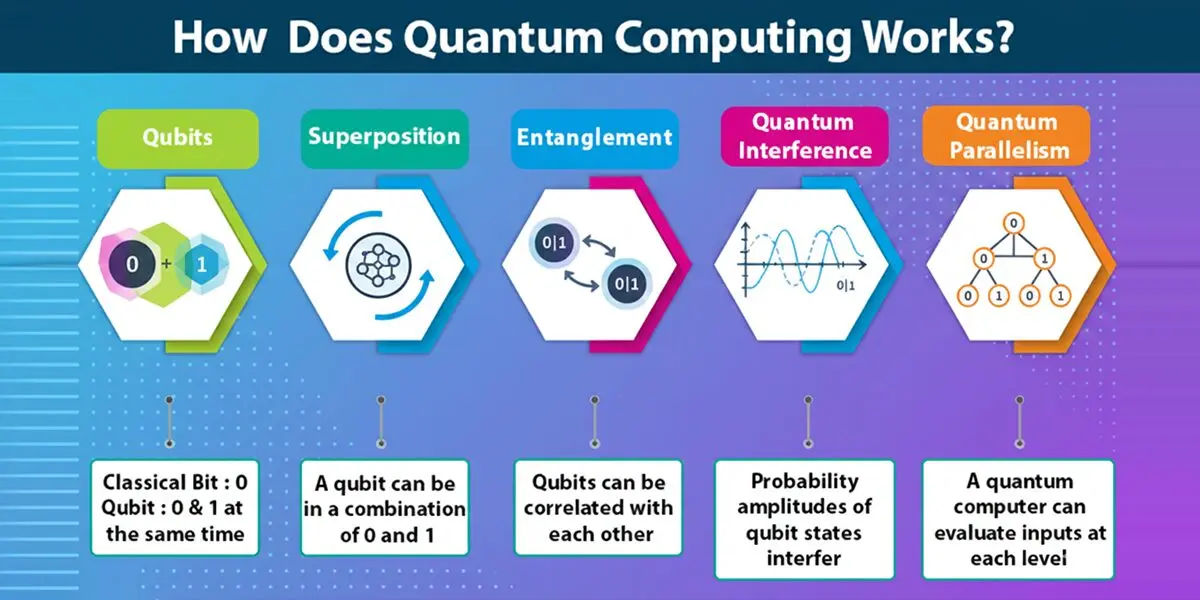
Quantum computing is a different way of processing information that uses qubits instead of normal bits.
A normal bit is either 0 or 1. A qubit can be 0, 1 or a mix of both at the same time. Groups of qubits can also be linked in a special way called entanglement. Because of this, a quantum computer can explore many possibilities at once. For some types of problems, this can be much faster than any classical supercomputer.
Inside a quantum computer, three ideas matter most:
- Physical qubits are the actual hardware units on the chip.
- Logical qubits are more reliable units built from several physical qubits using error correction.
- A fault-tolerant quantum computer would use logical qubits well enough to run long programs without errors taking over.
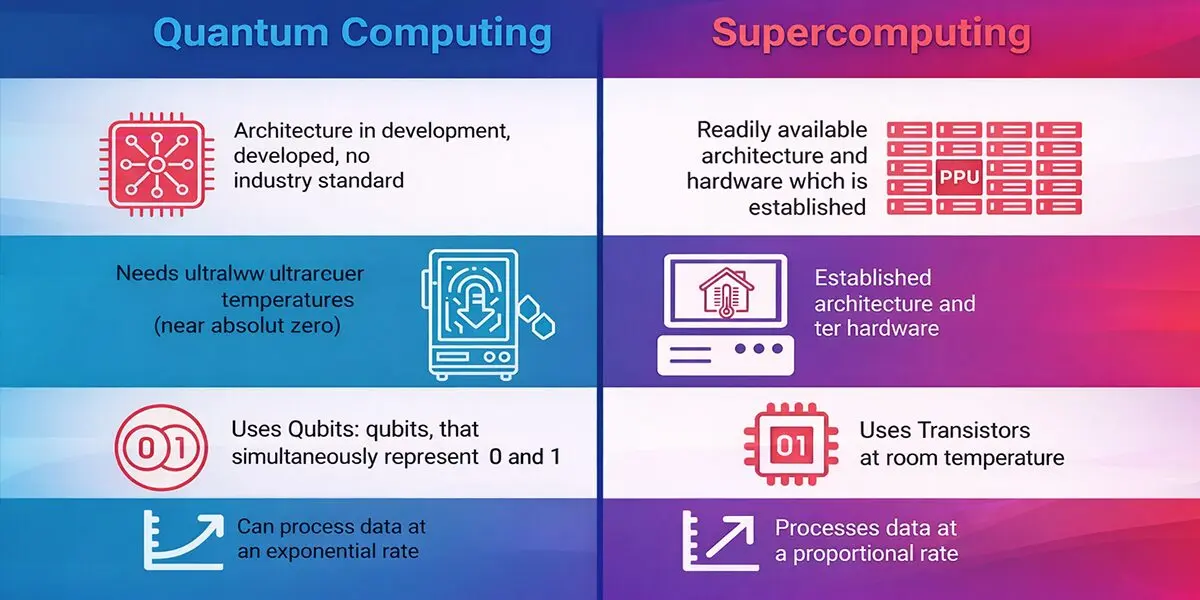
So, is quantum computing real today? Yes. Companies already run devices with tens to a few hundred qubits, often available through the cloud. However, most current systems are in what researchers call the noisy intermediate-scale quantum (NISQ) era, a term for today’s devices with tens to a few hundred noisy qubits. They are useful for narrow tasks and experiments, but they cannot yet run large general-purpose algorithms, such as breaking standard encryption.
When people talk about quantum computing in 2024, they are usually referring to three things at the same time: better qubits, more practical algorithms and a stronger ecosystem around the hardware.
How Many Logical Qubits Does a Useful Machine Need
A rough ratio helps here. Under current surface code approaches, one reliable logical qubit takes somewhere between tens and low thousands of physical qubits, depending on the hardware and the code distance. Running Shor’s algorithm against RSA-2048 is generally estimated to need thousands of logical qubits, which is why nobody credibly claims encryption is at risk today.
Microsoft has proposed a three level framework that the industry now argues about constantly. Level one is the noisy machines we have, roughly a thousand physical qubits with high error rates. Level two is small error corrected machines. Level three is large error corrected machines with hundreds of thousands or millions of qubits running millions of operations. By that framing, 2026 is the first year customers can take delivery of a level two machine.
IBM does not accept the framing. Jerry Chow, director of quantum systems at IBM Quantum, argues the levels are a device oriented view of the world and that the better question is what the circuits can actually be used for. IBM is pursuing error suppression and near term use cases while still targeting a fully error corrected machine, and has published a quantum roadmap that puts large scale fault tolerance in 2029.
Breakthrough 1: Error Correction and More Reliable Qubits
Error Correction Crosses the Threshold: Fewer Errors as Systems Grow
Everything in this section rests on one reversal. For most of the field history, adding qubits to a machine made it less reliable, because each new qubit brought more noise than the error correction could absorb. Crossing below the correction threshold flipped that relationship, and every roadmap published since assumes it holds.
Willow was the quantum error correction breakthrough that changed the direction of the field. The 48 logical qubit results from Harvard, MIT and QuEra was the logical qubits breakthrough that sat beside it, and the two together are why 2024 is treated as the turning point.
Google’s Willow Chip: Making Qubits Less Noisy
Noise is one of the biggest problems with quantum computing today. Qubits lose their information quickly, and small errors build up until the final result cannot be trusted. One of the most important quantum computing industry advancements in 2026 has been the continued progress in error-correction schemes that try to fix this by combining several physical qubits into a single logical qubit that can survive longer.
In December 2024, Google Quantum AI introduced Willow, a 105-qubit chip that achieved below-threshold quantum error correction. The team arranged qubits in grids such as 3×3, 5×5 and 7×7 (different code distances in a surface code). When they increased the grid size, the error rate of the logical qubit went down instead of up. In other words, adding more qubits made the stored information safer, not weaker.
This result matters because it shows that:
- scaling a quantum processor can actually reduce errors
- encoded qubits can keep information longer than single physical qubits
- large fault-tolerant machines are technically possible if we can reach enough scale
Willow also ran a demanding test called random circuit sampling. This test would take an enormous amount of time on a top classical supercomputer but finished in minutes on the chip.
It does not solve a direct business problem, but it is strong evidence that quantum hardware can outperform classical machines on certain carefully chosen tasks.
This work was significant enough that Physics World named it joint Physics Breakthrough of the Year for 2024, shared with Google’s Willow team and a Harvard/MIT/QuEra team led by Mikhail Lukin and Dolev Bluvstein, recognized for integrating 48 logical qubits into a single processor capable of logical operations.
Willow’s story did not end in 2024. In October 2025, Google announced a verifiable advantage test in which the chip ran 13,000 times faster than the fastest classical supercomputer on an algorithm that anyone could independently reproduce. Verifiability is the part that matters. Earlier advantage claims were hard to check, which is exactly the weakness that caught up with one of them in 2026.
Topological Qubit Breakthrough
Another important 2024 result came from Quantinuum together with researchers at Harvard and Caltech. They reported one of the first convincing experimental realizations of a topological qubit on their H2 trapped-ion system.
In simple terms:
- Atopological qubit stores information in global patterns of the system, not just at a single point
- Small local disturbances are less likely to change that information
- This gives the qubit built-in resistance to certain kinds of error
The team used three-level systems called qutrits and carried out operations that matched long-standing theoretical ideas about topological quantum computing. The experiment was still small, but it supports the idea that future topological designs could encode logical qubits using fewer physical resources than today’s surface-code approaches.
That would make large-scale machines easier and cheaper to build and marks one of the most meaningful breakthroughs of the year.
Microsoft’s Majorana 1 and the Topological Bet
In February 2025, Microsoft unveiled Majorana 1, which it describes as the first quantum processor powered by topological qubits. The chip is built on materials Microsoft calls topoconductors, engineered to host Majorana modes.
The idea behind the bet is straightforward. Every other approach corrects errors after they happen, using extra qubits and classical decoding. A topological qubit is designed to resist certain errors at the level of the physics itself, before any correction is needed. If that works at scale, the number of physical qubits needed per logical qubit falls sharply, and the whole fault tolerance timeline compresses.
Microsoft has reported eight topological qubits on a chip architecture it says is designed to scale toward a million. That is a very early number against a very large target, and independent verification of topological qubit claims has been contested in the field for years. Treat this as the highest risk and highest reward route on the board.
Amazon’s Ocelot Chip and the Cat Qubit Approach
Also in February 2025, Amazon Web Services announced Ocelot, a chip that combines cat qubits with transmon qubits. Cat qubits are built to suppress one specific type of error in hardware, which means fewer resources are needed to correct the rest. AWS framed the result as cutting years off the projected timeline to a practical machine.
Every new quantum chip announced through 2025 carried a version of the same message. The competition had shifted from how many qubits a processor holds to how few errors it makes.
Error Correction Became an Industry, Not a Paper
By 2025 the error correction news stopped being occasional and became constant. Companies publishing results in a single year included QuEra with magic state distillation on neutral atoms, Alice and Bob on bit flip stability, Microsoft on four dimensional codes, Google, IBM on decoders, Quantinuum, IonQ, Nord Quantique, Infleqtion and Rigetti.
Atom Computing has reported creating and entangling 24 logical qubits built from 112 physical qubits, and running computations on 28 logical qubits. That figure comes from vendor communications rather than independent replication, so it is worth watching rather than relying on.
Neutral Atoms Take the Lead: Magne, QuEra at AIST and the Caltech Array
Superconducting circuits dominated the coverage for a decade. Then both of the first error corrected machines heading to customers turned out to be built from neutral atoms, which is not a coincidence.
Neutral atom quantum computing moved from an interesting alternative to the leading route for error corrected machines in under two years, and the reason is structural rather than incremental.
How a Neutral Atom Quantum Computer Works
Inside a vacuum chamber, a gas of atoms is cooled to just above absolute zero. Individual atoms are then caught and held by tightly focused laser beams, a technique known as optical tweezing. Each trapped atom is one physical qubit, and they can be arranged in two dimensional or three dimensional arrays. Gates are performed by shining a separate laser at the atoms in a precisely orchestrated pattern.
Two properties make this attractive for error correction. The atoms can be physically moved, so any two qubits can be brought next to each other, which is impossible on a fixed superconducting chip. And the same laser pulse can operate on many pairs of atoms at once, which gives parallelism.
Yuval Boger, chief commercial officer at QuEra, has said that the ability to move neutral atoms around allows error correction methods that are simply not possible with static qubits.
Magne: Microsoft and Atom Computing Ship to Denmark
Microsoft and Atom Computing are delivering a machine called Magne to Denmark’s Export and Investment Fund and the Novo Nordisk Foundation. It is specified at 50 logical qubits built from roughly 1,200 physical qubits, with operation expected by the start of 2027.
Srinivas Prasad Sugasani, vice president of quantum at Microsoft, has framed the goal carefully. The machine is aimed at establishing a scientific advantage rather than a commercial one. That distinction is worth holding onto, because it is the honest version of what a level two machine can do.
QuEra at AIST in Japan
QuEra has delivered a machine ready for error correction to Japan’s National Institute of Advanced Industrial Science and Technology, with roughly 37 logical qubits depending on implementation, built from 260 physical qubits. The company plans to open it to global customers.
Caltech’s 6,100 Qubit Array
In September 2025, Caltech researchers split a laser beam into 12,000 parts to trap 6,100 caesium atoms in a single array. The qubits held superposition for 13 seconds, around ten times longer than previous arrays, and the atoms could still be moved while trapped. This is the largest array of its kind on record.
The Trade Off Nobody Hides
Neutral atom gates are slow. Jerry Chow at IBM Quantum puts operations on atomic systems at roughly one hundredth to one thousandth the speed of superconducting equivalents. QuEra’s counter argument is that clock speed is the wrong metric, and that time to solution is what counts, because more operations run in parallel and fewer are needed for error correction.
Justin Ging, chief product officer at Atom Computing, sums up the case for the approach in one word: scalability. Both QuEra and Atom Computing expect to put 100,000 atoms into a single vacuum chamber within a few years.
Superconducting Qubits Are Not Standing Still
The neutral atom story can make it sound as though superconducting circuits have been overtaken. They have not. Willow proved below threshold correction on a superconducting chip. The IBM Heron line is the processor behind the HSBC trading work and the Fugaku molecular simulation. Rigetti has cut two qubit gate error rates while scaling across multiple chips. And the 2025 Nobel Prize in Physics went to work on superconducting quantum circuits, the foundation under most of today machines.
Trapped ions occupy the third position and keep the accuracy crown. The Quantinuum H2-1 reached 56 fully connected qubits, and its successor Helios is positioned as the most accurate commercial system available. The honest summary is that no qubit type has won, and the gap between them is narrower than any single vendor messaging suggests.
Breakthrough 2: Algorithms and Applications Move Closer to Reality
Better qubits only matter if we can use them on real problems. In 2024, many research groups focused on hybrid approaches that mix classical computing, AI and quantum hardware so each part handles the work it does best.
Chemistry and Materials
One of the most active areas was chemistry and materials science.
Microsoft’s Azure Quantum Elements platform combined AI, high-performance computing and quantum techniques to study complex reaction networks. In one project, scientists ran more than a million advanced chemistry calculations and used quantum tools to reach very accurate energy estimates.
At the same time, a collaboration led by Pasqal used neutral-atom processors to study how water molecules arrange themselves inside tiny pockets in proteins. This detail strongly affects how drugs bind to their targets and is very hard to model with classical methods alone.
The message is simple: in a few carefully chosen cases, quantum tools are starting to help with simulations that are extremely costly on traditional machines. This is where some of the first practical quantum computing advances are appearing.
Quantum chemistry is also where the variational methods live. The Variational Quantum Eigensolver, usually shortened to VQE, and related ansatz designs such as the Local Unitary Cluster Jastrow method are the workhorses of near term chemistry on real hardware. They run a small quantum circuit repeatedly and hand the optimisation back to a classical computer, which is exactly the hybrid pattern that became standard across the field.
AI and Machine Learning
Quantum ideas also appeared in AI and machine learning. Instead of trying to replace classical models, researchers looked for ways to support them.
Quantinuum developed a quantum-based natural language model that uses circuits to represent sentence structure while still being trainable and understandable.
Terra Quantum built a hybrid quantum neural network for classifying liver images using only a handful of qubits in a federated learning setup, so patient data stayed inside each hospital.
These projects are early, but they show that small quantum models can work alongside existing AI systems, especially in sensitive settings where privacy and clarity matter.
The quantum and AI link tightened considerably afterwards. In October 2025, Nvidia announced NVQLink, an open architecture for coupling GPUs directly to quantum processors, with partners spanning most of the hardware industry. Quantinuum markets its newest system explicitly around generative quantum AI. Whether that produces results or remains positioning is still open.
Physics, Engineering and Simulation
Quantum computers are also starting to act as scientific tools.
In 2024, teams used real hardware to explore:
- Plasmas, in work by Riverlane and MIT related to fusion energy and other high-temperature systems
- Fluid flow, in BQP’s quantum-assisted simulations of simplified jet engine models
- Ideas from cosmology and quantum field theory, where quantum devices were used to test behaviors that are hard to study in any other way
These demonstrations are small in scale, but they show how quantum computing advances can support scientists as part of larger simulation workflows rather than replacing classical systems.
Speed as a Safety Feature: The Chalmers Single Cycle Result
This one arrived in September 2026 and it is the most recent significant result at the time of writing.
The logic behind it is simple. The longer a quantum operation takes, the more time errors have to accumulate. So making operations faster is not a performance optimisation, it is an error reduction strategy.
Researchers at Chalmers University of Technology in Sweden developed a method that performs a wide range of advanced quantum operations more than a thousand times faster. The work was published in Physical Review Letters by Tangyou Huang, Lei Du and Lingzhen Guo, working across Chalmers and Tianjin University in China.
The technique targets bosonic quantum codes. Rather than storing quantum information in individual qubits, bosonic codes encode it in the microwave fields inside superconducting circuits, which gives built in protection against certain error types. The catch has always been that preparing and controlling those states required guiding the system through thousands of repeated driving cycles.
The Chalmers method uses what the same team calls quantum lattice gates, a universal gate set they proposed recently, and implements them within a single driving cycle using Floquet control. Tangyou Huang describes the difference as building a Lego castle from pre made modules rather than brick by brick.
Lei Du, a researcher in Applied Quantum Physics at Chalmers and lead author of the study, describes the underlying problem in plain terms. Qubits are so sensitive that the smallest disturbance pushes the quantum state away from its target and information is lost, and if enough errors pile up before correction catches them, the computation fails. On the result itself, he frames the gain as completing a diverse range of operations on bosonic states within one driving cycle rather than several thousand, which makes them faster, more efficient, and less exposed to disturbance while they run.
Two caveats belong here. This is a theoretical study, not an experimental demonstration. And the team notes it can be implemented on existing superconducting platforms, with discussions already underway at Chalmers, which is building a 100 qubit machine of its own. Watch for the experimental follow up.
Room Temperature Quantum Devices and the Retreat From Cryogenics
Most quantum computers need dilution refrigerators operating near absolute zero. That single requirement drives much of the cost, the footprint and the difficulty of running one. Two developments started chipping at it.
Neutral atom systems still cool their atoms, but much of the surrounding infrastructure runs at room temperature, which removes the dilution refrigerator from the equation.
In May 2026, Stanford researchers demonstrated a nanoscale optical device that works at room temperature and links the quantum properties of light and electrons, using twisted light interacting with molybdenum diselenide monolayers inside silicon nanostructures. It is a component rather than a computer, but it points toward smaller and cheaper quantum systems for communication and sensing.
Breakthrough 3: Industry-Scale Chips, Cloud Access and Investment
| Qubit / chip type | How it works | Main advantage | Main challenge |
| Superconducting | Uses superconducting circuits and Josephson junctions to store and control quantum information. | Fast operations and established chip-fabrication methods. | Requires extremely low temperatures and careful error control. |
| Trapped-ion | Stores quantum information in individual ions controlled by electromagnetic fields and lasers. | High-fidelity operations and long coherence times. | Operations can be slower and scaling is complex. |
| Neutral-atom | Uses laser-controlled neutral atoms as individual qubits. | Strong scalability potential and flexible qubit arrangements. | Precise laser control and reliable gates remain challenging. |
| Photonic | Encodes quantum information in individual particles of light, such as their phase or polarization. | Well suited to optical networking and room-temperature components. | Creating and controlling photon interactions efficiently is difficult. |
| Topological | Encodes information in special quantum states designed to be less sensitive to local disturbances. | Could offer stronger protection against certain errors. | Still an experimental approach with major engineering challenges. |
| Quantum-dot / spin | Uses the spin of electrons confined in semiconductor structures to represent quantum information. | Potential compatibility with existing semiconductor manufacturing. | Precise control and large-scale integration remain difficult. |
| Cat qubit | Encodes information in superpositions of coherent states, often paired with transmons. | Suppresses one error type in hardware, reducing correction overhead. | Still early, and the remaining error types must still be corrected. |
| Dual-rail | A superconducting qubit with a control scheme that flags errors as they occur. | Reports errors in real time, which simplifies decoding. | A newer architecture with a smaller track record. |
Stronger Processors and Cloud Platforms
The year was not only about lab experiments. It was also about making hardware more useful in practice.
Quantinuum’s H2-1 trapped-ion system reached 56 fully connected qubits with very high gate quality. At the same time, companies such as IBM, Google, Microsoft, Amazon and IonQ expanded their quantum cloud services. This lets researchers and businesses run experiments on different types of quantum devices without owning the equipment.
The key shift in 2024 was:
- Fewer headlines about raw qubit counts
- More focus on quality, stability and error correction
This change is essential if quantum computers are going to support real workloads instead of remaining purely experimental.
Helios and the Move to Commercial Systems
H2-1’s successor arrived on 5 November 2025, when Quantinuum announced the commercial launch of Helios, which the company positions as the most accurate commercial system available. Helios lead architect Anthony Ransford described the scale of the calculation it performed by saying you would need to harvest every star in the universe to power a classical machine that could match it.
Take the framing with appropriate salt, but the customer list is the more useful signal. Early testers included SoftBank, JPMorgan Chase, Amgen working on hybrid quantum machine learning for biologics, and BMW researching fuel cells. Rajeeb Hazra, Quantinuum’s president and chief executive, framed it as the first time enterprises could access a highly accurate general purpose quantum computer.
Hybrid Quantum Classical Workflows and Quantum as a Service
The deployment model that actually settled in is not a quantum computer replacing a classical one. It is a quantum processor handling one hard subproblem inside a larger classical pipeline.
Hybrid quantum-classical computing is the architecture that actually shipped, and quantum as a service is how almost every team reaches it, because owning the hardware is out of reach for all but national laboratories.
IBM demonstrated this directly by orchestrating hybrid jobs through its Spectrum LSF workload scheduler, treating Qiskit Runtime primitives as resources alongside classical CPU and GPU nodes. In June 2025 IBM paired its Heron processor with the Fugaku supercomputer at RIKEN to simulate molecules at what IBM called utility scale.
Scott Buchholz, quantum computing lead at Deloitte, makes the practical case: the science and chemistry problems people expect to solve with quantum computers are solved today with high performance computing, so having the two talk to each other and each handle what it is strongest at is a sensible design.
On the access side, AWS Braket, IBM Quantum Network, Google Quantum AI and Microsoft Azure Quantum all offer pay as you go access to quantum processing units. Billing looks more like cloud compute, priced per shot or per circuit, than like traditional HPC capital investment. Building and running a machine in house costs tens of millions of dollars and needs near absolute zero infrastructure, so for almost every organisation the cloud is the only realistic route.
Cloud access removes the hardware barrier. It does not remove the expertise barrier. Teams still need people who can formulate a problem in a quantum friendly way and interpret probabilistic output, and that gap is wide across most enterprises.
Funding and Market Growth
On the business side, investment in the field continued to rise. According to McKinsey quantum technology start-ups raised nearly $2.0 billion worldwide in 2024, up 50% from $1.3 billion in 2023, with private venture capital accounting for about two-thirds of that total. Quantum computing companies alone generated $650 million to $750 million in revenue in 2024, and are expected to surpass $1 billion in 2025. Governments launched and expanded national programs worth tens of billions over the coming years, and IBM led the industry with 191 quantum technology patents granted in 2024, followed by Google with 168.
This long-term commitment is important because large, reliable quantum systems require:
- years of engineering to move from one-off demos to stable products
- specialized teams across physics, engineering and software
- major infrastructure, from fabrication to cryogenic cooling and control electronics
The money flowing into the field is a sign that many stakeholders see today’s progress as real, even if the big payoffs are still in the future.
What Happened to Funding After 2024
The curve steepened sharply. In September 2025, PsiQuantum raised $1 billion at a $7 billion valuation. Quantinuum’s funding round, joined by Fidelity, brought its total to $800 million at a $10 billion valuation.
Government money moved too. In November 2025, DARPA selected eleven quantum computing firms for its Quantum Benchmarking Initiative, with up to $15 million each, aimed at utility scale computing by 2033.
Publicly traded quantum firms including Rigetti, IonQ, Quantum Computing Inc and D-Wave saw extremely volatile share prices through this period. Yuval Boger at QuEra reads the financing as investor confidence that the sector is entering a deployment phase rather than a pure research one. That is one reading. The volatility supports a more cautious one.
What Enterprises Actually Achieved With Quantum Computing
Pilot projects are easy to announce and hard to verify. These are the ones with published numbers attached.
| Organisation | What they did | Result | Status |
| HSBC with IBM | Applied a Heron processor to bond trading prediction | 34% improvement over classical alone | Announced September 2025 |
| Ford Otosan with D-Wave | Production scheduling using quantum annealing | Scheduling cut from 30 minutes to under 5 | Running in production |
| Ansys with IonQ | Fluid interaction analysis in medical devices | 12% speed improvement over classical alone | Announced March 2025 |
| Boeing | QUICK project on aircraft corrosion modelling | $2.5 million programme, hybrid workflow | Vendor reported |
| Amgen with Quantinuum | Hybrid quantum machine learning for biologics | Exploratory | Early tester on Helios |
| BMW with Quantinuum | Fuel cell research | Exploratory | Early tester on Helios |
The Ford Otosan case is the one to watch, because it is the only entry on that list described as deployed in production rather than tested. It is also worth noting what kind of machine did it. D-Wave builds a quantum annealer, not a general purpose gate based computer, and annealers are well suited to optimisation problems like scheduling and routing.
A D-Wave sponsored survey of 400 business leaders working in optimisation found that a majority said they had reached the limits of classical computing and were planning to build quantum into their workflows. It is vendor sponsored research, so read it as directional rather than definitive.
The Classical Counter Punch: A Supremacy Claim Overturned on a Laptop
This is the part of the story most coverage skips, and it is the single best test of whether a quantum advantage claim is real.
In March 2025, a group of quantum computing researchers reported in Science that they had calculated the dynamics of an intricate system of qubits on a quantum computer, and stated the feat was impossible for classical computers to match.
In May 2026, physicists at the Center for Computational Quantum Physics at the Simons Foundation’s Flatiron Institute, with collaborators at Boston University, did it on a conventional computer. Much of the initial calculation ran on a personal laptop.
Joseph Tindall, the first author, describes the team’s instinct toward these claims as skeptical by default, asking whether the claimants had really tried every classical approach. Co author Miles Stoudenmire says they picked this particular target precisely because it had a big claim attached to it.
The method rests on tensor networks. Tindall likens a tensor network to a zip file for the wave function, compressing an object that grows exponentially with particle count into an interconnected structure of small numerical tables. The team also revived belief propagation, an algorithm from the 1980s recently adapted for quantum systems, which is more approximate than alternatives but far cheaper to run. The work used ITensor, a tensor network software library developed at the centre.
Their results matched the quantum computer’s, at state of the art accuracy, with no quantum computer involved.
Neither researcher frames this as classical computing winning. Tindall points to real synergy between the two camps, since classical simulation guides quantum work and the barrier to entry is far lower when you do not have to build a machine first. The practical lesson for anyone evaluating a vendor claim is direct. Before accepting that a problem is classically intractable, ask whether it has been tested against tensor network methods.
How to Tell a Genuine Advance From a Press Release
Use this as a checklist the next time a quantum headline crosses your desk.
| Check | What to ask | Warning sign |
| Source | Peer reviewed journal, preprint, or company blog? | Only a press release exists |
| Qubit type | Logical or physical qubits in the headline number? | Physical count presented as capability |
| Baseline | What classical method was it compared against? | Compared to brute force, not the best method |
| Reproducibility | Can an independent party verify it? | Result depends on proprietary tooling |
| Problem | Is the task useful or constructed to be hard? | Random circuit sampling framed as an application |
| Stage | Theory, lab demonstration, or shipped product? | Roadmap dates presented as achievements |
| Who benefits | Does the claimant sell the thing being validated? | Vendor is the only source |
IBM published a paper in July 2025 arguing that evaluating quantum advantage claims is genuinely hard and that real advantage requires industry consensus rather than a single vendor’s benchmark. IBM has also released a set of optimisation benchmarks. Both are steps toward the standard Tayur says has been missing.
Main Quantum Computing Challenges After 2024
Even after a year full of results, quantum computing is still in its early days. Several deep challenges of quantum computing remain and shape what comes next.
1. Scaling Up to Large Systems
The most powerful algorithms are expected to need thousands of logical qubits and possibly millions of physical ones. Current chips like Willow and H2 are important steps, but they are still far from that scale. Each logical qubit usually needs many physical qubits, and only a small number can be run at once.
Scaling from dozens or hundreds of qubits to millions is one of the hardest engineering tasks in modern technology and remains a central problem for the field.
2. Noise and Engineering Complexity
Qubits are extremely fragile. Superconducting devices must operate close to absolute zero and lose their energy in microseconds. Tiny disturbances from the environment, control electronics or fabrication defects can spoil a calculation.
Large systems therefore need:
- Complex cooling equipment
- Precise control hardware, often using lasers or microwaves
- Careful layout to reduce interference and crosstalk between qubits
Coordinating, calibrating and stabilizing many interacting qubits at once is a major technical challenge and one of the main reasons quantum computers are hard to build.
The list of things that can corrupt a calculation is longer than most people expect. Electrical noise, mechanical vibration, overheating and even cosmic radiation passing through the chip all register as errors.
3. Limits of Algorithms and Verification
On the software side, there are also important limits.
Only a few classes of problems are known to benefit clearly from quantum speedups, such as factoring, some search tasks and certain physics simulations. Many proposed optimization and machine learning methods are still experimental, and it is not always clear when they will beat the best classical algorithms.
Checking the output of a large quantum computation is also difficult when the system is too large to simulate directly. This raises new questions about reliability and trust.
4. Security and Encryption
Security is one of the most widely discussed topics around quantum computing. In theory, a large fault-tolerant quantum computer could run Shor’s algorithm and break common public-key systems such as RSA and elliptic-curve schemes. No such machine exists today, but encrypted data stored now could be at risk in the future.
To prepare for this, many organizations are starting to adopt post-quantum cryptography (PQC), which uses new mathematical problems that are believed to be safe even if powerful quantum machines become available.
Harvest Now, Decrypt Later and the Q-Day Clock
The threat is not only that a future machine will break today’s encryption. It is that adversaries are capturing encrypted traffic right now and storing it to decrypt once the hardware exists. That practice has a name in the security community: harvest now, decrypt later. The moment a quantum computer can break widely used public key cryptography is referred to as Q-Day.
Isabella Bello Martinez, senior quantum technologist at Booz Allen Hamilton, describes her post-quantum cryptography team as ringing the fire bell, and warns against the assumption that a vendor will handle the migration on your behalf.
The timeline tightened in May 2025 when Google researchers published work showing that combining error correction advances with more efficient algorithms made breaking RSA roughly twenty times less resource intensive than previously estimated. Nothing about that means encryption is broken today. It means the migration window is shorter than many plans assume.
Post-quantum cryptography migration is therefore a planning problem for today rather than a future one, and the organisations that start early will be the ones with the least to rewrite.
5. Skills, Cost and Access
Finally, there are human and economic issues.
The field requires people who understand physics, engineering, computer science and mathematics at a deep level, and that mix of skills is rare. Building and operating quantum hardware is also expensive. For those looking to strengthen their data foundations, you can use DataDriven for practicing SQL interview problems as a starting point for building the analytical skills the industry demands.
For now, most users work with this technology through shared cloud platforms and research partnerships instead of owning their own systems. That is one reason most projects are still pilots rather than large-scale deployments.
6. Benchmarks Nobody Agrees On
This challenge did not exist in the 2024 conversation and now sits near the top. Every company that claims quantum advantage does so on a benchmark of its own choosing, with its own mix of hardware and software optimisation. There is no standard disclosure of what classical machine was used, how much time went to classical work and how much to quantum.
Until an independent benchmarking standard exists, treat every comparative claim as a starting point for questions rather than a finding.
Emerging Real-World Use Cases From 2024
Even if fully fault-tolerant machines are still in the future, work in 2024 gives a clearer picture of where early value may appear.
The latest advancements in quantum computing applications 2025 2026 cluster in four areas, and each one is at a different stage of maturity.
1. Drug Discovery and Health
Researchers are using quantum-inspired methods and early devices to:
- study how molecules react and bind in complex environments
- model how water and other solvents surround proteins
- support medical decisions, such as transplant matching, with hybrid quantum AI models
The goal is to make research faster and more precise so that promising ideas can move from the lab to real treatments more quickly.
Pharmaceutical work is consistently named as the first sector likely to see genuine value from fault tolerant machines, because molecular simulation is the problem class where quantum computers have the clearest theoretical edge.
2. Materials, Energy and Climate
In materials and energy research, teams are testing quantum tools to:
- design better batteries and catalysts
- improve key industrial reactions with lower emissions
- model plasmas for fusion energy
- explore advanced fluid and climate models that strain classical supercomputers
More accurate simulations could lead to better designs, cleaner processes and new materials.
3. Finance, Logistics and Optimization
In finance and logistics, experiments focus on:
- portfolio design and risk analysis
- routing, scheduling and matching problems
Most of these studies still run on simulators or modest hardware, but they help organizations learn how quantum optimization might fit into existing decision-making systems once the technology matures.
This is also the category with the most concrete published results, including the HSBC bond trading work and the Ford Otosan scheduling deployment described earlier.
On the algorithm side, most of this work runs on hybrid methods rather than pure quantum ones. The Quantum Approximate Optimization Algorithm, usually shortened to QAOA, is the standard approach for combinatorial problems, and quantum annealing is the alternative route that D-Wave took. Neither has a proven advantage over the strongest classical optimisation methods yet, which is worth stating plainly given how often optimisation is named as the first commercial application.
4. AI and Data Analytics
Research groups are building quantum routines for tasks such as matrix multiplication, eigenvalue estimation and dimensionality reduction. Over time, these building blocks could sit inside larger AI and analytics pipelines, with classical hardware doing most of the work and quantum accelerators handling specific sub-tasks.
Distributed Quantum Computing: Connecting Separate Processors
Building one enormous quantum chip is extremely hard. Connecting several smaller ones is a different problem, and for some approaches it may be the easier one.
Distributed quantum computing links multiple quantum processors so they behave as a single larger machine. The hard part is that the link itself has to be quantum. Classical wiring can carry control signals and measurement results, but sharing computation across modules needs entanglement distributed between them, which is fragile over distance and slow to establish.
Progress here is real but early. Rigetti has demonstrated a multi chip system that ties several processors together, and IBM has built quantum communication links into its modular roadmap. Neutral atom systems approach the same goal differently, by aiming to put far more qubits inside one vacuum chamber rather than connecting chambers together.
Treat distributed quantum computing as a scaling strategy still in research rather than a shipping capability. If it works, it removes the hard ceiling on how large a single processor can be. If it does not, every roadmap depends on making one chip much bigger.
Quantum-Inspired Computing and How It Differs
A term that appears often in vendor material and is easy to misread. Quantum-inspired computing runs mathematics borrowed from quantum algorithms on ordinary classical hardware. There is no qubit, no cryogenics and no quantum processor involved.
The methods include variational optimisation patterns, annealing style solvers and tensor network techniques, all executed on high performance computing clusters and GPUs. Because they run on existing infrastructure, teams can deploy them today without waiting for hardware to mature, and several engineering vendors sell exactly this.
The important distinction is what it does not give you. Quantum-inspired methods cannot deliver a quantum speedup, because the underlying computation is still classical. Where they help is in restructuring a problem the way a quantum algorithm would, which sometimes produces a better classical solution than the conventional approach. The Flatiron Institute result described earlier is a research example of the same principle, classical methods guided by quantum thinking.
Who Is Building What: A Company by Company Map
The field has not converged on a single qubit type, and the honest read is that it may not for years. Here is the landscape as it stands.
| Company | Qubit type | Flagship system | Stated direction |
| IBM | Superconducting | Heron, Flamingo line | Large scale fault tolerance targeted for 2029 |
| Superconducting | Willow | Below threshold correction, verifiable advantage | |
| Microsoft | Topological, plus partners | Majorana 1, Magne with Atom Computing | Topological qubits, chip designed to scale toward a million |
| Quantinuum | Trapped ion | Helios, System Model H2 | Highest accuracy commercial system, generative quantum AI |
| IonQ | Trapped ion | Forte line | 1,600 logical qubits in 2028 rising to 80,000 by 2030 |
| QuEra | Neutral atom | System at AIST Japan | Error corrected machine with roughly 37 logical qubits |
| Atom Computing | Neutral atom | Magne with Microsoft | 50 logical qubits from around 1,200 physical |
| Amazon Web Services | Cat and transmon hybrid | Ocelot | Reduce error correction overhead in hardware |
| PsiQuantum | Photonic | Photonic processor | Million qubit commercial machine, most funded startup in the field |
| Xanadu | Photonic | Borealis line | Photonic route to fault tolerance |
| D-Wave | Quantum annealing | Advantage | Optimisation problems, already in production use |
| Rigetti | Superconducting | Multi chip systems | Multi chip scaling, halved two qubit gate error |
| Nvidia | Not a qubit maker | CUDA-Q, NVQLink | Couple GPUs to every vendor’s quantum processor |
Nvidia’s position is worth a separate note. It does not build qubits. It is instead making itself the classical half of every hybrid system, with partners across neutral atom, trapped ion, superconducting and photonic hardware. In a field where nobody knows which qubit wins, that is a deliberately neutral bet.
Quantum Computing Milestones Timeline: 2024 to 2026
A compact reference for how the three years fit together.
| Period | What happened |
| 2024 | Willow achieves below threshold error correction in December. Harvard, MIT and QuEra integrate 48 logical qubits. Quantinuum H2-1 reaches 56 fully connected qubits. Azure Quantum Elements runs over a million chemistry calculations. Pasqal models water in protein pockets on neutral atoms. Start-ups raise close to $2 billion worldwide. IBM is granted 191 quantum patents. |
| 2025 | Microsoft unveils Majorana 1 in February and AWS unveils Ocelot. D-Wave claims advantage on a materials problem in March. Ansys and IonQ report a 12% speedup, Ford Otosan deploys annealing in production. IBM and RIKEN pair Heron with Fugaku in June. IBM and IonQ publish updated roadmaps. Caltech traps 6,100 atoms in September. HSBC reports a 34% trading prediction improvement. Google demonstrates verifiable advantage in October and Nvidia announces NVQLink. The Nobel Prize in Physics goes to superconducting quantum circuits. Quantinuum launches Helios in November. DARPA selects eleven firms for its benchmarking initiative. The United Nations names 2025 the International Year of Quantum Science and Technology. |
| 2026 | Microsoft and Atom Computing prepare to deliver Magne to Denmark and QuEra delivers to AIST in Japan, the first level two machines to reach customers. Stanford demonstrates a room temperature quantum optical device in May. The Flatiron Institute overturns a supremacy claim using tensor networks on a laptop, also in May. Chalmers publishes a method making bosonic code operations more than a thousand times faster in September. |
What To Expect After the Breakthroughs of 2024
Taken together, the quantum computing breakthrough latest in 2024 gives a balanced picture of where the field stands.
Today, the landscape looks like this:
- hardware in the NISQ regime with up to a few hundred physical qubits
- clear demonstrations of quantum advantage on selected benchmarks
- real pilot projects in chemistry, materials, AI and physics
Over the next few years, it is reasonable to expect:
- more and better logical qubits with lower error rates
- wider use of hybrid quantum-classical workflows in sectors such as chemicals, life sciences and finance
- continued rollout of quantum-safe cryptography and early quantum communication networks
Looking further into the late 2020s and 2030s, many experts anticipate:
- the first fault-tolerant machines able to run long programs on tens or hundreds of logical qubits
- clear advantages on real industrial problems rather than just test cases
- deeper integration of quantum processors into cloud and AI systems as specialized accelerators
Quantum computing is not a magic shortcut that arrives overnight; current quantum computer problems around noise, scale and cost mean progress is gradual. The story of 2024 is one of steady progress, where better qubits, smarter codes, more useful algorithms and a growing ecosystem slowly turn a fragile concept into a practical technology.
FAQ: Latest Breakthroughs in Quantum Computing 2024
Is quantum computing real in practice?
Yes. Quantum devices are already used in research, education and pilot projects through cloud access, but they are not yet ready for broad everyday workloads.
What changed most in 2024?
The main shift was from simply adding more qubits to improving quality, error correction and practical use cases in areas such as chemistry, materials science and AI.
Are quantum computers close to breaking common encryption?
No. Current machines are far too small and noisy. The risk is long term, which is why work on quantum-safe cryptography has started early.
The nearer term concern is harvest now, decrypt later, where encrypted data captured today is stored for decryption once the hardware exists.
What are the main challenges now?
The hardest quantum computing problems involve scaling to many stable logical qubits, controlling noise in complex hardware and proving clear advantages over strong classical algorithms.
Which areas are likely to benefit first?
Early benefits are most likely in chemistry, new materials, selected optimization tasks and specialized data analysis, where today’s algorithms already match the strengths of early quantum hardware.
What is the most recent breakthrough in quantum computing?
Engineers finally figured out how to fix real-time data errors on running chips. Rather than qubits collapsing after a few seconds due to room noise, newer setups group qubits to catch mistakes on the fly, keeping calculations going.
Who is currently leading in quantum computing?
IBM and Google build the largest hardware setups, while companies like Quantinuum and IonQ focus on chips with lower error rates. Microsoft also plays a major role by building cloud tools and error-correction software for researchers.
On logical qubits, the leaders are currently the neutral atom systems. Magne is specified at 50 logical qubits and the QuEra machine at AIST at roughly 37.
Which country is No. 1 in quantum computing?
The US holds first place right now thanks to massive cash from private venture firms and tech giants like IBM and Google. China sits right behind in second place, spending billions of dollars in state funds on secure quantum networks and research labs.
What is the most recent breakthrough in quantum computing?
In September 2026, researchers at Chalmers University of Technology published a method in Physical Review Letters that performs a broad range of quantum operations more than a thousand times faster, by completing them in a single driving cycle instead of thousands. Faster operations mean less time for errors to accumulate, which moves fault tolerant quantum computing closer. The work is theoretical and awaits experimental demonstration.
What is quantum-inspired computing and how is it different?
Quantum-inspired computing applies mathematical techniques borrowed from quantum algorithms to classical hardware. It uses no qubits and needs no quantum processor, so it runs on existing HPC and GPU infrastructure today. It cannot produce a quantum speedup, because the computation underneath is still classical, but reframing a problem the way a quantum algorithm would sometimes yields a better classical result.
How do quantum computers work?
A quantum computer stores information in qubits rather than bits. A qubit can hold 0, 1 or a superposition of both, and qubits can be entangled so their states depend on each other. Operations are applied as quantum gates, and the result is read out as a probability distribution rather than a single definite answer, so most programs are run many times and the output is analysed statistically.
What is a logical qubit?
A logical qubit is one qubit’s worth of information encoded across many physical qubits so that errors can be detected and corrected. Physical qubits are the hardware. Logical qubits are what programs actually run on. A machine with 50 reliable logical qubits can do more useful work than one with several thousand noisy physical ones.
Can classical computers still beat quantum computers?
On many problems, yes. In May 2026, researchers at the Flatiron Institute used tensor network methods to solve a problem previously claimed to require a quantum computer, running much of it on a laptop. Before accepting that any problem is classically intractable, it is worth asking whether the best classical methods have actually been tried.
What are neutral atom quantum computers?
They use individual atoms held in place by focused laser beams inside a vacuum chamber, with each trapped atom acting as one qubit. The atoms can be physically moved and many pairs can be operated on simultaneously, which makes certain error correction schemes possible that fixed chip architectures cannot support. Both of the first error corrected machines heading to customers use this approach.
Do quantum computers have to be kept extremely cold?
Most do. Superconducting systems run in dilution refrigerators close to absolute zero, and that requirement drives much of their cost and size. Neutral atom systems cool their atoms but run much of the surrounding infrastructure at room temperature, and researchers are developing room temperature quantum optical components, so the dependency is starting to loosen.
How many qubits does a quantum computer have?
It depends entirely on the type. Superconducting processors are in the hundreds to low thousands of physical qubits. The largest neutral atom array on record holds 6,100. Error corrected systems currently offer a few dozen logical qubits. The qubit count on its own tells you very little without knowing error rates and connectivity.
What are the latest breakthroughs in distributed quantum computing?
Distributed quantum computing connects separate quantum processors so they act as one larger machine, which requires entanglement shared between modules rather than ordinary wiring. Rigetti has demonstrated a multi chip system and IBM has built quantum communication links into its modular roadmap, but the field is still at the research stage. Neutral atom vendors are pursuing the opposite strategy of packing far more qubits into a single chamber.
Further Resources
The sources below also carry recent physics news beyond quantum computing, which is useful context when a result crosses over from condensed matter or optics.
Google Quantum AI blog | IBM quantum roadmap | NIST post-quantum cryptography
Flatiron Institute CCQ | Chalmers quantum research | Caltech qubit array

Comments are closed