
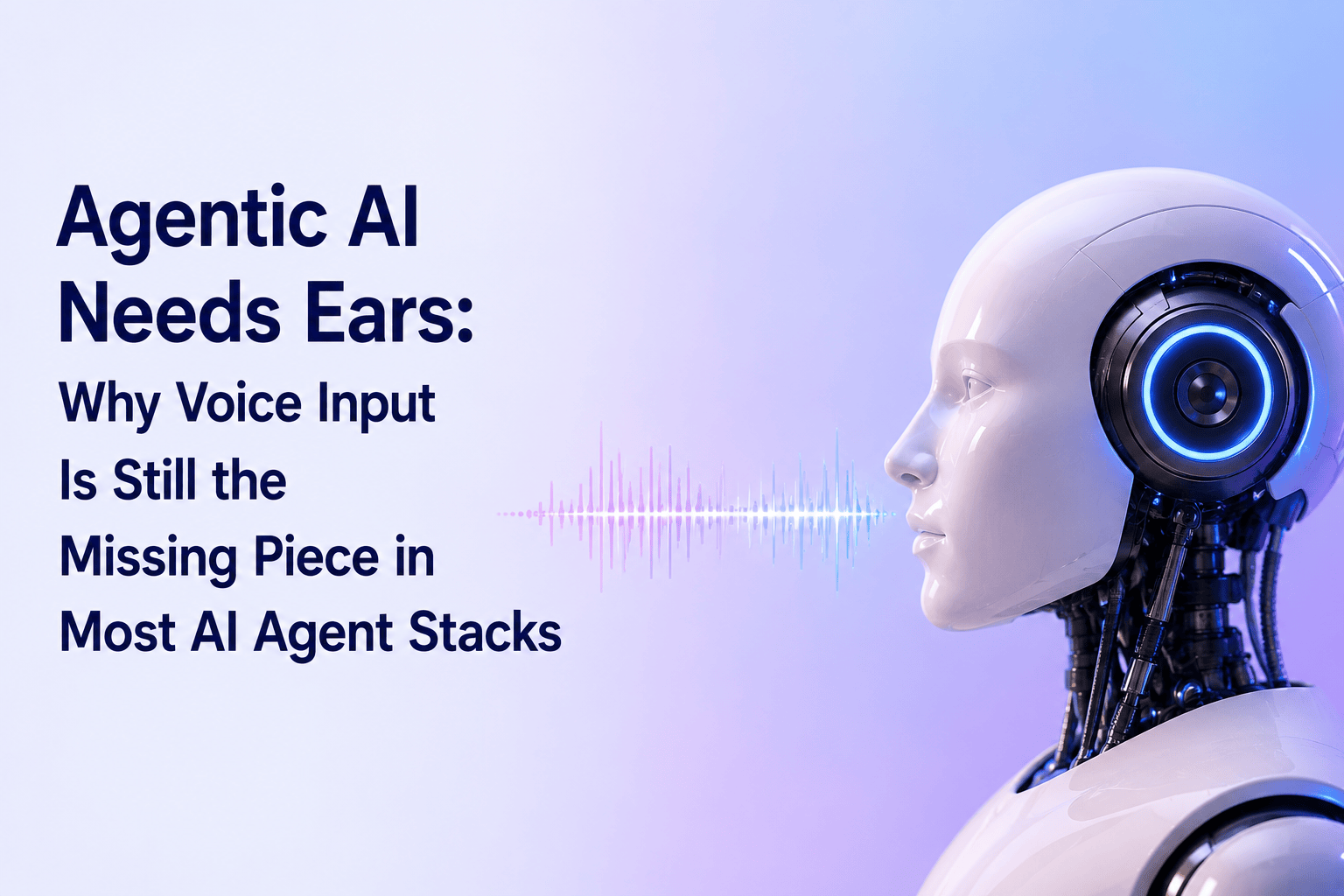
Most teams building an AI agent today can point to a solid list of things it already handles: reading email, summarizing a contract, pulling numbers out of a database, scheduling a meeting, even writing a decent chunk of code. Fewer of them have a good answer for what happens once a customer calls instead of typing. Agent stacks get built and evaluated almost entirely against text, and voice tends to show up later, if it shows up at all.
The problem surfaces the first time a support call, a sales conversation, or a physician’s dictation needs to reach the same agent handling everything else. Spoken audio has to become text before an agent can do anything with it, and that step typically runs through AI speech-to-text integration, converting the recording into a transcript the model can actually process. Without that conversion, there is no input for the agent to work from.
This gets overlooked more often than it should, given how much company information still arrives out loud rather than typed. Sales conversations, support lines, interviews, clinical visits, courtroom testimony, instructions called out across a warehouse floor: none of it touches a keyboard on its way into the business. Most agent frameworks, though, are still built around the assumption that clean, typed text is what shows up first.
Why Text Dominates Most Agent Stacks
Open up LangChain, AutoGen, or CrewAI and you will find a lot of thoughtful support for prompts, tool calls, memory, and multi-step reasoning. What you generally will not find, at least not by default, is native handling for audio input, such as a sixteen-minute recording of overlapping conversation on a low-quality microphone. Text is the default input format. Voice has to be converted first.
This is not a criticism of these frameworks so much as a description of how the field developed. Large language models were trained overwhelmingly on written material: books, articles, code, forum posts. Speech recognition developed separately, closer to signal processing than to language modeling, and the two fields only started to intersect in the last few years. Agent frameworks inherited the text-first assumption because the underlying models did too.
Why Voice Breaks the Standard Agent Loop
A standard agent loop works in three steps: perceive, reason, act. For a text-based agent, the perceived step is nearly trivial. The message already exists as a string, so the agent simply loads it and processes it.
Voice complicates that step considerably. A phone call might involve two or three speakers talking over each other. Background noise from a warehouse floor or a busy call center reduces accuracy. Regional accents and industry-specific terms can confuse models trained mostly on standard broadcast English. And unlike a typed message, audio arrives as a continuous stream, so the agent also has to decide whether to wait for a pause, process in short segments, or wait until the call ends.
None of this is unusual from an engineering standpoint. Teams building call centers and telehealth platforms solve these problems regularly. It is simply work that sits outside the standard agent framework. Someone still has to build a transcription pipeline, hand the agent a clean transcript, and manage every detail of converting audio into text.
Why Voice Support Is Rarely Built In by Default
Part of the reason comes down to priorities. Model providers compete on reasoning quality, coding ability, and how well an agent handles long, complex tasks. Voice input rarely factors into the comparisons that get the most attention. A framework without native audio support can still appear complete, since so much of the industry’s focus remains on text and, more recently, images.
There is also a practical reason. Speech-to-text is a separate, established field with its own vendors, pricing models, and accuracy trade-offs. OpenAI’s Whisper demonstrated that open, general-purpose transcription could reach a high level of accuracy. Companies like AssemblyAI built entire products around turning that capability into production-ready infrastructure, including speaker separation and summarization. For a period, it made sense for agent frameworks to treat that layer as a separate concern rather than build it from scratch.
This separation often just moves the integration work elsewhere. Teams connect a transcription API to an agent framework manually, and the practical issues tend to surface only once real calls start flowing through the system.
The Practical Challenges of Working With Audio
Working with audio introduces problems that text does not have. A support ticket stays in place until someone reads it; a phone call does not.
Diarization, or determining who said what, is one of the more difficult parts of this process. Two people speaking over each other for even a fraction of a second can distort a transcript enough that an agent misattributes a statement to the wrong speaker. A poor connection, a strong accent, or an unfamiliar technical term can lower accuracy further. This is why teams that take this seriously test multiple transcription engines against their own audio rather than relying on a vendor’s published numbers. A model that performs well on studio-quality recordings can still perform poorly on a noisy call from a warehouse floor.
There is also a timing decision that text-based agents never have to make: real time or batch processing? A live voice assistant needs a transcript within a second or two to feel responsive, which usually means accepting a small reduction in accuracy in exchange for speed. A nightly job summarizing the previous day’s support calls can wait, process everything together, and prioritize accuracy instead. Most agent frameworks have no built-in concept of this trade-off, since they have not needed one until now.
How Teams Add Voice Support in Practice
Here is roughly what most teams are doing today, regardless of what their chosen framework supports natively. Audio is sent to a transcription engine and returned as text, ideally with timestamps and speaker labels included. That transcript is then passed to the agent the same way any other message would be. From the model’s perspective, it does not process audio directly; it reads a document that describes a conversation.
This approach works, and many production systems rely on it. But it means every agent stack effectively contains a second pipeline that is rarely documented: audio capture, noise handling, transcription, formatting, and only then the reasoning step people typically think of as “the agent.” If any part of that process fails, the output the agent reasons over becomes unreliable.
Denebrix has already discussed how agentic RAG extends retrieval beyond static documents into live, tool-based lookups, and a similar principle applies here. Voice is simply another external input that an agent needs to retrieve and interpret correctly before it can reason about it.
Who Is Already Building This
The tools available for handling voice input have developed faster than most agent frameworks acknowledge. LangChain can incorporate a transcription step into a chain relatively easily once the audio has already been converted to text. Twilio’s Voice API manages the call infrastructure itself, which most agent developers prefer not to handle directly. Contact center platforms and CRM vendors have also started adding voice channels to their own agent products, treating transcription as a standard requirement rather than an optional add-on.
This does not change the underlying pattern. Voice handling still exists as a separate service connected to the agent, not as a built-in part of its reasoning process. That may be a reasonable approach for now, but it also means each team is solving a similar integration problem independently, rather than having it addressed once at the framework level.
Getting Voice Integration Right
Teams that get this right tend to make a few decisions early rather than discovering them later in production. Three questions come up consistently:
- Whether to prioritize real-time or batch processing, since this decision affects latency, accuracy, and vendor selection.
- How much diarization the use case requires, since a single-speaker recording and a four-person call involve very different requirements.
- Whether the model needs custom vocabulary, since even accurate general-purpose models can misinterpret product names or internal terminology without additional training.
This part of the process rarely receives the same attention as prompt design or agent memory architecture, but it plays a significant role in whether a voice-enabled agent performs reliably with real customers, accents, and background noise. Denebrix’s own article on building agentic AI applications with a problem-first approach makes a related point: address the actual complexity of the problem rather than a simplified version of it.
Summing It Up
Agent frameworks have become highly capable at processing text. Voice input, however, is still treated as a secondary concern, despite how much business communication still happens by phone or in person. Addressing this does not require a complex solution. It requires treating transcription, diarization, and audio quality as part of the agent’s core function rather than something added after the fact.
Teams that build this capability in from the start, rather than adding it after a customer notices the system missed part of what they said, are more likely to build agents that reflect how people actually communicate. Text-only agents will likely continue to be faster to build in the short term. Agents that also handle voice reliably will be better positioned to manage interactions that other systems cannot.
FAQs:
Q1: What is AI speech-to-text integration and how does it work?
AI speech-to-text integration converts spoken audio into written text using machine learning models. The audio is sent to a transcription engine, which processes it and returns a transcript often with timestamps and speaker labels that an AI agent can then read and act on.
Q 2: What is diarization in AI transcription?
Diarization is the process of identifying who said what in a conversation. It separates a multi-speaker audio recording into labelled segments per speaker, so an AI agent receives a clean, attributed transcript rather than one undifferentiated block of text.
Q3: What is the difference between real-time and batch transcription?
Real-time transcription processes audio with very low latency (1–2 seconds) to enable live voice assistants, but accepts slightly lower accuracy. Batch transcription waits until a recording is complete, then processes it for higher accuracy suited for use cases like reviewing the previous day’s support calls overnight.
Q4: How do AI agents handle voice input?
Most AI agents do not process audio directly. Voice input is first sent to a separate speech-to-text service, converted into a text transcript, and then passed to the agent the same way a typed message would be. The agent reasons over the transcript, not the raw audio.
Q5: Which speech-to-text API is best for AI agents?
It depends on the use case. OpenAI Whisper is a strong open-source option for general-purpose transcription. AssemblyAI offers production-ready infrastructure with speaker diarization and summarization built in. Teams building call center or healthcare agents typically test multiple engines against their own audio before committing, since real-world accuracy varies significantly from vendor benchmarks.

Comments are closed