

Right now, many software developers are focused on creating self-running programs that can explore the web, read files, and make choices on their own. Every week, a new tool promises to make these bots fully independent. But if you look at developer forums, you see a clear trend. Technical teams are building highly complex AI systems for simple tasks. Standard, regular code could do the exact same job faster and more cheaply.
The data shows how hard this is to get right. A McKinsey survey found that 88% of organizations already use AI in at least one business function. Yet, only 23% have successfully scaled an agentic AI system. Why is there a gap? The issue is not that the software is weak. The problem is that engineers focus on the new tool rather than the actual work. When you put the tool first, you end up with software that gets stuck in loops, makes random mistakes, and wastes your budget.
When you are building agentic AI applications with a problem-first approach, you flip your thinking. This means you use normal code for almost everything. You use AI features only for the specific steps where standard software fails. By setting strict rules for the system, you keep the whole application safe. This guide shows you how to identify the right problems for these tools so your software delivers stable, reliable results.
Why Rushing to Build AI Agents Can Lead to the Wrong Solution

The race to use new AI agents is happening in almost every industry. However, building these complex systems often leads to major problems, budget overruns, and failed projects. When companies rush to use new technology without a clear plan, they fall into a trap. They build impressive software that does not solve any real business problems.
As artificial intelligence becomes more accessible, businesses and professionals can increasingly build intelligent applications without relying entirely on traditional software development. Those looking to understand how generative AI can be used to create intelligent workflows and applications can explore a no code generative ai program to develop practical knowledge of generative AI and agentic systems.
Picking the Tool Before the Problem
The model-first mindset occurs when a company starts a project by choosing a tool. Rather than looking at a real-world problem, teams choose an AI model before they know what they want it to fix.
Focusing too much on the AI tool changes how teams measure success. Despite tracking real business value, they focus on technical scores. They feel successful if the AI performs well in a simple demo. This mindset assumes the model itself will create value, no matter what. Because everything is built around the tool rather than a clear business rule, the final project is forced to fit the model. It should be the other way around. The technology should serve the actual work.
When Technology Becomes the Starting Point
Choosing your tools and AI models first creates a bad habit. When developers choose advanced software at the very start, they look for ways to justify its use. The result is software driven by technology choices rather than actual business needs.
Putting technology ahead of the real work introduces many risks. Teams quickly get stuck with common AI errors. The system might get caught in endless logic loops, make random mistakes, or run up huge cloud bills. Often, these tools are used for tasks that do not even need an AI. For example, a team might build a complicated AI network just to organize customer data. In reality, standard code could handle the same job faster, cheaper, and with less trouble.
Why These Projects Struggle to Deliver Value
Moving an AI app from a small test to a real, working business tool is incredibly hard. Leading research highlights the big gap between buying AI and actually getting value from it:
- Unrealistic Expectations: A Gartner survey of 782 tech leaders shows just how hard it is to get these projects right. Of all the AI projects they tracked, only 28% worked well and recouped their costs, while 20% failed completely. Most of these failed projects failed for the same reasons: they tried to do too much too fast, or the teams did not clearly define what the AI was supposed to do in the first place.
- Skipping Workflow Redesign: You rarely get real business value by simply adding AI to an existing process. McKinsey’s research shows that organizations seeing the strongest financial impact from AI are more likely to redesign workflows as they deploy AI rather than layering the technology onto existing ways of working.
When companies rush to build AI apps without putting the problem first, they get stuck fixing technical errors and unpredictable AI behaviors. They waste time instead of driving real business results.
The Problem-First Mindset: Start with the Work, Not the Model
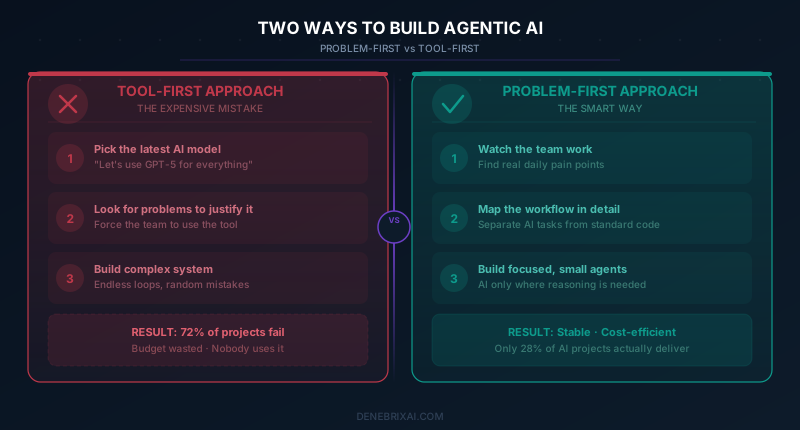
Buying the solution before you find the problem is a big mistake. A team will spot a new AI model online and spend weeks trying to force it into their company. Nobody ever stops to ask what daily task they are actually trying to speed up. You just end up with expensive code that nobody uses.
Go sit with your team and watch them work. Find out what makes them annoyed. Take customer support. People always jump to saying, “We need an AI chatbot.” But when you look at the logs, you might see that your staff spends three hours a day just copying user emails into a database. A chatbot will not fix that mess, but a simple script will. You have to find the actual guideline before you throw AI at it.
Building agentic AI applications with a problem-first approach means you stop worrying about the models. The tech will change next month anyway, but your business needs will stay the same. Once you map out the work steps clearly, choosing the right tech gets incredibly easy.
Understanding the Workflow Before Choosing the Technology

Before writing any code, it helps to map out how a task actually travels through your office. Skip the idealized diagrams meant for corporate slideshows. The goal here is to document the actual, day-to-day workarounds, messy spreadsheets, and all.
Map the Current Workflow Before Making Changes
A good first step is tracking a single task from start to finish. This means noting who receives the initial email, which spreadsheet they open to log it, and what buttons they have to click to pass it along. It is about following the actual, clunky path the team uses every single day, rather than the polished process described in a training manual.
Getting these details down usually highlights where things actually get stuck. Maybe files pile up for days waiting for a manager’s signature, or someone spends their entire afternoon manually transferring names from PDFs into a database. Putting this on paper makes the real pain points obvious before you spend any budget on software.
Find the Decisions That Actually Need Intelligence
Sorting these tasks helps separate basic automation from work that truly requires human-like reasoning. Most guidelines do not need a complex language model; a simple script can copy customer names between databases without any issue. AI belongs in spots where someone has to read, interpret, and make a subjective judgment call. Rather than using a model to organize files, you might use it to read customer emails and separate urgent complaints from routine requests. Defining where the software stops and where human approval is required keeps you from over-engineering simple problems. Once you know where human-level judgment is actually needed, choosing the right tech stack gets much easier.
Not Every Problem Needs an AI Agent
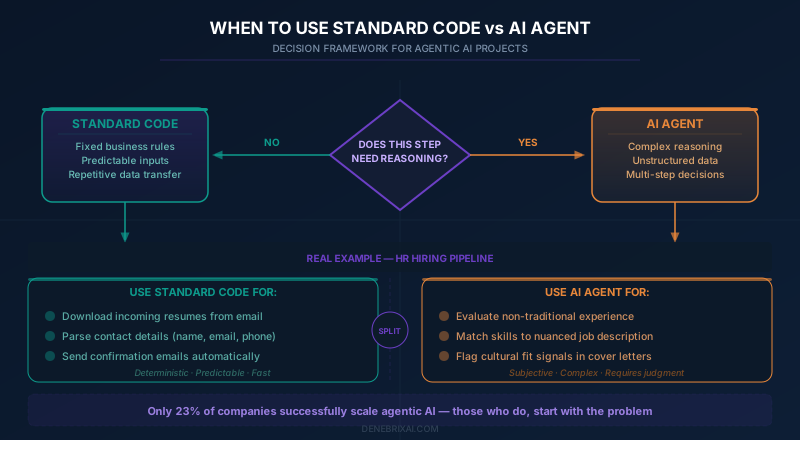
Many business processes do not require complex planning or decision-making. If every step of a task follows predefined rules, forcing an AI agent into the mix only adds unnecessary cost and complexity. Traditional software and workflow automation are far more reliable than generative models for these predictable pipelines. Anthropic’s engineering guidance recommends building the simplest solution first and introducing AI agents only when deterministic software is no longer sufficient. Software architectures for agentic AI perform best when they are not bloated with basic tasks. If a task is fully deterministic, standard code will always run faster and execute without the risk of unpredictable behavior.
The decision comes down to whether a step requires reasoning or simply follows a fixed path. Consider an HR team processing job applications. Downloading incoming resumes, parsing contact details, and sending confirmation emails are deterministic tasks best left to standard workflow automation. However, evaluating how well a candidate’s non-traditional experience aligns with a nuanced job description requires actual reasoning. That single evaluation step is where an AI agent brings real value. Rather than building an agent to manage the entire hiring pipeline, you use traditional tools and save the AI model strictly for subjective decision-making. Working with specialized AI agent development services allows you to cleanly isolate these complex reasoning steps while leaving the rest of the application runtime on predictable, hardcoded logic.
| Standard Automation | Use an AI Agent |
| Fixed business rules | Complex reasoning |
| Predictable inputs | Unstructured data |
| Repetitive data transfer | Multi-step decision-making |
| High precision required | Adaptive responses |
Keeping these boundaries clear keeps your cloud bills down and makes debugging a lot less painful. If something goes sideways, you immediately know if it was a simple typo in your code or if the AI model just had a weird moment. It is much easier to manage a system when your standard code handles the predictable work, leaving the AI to step in only when things get difficult.
Designing the Agent Around the Problem
Once you know you actually need an AI agent, you have to build it to fit the work.
A big mistake people make here is trying to build one giant system that does everything. To make something that actually works, you have to keep the agent focused on one clear task.
Give the Agent a Clear Responsibility
An agent works best when it has just one job. If you try to make it handle different things at once, it starts making mistakes. Anthropic’s engineering research shows that keeping agents simple and focused gets the best results.
Set clear starting points and expected results for the agent. If you are building a customer support assistant, do not make it handle billing issues, password resets, and tech support all at once. Keeping the focus tight makes the system much easier to set up, test, and fix when things go wrong.
Connect the Agent to the Right Systems
An AI model on its own can write text, but it cannot look up live data or do real work. To be useful, your agent needs to connect to your existing systems. It needs safe access to databases, company docs, and external APIs.
Modern agent tools like LangGraph and OpenAI’s Agents SDK treat the AI as a coordinator. The AI decides what to do, but it uses other tools to do the heavy lifting.
For example, an agent checking insurance claims cannot work in a vacuum. It has to use a lookup tool to check a customer’s policy, use a search tool to read past claims, and use an API to update the company portal. Without these tools, the agent is just guessing. Building this kind of tool-integrated agent — one that’s scoped tightly and wired safely into live systems — is exactly the work agentic AI development services are built for.
Build Safety Into the Workflow
An agent is only as good as the safety rules you set up. You need to build in protections from the very first day. This means adding human approval for big decisions, setting strict API limits, and making sure the agent cannot get stuck in an endless loop.
Both Microsoft’s Responsible AI guidelines and Google Cloud’s architecture frameworks say you should keep humans in the loop for important steps. Forcing the agent to obtain a manager’s approval before changing database records helps keep your data safe and the system under control.
Every step the agent takes should be easy to track so you can measure its speed, accuracy, and value over time.
From Prototype to Production: Testing What Actually Works
Building a working prototype on your laptop is easy, but getting an agent ready for actual users is a completely different challenge. In a test environment, your inputs are clean and predictable. In the real world, users ask strange questions, APIs go down, internal databases return incomplete information, and formatting is messy. A demo that looks perfect during a team presentation will quickly break when it meets actual production data.
Once you deploy, you have to constantly monitor how the agent behaves in the wild. Teams use evaluation platforms like LangSmith to track actual success rates, catch failed tool calls, and measure how often the system has to hand tasks back to a human. Keeping an eye on these metrics, along with API costs and direct user feedback, is the only way to identify weak points. Testing should continue long after deployment so the agent can keep improving as your business needs evolve.
What GitHub Projects Can Teach You About Building Agentic AI Applications with a Problem-First Approach
If you search for building agentic AI applications with a problem-first approach on GitHub, you will see a clear pattern. The best open-source projects are highly practical. Developers on these platforms do not try to build all-knowing systems. They write simple code to solve very specific problems.
Popular codebases built on LangGraph, CrewAI, or the OpenAI Agents SDK share the same basic rules. They use small, focused agents, modular setups, clear tools, and simple safety checks. The biggest lesson from these GitHub projects is that they do not try to automate everything. They use AI only where reasoning adds real value, and they leave the rest of the work to standard code.
Conclusion
Successfully building agentic AI applications with a problem-first approach is not about chasing the newest model. It is not about building the most complex system. As active projects on GitHub show, the best applications start by looking at the real problem first.
Start by mapping your workflows. Keep your basic automation separate from steps that need real reasoning. Put tight limits on what your agent can do. Doing this keeps your code stable and your costs low. Standard code should always run the predictable parts of your business. Only use AI where you actually need a human-like choice.
If you design your systems around the actual work rather than the technology, you will build tools that work. Your software will easily make the jump from a quick test on your laptop to a reliable, everyday tool.
FAQs
What is building agentic AI applications with a problem-first approach?
This means you do not start by picking an AI tool and looking for a way to use it. Rather, you start by finding a real business headache that needs fixing. You only add AI to the small steps where normal, everyday code cannot do the job.
Why is a problem-first approach important when building agentic AI applications?
Without it, you will waste a lot of money building fancy software that nobody actually needs. Starting with the problem keeps your system simple, cheap, and easy to fix. It ensures your AI is actually useful rather than just a cool tech demo.
How do you know if a business process actually needs an AI agent?
You need an agent when a task is repetitive but keeps changing, or when it requires real decision-making. If the job only follows simple, set rules, you should use standard automation instead. Only use AI when the system must read messy data and make a smart judgment call.
What is the biggest mistake when building agentic AI applications?
The biggest mistake is trying to build one giant agent that tries to do everything at once. This makes the system get confused, make silly errors, and run up massive bills. It is much better to build small, focused agents that only do one simple job really well.

Comments are closed